Carbon is one of the building blocks of life. It is in forests, soils, oceans, food, fuels and the bodies of every living organism. The climate problem is not carbon itself, but the speed and scale at which human activity is moving carbon from underground stores into the atmosphere, mainly as carbon dioxide.
What Is Carbon and Why It Matters for the Climate
Carbon cycles naturally through the Earth system. Plants absorb carbon dioxide, or CO2, during photosynthesis. Oceans take up and release carbon. Animals, microbes and decomposing matter return carbon to the air and soil. Over long periods, some carbon becomes locked away in coal, oil, natural gas and carbonate rocks.
Modern climate change is driven by a disruption of that balance. Since the Industrial Revolution, economies have burned fossil fuels that formed over millions of years, releasing their carbon in a matter of decades. CO2 is a greenhouse gas: it lets much of the sun’s energy reach Earth’s surface, then absorbs some of the heat that the planet radiates back toward space.
The effect is measurable. The Intergovernmental Panel on Climate Change says human activities, principally greenhouse gas emissions, have “unequivocally caused global warming,” with global surface temperature reaching about 1.1 degrees Celsius above 1850-1900 levels in 2011-2020 (IPCC). Atmospheric CO2 has also climbed sharply. NOAA reported that the global average concentration reached 422.8 parts per million in 2024, a new record (NOAA Climate.gov).
Carbon dioxide is not the only climate pollutant. Methane, nitrous oxide and fluorinated gases also warm the planet, often more powerfully molecule for molecule. But CO2 receives particular attention because it accounts for a large share of human-caused warming and remains in the climate system for a long time. Cutting carbon emissions is therefore central to stabilizing temperatures.
Major Sources of Carbon Emissions Worldwide
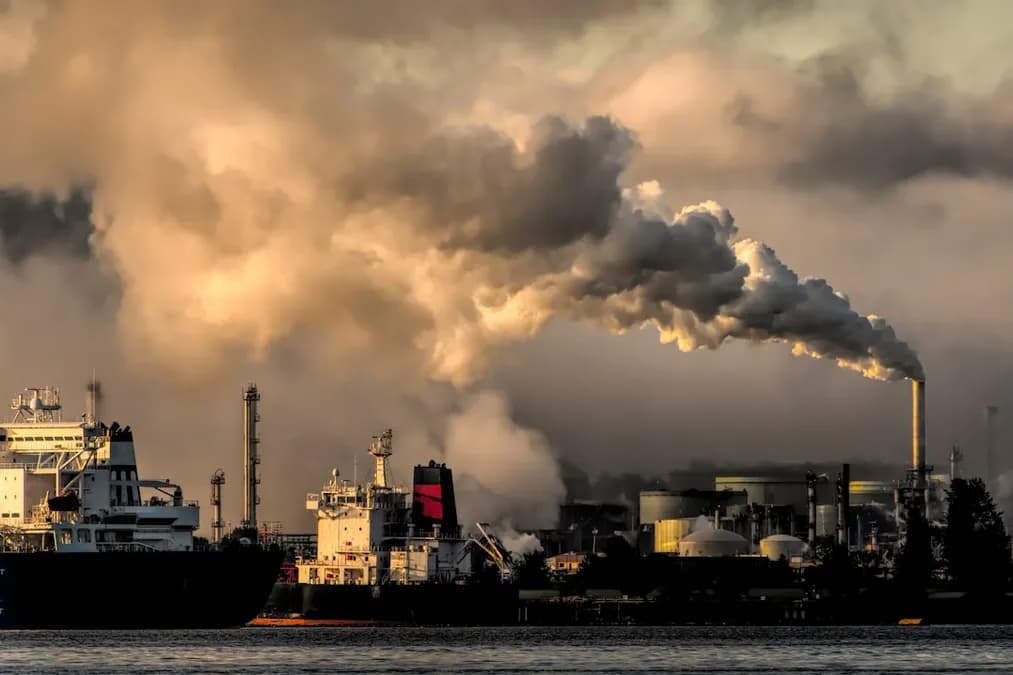
The largest source of carbon emissions is the burning of coal, oil and natural gas for energy. That includes electricity generation, heating, transportation, heavy industry and fuel production. The International Energy Agency estimated that global energy-related CO2 emissions rose 0.8 percent in 2024 to a record 37.8 billion tonnes (IEA).
Read next How Climate Change Works: A Clear ExplainerCoal remains the most carbon-intensive major fuel. It is still widely used for power generation and industrial heat, especially in fast-growing economies with large electricity demand. Oil dominates transport, powering cars, trucks, ships and aircraft. Natural gas emits less CO2 than coal when burned, but it is still a fossil fuel, and leakage of methane across gas systems can worsen its climate footprint.
Industry is another major contributor. Steel, cement, chemicals and refining require high heat and often release CO2 through chemical processes, not only fuel combustion. Cement is a clear example: making clinker, the key ingredient in cement, releases CO2 when limestone is heated. The Global Carbon Budget 2025 estimated fossil CO2 emissions in 2024 at 10.3 billion tonnes of carbon, equivalent to roughly 37.8 billion tonnes of CO2, with coal at 41 percent, oil at 32 percent, natural gas at 21 percent and cement at 4 percent (Earth System Science Data).
Land use also matters. Deforestation, peatland drainage and land clearing release stored carbon and reduce the ability of landscapes to absorb CO2 in the future. Agriculture adds more greenhouse gases through livestock methane, fertilizer-related nitrous oxide and energy use. UNEP estimated that total global greenhouse gas emissions reached 57.1 billion tonnes of CO2 equivalent in 2023, with power, transport, agriculture, industry, buildings, fuel production, industrial processes, land use and waste all contributing (UNEP).
Impacts of Excess Carbon Dioxide on Earth
Excess CO2 changes the planet in several linked ways. The most visible is warming. Higher average temperatures raise the odds of heat waves, intensify evaporation and alter weather patterns. Warmer air can hold more moisture, which can make heavy rainfall more intense in some regions, while other areas face longer dry spells and higher wildfire risk.
Oceans absorb more than heat. They also take up a substantial portion of human-produced CO2, slowing atmospheric warming but changing seawater chemistry. As CO2 dissolves in seawater, it forms carbonic acid, lowering pH. This process, known as ocean acidification, can make it harder for corals, shellfish and some plankton to build calcium carbonate structures. Those organisms sit near the base of marine food webs and support fisheries, tourism and coastal protection.
Ice and sea level are also affected. As the atmosphere and oceans warm, glaciers retreat, ice sheets lose mass and seawater expands. Rising seas increase the reach of storm surge and high-tide flooding, especially in low-lying coastal cities and island nations. The impacts are not evenly distributed: poorer communities often have fewer resources for cooling, flood defenses, insurance or relocation.
Carbon pollution can also feed back on the natural carbon cycle. Drought, fire, forest stress and warming soils can reduce the ability of land ecosystems to store carbon. In severe cases, carbon sinks can weaken, meaning a larger fraction of annual emissions stays in the atmosphere. That is one reason climate scientists focus not only on annual emissions but on cumulative emissions: every additional tonne of CO2 adds to the long-term burden.
Carbon Capture and Storage Technologies
Carbon capture and storage, or CCS, refers to technologies that capture CO2 before or after it enters the atmosphere and then store it underground or use it in products. The most established version captures CO2 from large industrial sources such as gas processing plants, ethanol facilities, cement kilns, steel mills or power stations. The captured gas is compressed, transported by pipeline or ship, and injected into deep geological formations.
CCS can be useful where emissions are hard to eliminate. Cement, chemicals and some forms of heavy industry may need capture technology alongside electrification, efficiency and alternative materials. In those sectors, CO2 comes partly from the chemistry of production itself, making fuel switching alone insufficient.
There are limits. CCS does not remove the need to cut fossil fuel use, and projects must prove that stored CO2 remains securely underground. Costs vary widely by source, concentration, transport distance and storage geology. Capturing CO2 from a concentrated industrial stream is generally cheaper than removing it from ambient air, where CO2 is dilute.
Direct air capture, or DAC, uses machines and chemical sorbents to pull CO2 directly from the atmosphere. It could help balance residual emissions from aviation, agriculture or industry, but it remains expensive and energy-intensive at today’s scale. The IEA has noted that announced capture projects could bring total capture capacity to about 435 million tonnes of CO2 per year by 2030, still small compared with annual global emissions (IEA).
The strongest case for carbon capture is targeted use: industrial sites with few alternatives, verified geological storage and transparent accounting. The weakest case is using capture promises to delay proven emissions cuts.
Pathways to Carbon Neutrality
Carbon neutrality means balancing remaining emissions with removals so that net emissions are zero. For climate stabilization, the priority is rapid reduction of gross carbon emissions, followed by high-quality removals for sources that cannot be fully eliminated.
The electricity sector is the foundation. Replacing coal and gas generation with solar, wind, hydro, geothermal, nuclear and other low-carbon sources reduces emissions directly and enables cleaner transport, buildings and industry through electrification. Batteries, transmission lines, demand response and long-duration storage help manage variable power.
Transport requires multiple approaches. Electric vehicles can cut emissions where grids are clean and are becoming increasingly practical for cars, buses and delivery fleets. Rail, public transit, walking and cycling reduce the need for fuel in the first place. Aviation and shipping are harder, likely requiring efficiency, cleaner fuels and careful demand management.
Buildings can cut carbon through insulation, efficient appliances, heat pumps and cleaner construction materials. Industry needs efficiency, electrified heat, green hydrogen in some applications, material recycling and product redesign. Food and land systems can contribute through reduced deforestation, better soil management, lower food waste and diets that place less pressure on land.
Policy matters because markets alone rarely price climate damage. Carbon pricing, clean energy standards, methane rules, building codes, public procurement, research funding and permitting reform can all shift investment. UNEP warned in its 2024 Emissions Gap Report that current policies put the world on a much hotter path than the Paris Agreement goals, while also finding that existing technologies still offer substantial emissions-cutting potential this decade (UNEP).
The Future of Carbon Management
The next phase of carbon management will be more practical than rhetorical. Governments and companies are moving from broad pledges to detailed accounting: which emissions are being cut, which are being captured, which are being offset and which remain unresolved. That scrutiny is healthy. A tonne of avoided CO2 from shutting down a coal plant is not the same as a low-quality offset with uncertain permanence.
Better measurement will change the debate. Satellites, sensors and digital reporting are making it harder to hide methane leaks, land-clearing emissions or underperforming projects. Investors and regulators are also asking companies to distinguish between operational emissions, supply-chain emissions and customer-use emissions.
The central challenge is speed. Carbon dioxide accumulates, so delayed cuts raise the total amount of warming that societies must manage. Yet the transition is not only a story of sacrifice. Cleaner air, lower fuel imports, cheaper renewable power, healthier buildings and more resilient landscapes are near-term benefits that can accompany emissions reduction.
Carbon will remain essential to life, industry and the economy. The task is to stop treating the atmosphere as an unlimited dumping ground. That means cutting carbon emissions at the source, protecting natural carbon sinks, building credible removal systems and reserving carbon capture for the places where it can do the most good. The countries and companies that master that mix will shape the low-carbon economy now emerging.
Related coverage