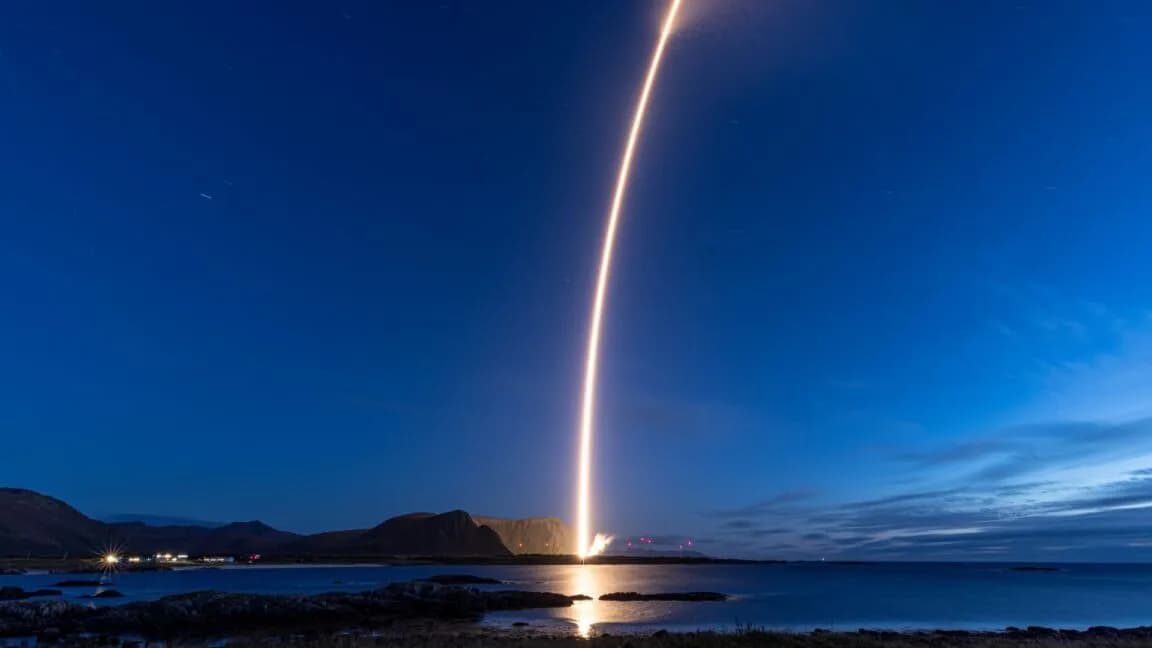
On a Saturday inside the Arctic Circle, a German rocket lit its engines and climbed beyond the atmosphere, writing a new chapter in European spaceflight. Isar Aerospace's two-stage vehicle, Spectrum, became the first fully commercial European launch vehicle to reach low-Earth orbit—a milestone analysts and policymakers have anticipated for years. The company pulled it off on just its second attempt.
Isar Aerospace Makes History: Europe's First Commercial Orbital Launch
Three students at a German university founded Isar Aerospace in 2018 with an ambition that would have sounded fanciful to most of the continent's established aerospace community: build a privately funded rocket, without government contracts as the primary revenue stream, and put it into orbit. Seven years later, they did exactly that.
Spectrum lifted off from the Andøya Spaceport in northern Norway, ascending through Norwegian skies before arching toward polar orbit. The two-stage vehicle successfully reached low-Earth orbit, confirming Isar Aerospace's status as the first purely commercial company in Europe to cross that threshold.
The "purely commercial" designation carries weight. Europe has a rich launch heritage—Arianespace has been lofting satellites since the 1980s, and the Vega and Ariane family of rockets fly under the auspices of the European Space Agency. Isar Aerospace orbit represents something qualitatively different: a privately capitalized company, not underwritten by a multinational government consortium, standing alongside the United States and New Zealand as having produced commercial orbital launch providers.
The second-attempt achievement deserves its own examination. Reaching orbit is orders of magnitude harder than reaching space. SpaceX, now the most experienced launch provider in history, needed four flights before its Falcon 1 successfully made orbit in September 2008—each of those early failures a costly lesson in orbital mechanics and vehicle integration. Rocket Lab required two launch attempts before Electron achieved orbit in January 2018. Isar's success on attempt number two places the company in a short, elite cohort.
Why This Milestone Matters for the European Space Industry
The commercial space launch market has grown substantially over the past decade. Space Capital, which tracks quarterly investment across the space economy, has consistently ranked launch infrastructure among the highest-conviction categories for institutional investors. Euroconsult, the Paris-based space market research firm, has projected that global demand for small satellite launches will require dozens of additional orbital insertion opportunities per year through the early 2030s. Europe, despite its deep history in space, has had to rely on non-European providers whenever its own vehicles were grounded or unavailable.
Read next Laika's Wildwood: Stop-Motion Fantasy at TIFF 2026That dependence carries strategic consequences. ESA's commercial strategy framework and the European Commission's broader space programme ambitions have both emphasized autonomous access to space as a policy priority. The recognition is straightforward: a continent cannot fully guarantee the security of its satellite communications, Earth observation systems, and navigation constellations if it cannot independently launch them.
The pressure grew more acute after 2022, when the war in Ukraine severed Russia's Soyuz cooperation with European launch customers, eliminating a significant pathway to orbit from European soil. Ariane 6, which finally flew in 2024 after years of delays, eased some of that strain. But Ariane 6 targets heavy payloads for large government and commercial customers. The swelling market for small satellites—cubesats, IoT constellations, Earth observation networks—demands smaller, more responsive, and more affordable launch options.
That is the niche Isar Aerospace orbit is designed to fill. A commercial small-launch provider with European headquarters, a European launch pad, and a cadence aimed at rapid turnaround does not merely add another rocket to the manifest. It reshapes where European satellite operators direct their launch contracts, how quickly startups in the EU space sector can get hardware into orbit, and how much negotiating power European governments hold with non-European providers.
Andøya Spaceport: Launching From the Arctic Circle
Andøya Spaceport, located on an island off the northwestern coast of Norway above the Arctic Circle, has operated as a sounding rocket and research facility for decades. Its evolution into a site capable of hosting orbital launch vehicles has been a deliberate, years-long project supported by Norwegian government investment and ESA cooperation.
The geography is intentional. A high-latitude spaceport like Andøya suits sun-synchronous and polar orbits especially well—the trajectory families most commonly requested by Earth observation and remote sensing satellite operators. A rocket departing from roughly 69 degrees north latitude can reach these high-inclination orbits with minimal propellant penalty, compared with launching from equatorial or mid-latitude sites.
For Isar Aerospace, Andøya offered practical advantages: established range safety infrastructure, proximity to European regulatory frameworks, and an existing relationship with the Norwegian Space Agency. Operating from within the European regulatory environment also simplifies compliance for Isar's customers, many of whom are European organizations subject to EU export control and data governance requirements.
The spaceport is not Isar's exclusive domain. Norway has positioned Andøya as a multi-tenant facility capable of hosting multiple launch providers—an approach that matters as the continent looks to cultivate a broader commercial launch ecosystem rather than placing all its bets on a single national champion.
What's Next: Scaling Up and Europe's Second Commercial Launch Firm
The questions that follow any first successful orbital launch are consistent: How quickly can the provider achieve operational cadence, and at what cost per kilogram to orbit? A single successful mission, however historically significant, is a proof of concept. A reliable launch business requires repeatable operations, predictable failure modes, and pricing that competes with established providers.
The company's next moves—how quickly it scales Spectrum production, how it structures launch contracts, and whether it pursues government anchor customers alongside commercial ones—will determine whether this milestone translates into a sustainable business. Scaling from a second-mission success to a double-digit annual launch rate is where most launch startups encounter their hardest engineering and operational challenges. Supply chains, launch site throughput, and workforce growth all compress simultaneously.
Europe's second commercial launch firm is also watching closely. The continent has several additional private launch ventures in various stages of development, pursuing different propellant combinations, different payload classes, and different spaceport partnerships. How quickly the second European commercial orbital success arrives remains an open question—and a meaningful one for whether a genuine multi-provider European launch market materializes or whether Isar holds a durable first-mover position.
Rocket Report Roundup: Small, Medium, and Heavy-Lift News
Edition 9.10 of the Rocket Report arrives at a moment of broad activity across all vehicle classes. The small-lift segment, where Isar competes, continues to attract new entrants while established players refine their operational cadence. The medium-lift category remains competitive as providers vie for national security and commercial constellation payloads. Heavy-lift development, anchored by ongoing Starship program work and watched closely by NASA mission planners, proceeds on its own extended timeline.
The wider pattern is one of diversification: more providers, more launch sites, and more payload classes than at any previous point in the commercial launch era. That diversification benefits satellite operators directly, who gain options and real competitive pressure on pricing. It is the market structure the industry has been building toward for two decades.
Ravn X Sighting and Other Launch Highlights This Week
The Rocket Report this week also notes a reported sighting of the Ravn X vehicle, the air-launched system developed by Aevum. Air-launch concepts have attracted intermittent attention for their theoretical flexibility—departing from a runway rather than a fixed pad means the system can theoretically position itself for a wider variety of orbital inclinations without geographic constraints. Whether the Ravn X sighting signals renewed development activity or simply visible hardware movement remains unconfirmed; details are sparse and the observation warrants continued attention rather than firm conclusions.
Three launches appear on the near-term calendar, spanning multiple vehicle classes and sites. The pace of commercial spaceflight in 2026 has reached a point where a single week can contain both historic firsts and routine cadence operations running in parallel. That combination—the extraordinary alongside the unremarkable—is its own kind of benchmark. It signals an industry that has moved, however unevenly, from aspiration to infrastructure.
The Rocket Report publishes weekly. Reader submissions are welcome; subscription details appear below.
Related coverage
- SpaceX Starship Reaches Orbit: What It Means for Space
- US Military Confirms Weapons Are Now in Orbit
Source: Ars Technica - All content


