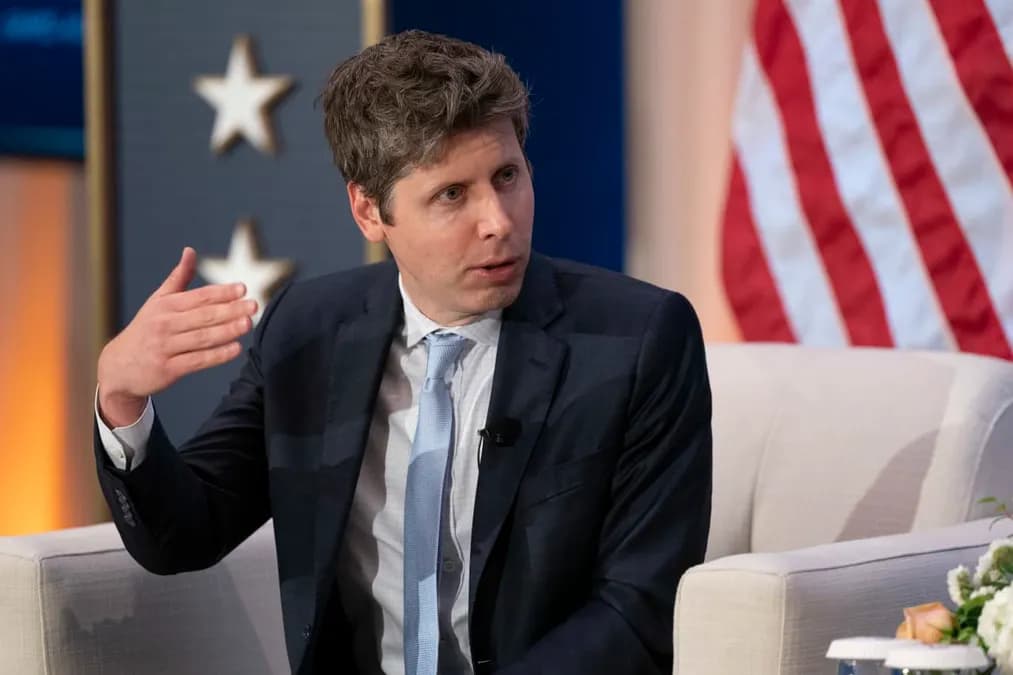
Sam Altman has put a number on patience: at least another year. The OpenAI chief executive's declaration that pursuing a public offering in 2026 would be "ill-advised" is not merely a calendar note — it is a strategic signal that reverberates across the entire AI private-market ecosystem, shaping how institutional money prices risk from San Francisco to Singapore.
What Sam Altman Actually Said About Going Public
Altman's language was deliberate. "Ill-advised" carries a different weight than "premature" or "not yet." It implies that external conditions, not internal readiness, are the binding constraint. In the context of an increasingly heated debate around AI safety, that framing matters for how analysts should interpret the decision.
The ChatGPT creator has been on a remarkable capital-formation trajectory. OpenAI closed a funding round in late 2024 that valued the company at approximately $157 billion, making it one of the most richly valued private companies in history by any measure tracked in PitchBook's global unicorn dataset. That valuation figure was already straining the traditional frameworks venture capitalists apply to revenue multiples. A public offering at that scale, absent a clear regulatory and safety narrative, would expose the company to a level of scrutiny that quarterly earnings calls are poorly designed to absorb.
Altman's statement effectively communicates to the market that OpenAI is choosing the controlled information environment of private capital over the unforgiving transparency of public markets — at least for now. That is a rational calculation. It is also one with significant second-order effects on how every AI startup behind it gets valued.
AI Safety Concerns as a Market Signal

AI safety concerns have accelerated in 2026. That acceleration is not abstract. Regulatory bodies in the European Union have begun phased enforcement of the AI Act's higher-risk provisions, and congressional scrutiny in the United States has intensified around foundation model liability. These are not fringe debates — they are moving into mainstream institutional due diligence processes.
Read next Iran's Hormuz Leverage and What It Means for Oil PricesConsider what this means for a prospective IPO roadshow. Underwriters would face sustained questions about model governance, bias auditing, and catastrophic-risk mitigation that do not yet have standardized disclosure frameworks. Unlike cybersecurity risk — where the SEC's 2023 disclosure rules gave companies a template — AI safety liability remains genuinely undefined in legal and accounting terms. An IPO filed in that vacuum invites both plaintiff attorneys and short-sellers.
Institutional investors managing pension and endowment capital are already treating AI safety posture as a filter criterion, not merely a footnote. Research published by venture capital analysts at firms including Coatue Management and Sequoia Capital has flagged AI governance as a material factor in late-stage valuation models. When the largest capital allocators on Earth begin embedding safety track records into their risk frameworks, a CEO who ignores that signal is not being bold — he is being reckless.
Altman is not ignoring it. His statement reads, in part, as a message to institutional LPs and potential public-market anchor investors that OpenAI intends to bring clarity to those questions before ringing any bell.
Implications for AI Private-Market Valuations

OpenAI's continued private status has a gravitational effect on the broader AI funding landscape. According to CB Insights data tracking global AI investment flows, the number of AI companies valued above $1 billion grew sharply through 2024 and into 2025, with many of those valuations benchmarked implicitly against OpenAI's own reported figures.
When the category-defining company signals it is not yet ready for public price discovery, it removes a key reference point from the market. Private valuations partly depend on the plausibility of an eventual liquidity event — either an acquisition or an IPO. When that IPO horizon shifts, secondary market pricing adjusts. Expect the already-discounted secondary market for OpenAI employee shares to price in a longer hold period, which in practice means lower bids.
The ripple effect extends beyond OpenAI itself. Anthropic, xAI, and a cohort of infrastructure-layer AI companies that have raised at aggressive multiples are all watching this decision. If the category leader cannot confidently point to a 2026 public offering, the case for sustaining comparable valuations at the next funding round becomes harder to defend. Crossover investors — mutual funds and hedge funds that take late-stage private positions in anticipation of IPO gains — will recalibrate their entry price expectations accordingly.
This is not necessarily a negative for the sector. Compressed private valuations, if that is the outcome, can represent a healthier equilibrium. The 2021 vintage of AI unicorns was priced at multiples that assumed near-perfect execution and an accommodating rate environment. Neither condition held uniformly.
Historical Precedent: When Tech Giants Delayed Their IPOs
The tech industry has a well-documented history of extended private periods producing complicated public-market outcomes — in both directions.
Stripe remained private for over a decade, accumulating a peak valuation near $95 billion before conducting a downround in 2023 that marked the company at $50 billion. The delay allowed Stripe to deepen its product surface and international footprint, but it also meant early employees and investors faced prolonged illiquidity while the macro environment shifted against them. When Stripe ultimately pursued a path toward public markets, it did so with a substantially reset price.
Airbnb offers the more constructive template. The company delayed its IPO through the early disruption of the COVID-19 pandemic, only to list in December 2020 at a price that exceeded its pre-pandemic private valuation. The patience rewarded disciplined execution — though Airbnb's delay was forced by market conditions rather than chosen, which is a meaningful distinction.
Uber's 2019 IPO, preceded by years of high-profile private fundraising at escalating valuations, delivered the opposite lesson. The company priced at $45 per share and closed its first day of trading below that level, a symbolic moment that redefined how investors thought about the gap between private valuation and public-market appetite. The lesson: private price discovery can outrun public-market willingness to pay, particularly when a company carries unresolved regulatory and profitability questions.
OpenAI sits at the intersection of all three templates simultaneously. It has Stripe's complexity, Airbnb's timing sensitivity, and the regulatory overhang that dogged Uber. Altman's caution is arguably the most rational read of that confluence.
What Investors and Analysts Should Watch Next
Five indicators will determine whether Altman's "ill-advised" assessment remains valid through 2027 or begins to look like an overcorrection.
First, regulatory clarity. If the EU's AI Act enforcement produces a workable compliance framework that US regulators adopt as a reference point, the legal ambiguity underpinning IPO hesitation shrinks materially. Watch for any SEC rulemaking on AI-specific disclosures as a leading indicator.
Second, profitability trajectory. Public markets will not absorb a loss-making AI company at a nine-figure valuation unless the path to break-even is credible and near-term. Any leaked financial metrics suggesting OpenAI's revenue growth is outpacing compute costs will shift the IPO calculus faster than any regulatory development.
Third, secondary market pricing. The implied valuation at which OpenAI shares trade on platforms like Carta or Nasdaq Private Market serves as a continuous, if noisy, signal of where sophisticated buyers think the company will eventually price publicly. Sustained compression there would confirm market skepticism; a recovery would suggest the delay is being read as prudent rather than evasive.
Fourth, competitive positioning. If a rival foundation model company successfully navigates a public offering and gains access to public capital markets at favorable terms, the strategic cost of OpenAI's continued private status rises sharply. That competitive pressure could accelerate Altman's timeline.
Fifth, and perhaps most importantly: the tenor of AI safety discourse itself. If 2027 arrives with clearer consensus frameworks — from governments, standards bodies, or the insurance markets that price AI liability — the "ill-advised" conditions Altman described will have changed. Public markets are not categorically hostile to AI risk. They are hostile to unquantifiable AI risk.
Altman is betting that the quantification is coming. The OpenAI IPO 2026 story, then, is less about a delay and more about a calculated read on when the market will be ready to price complexity — not just potential.
Source: MarketWatch.com - Top Stories