Why the 'Best Beatles Album' Question Never Gets Old
The Beatles released thirteen studio albums across roughly a decade, yet the conversation about which one sits above the rest has occupied critics, academics, and bedroom listeners with equal ferocity for sixty years. Ask the question in a room of serious fans and you won't get silence — you'll get a small civil war. Meet the Beatles, the Capitol Records debut that turned American radio inside out in 1964. Let It Be, the fractured farewell that broke hearts before it even arrived in shops. Abbey Road, the medley-closing monument. Every answer carries its own biography of the person giving it.
And yet, as Variety recently observed in its review of the new Beatles Rubber Soul Super Deluxe boxed set, the answer for most fans who have moved past sentiment about their personal entry point tends to land in the same place. Not on the polished grandeur of Sgt. Pepper's Lonely Hearts Club Band, not on the sprawling ambition of the White Album, but on the album that made those albums possible: Rubber Soul, released in December 1965. The question never gets old because the answer keeps changing depending on who you are when you ask it. The more interesting question is why — and a major reissue package is the perfect occasion to work through it.
The Malleable Case for Rubber Soul at the Top

The title of the Variety review leans hard on the word "malleable," and that framing is doing real critical work. Rubber Soul is not simply a great album. It is, in a measurable historical sense, at least two different albums simultaneously — and that duality has shaped how listeners in different countries have heard the Beatles' artistic evolution for six decades.
Read next 1963 : le tube yéyé qui a enflammé la France — reconnaîtrez-vous cette voix ?The UK pressing, released on Parlophone on December 3, 1965, ran fourteen tracks. Capitol Records' American version, issued the same month, stripped it down to twelve songs, removing four tracks and substituting two that appeared on the British Help! record. The commercial logic was standard 1960s label practice — fewer tracks meant lower mechanical royalty costs and more room to extract additional product from the same recordings. The cultural consequence was something else entirely. Capitol's edit leaned the American Rubber Soul heavily toward acoustic folk-rock, creating an album with a notably more introspective and pastoral feel than its UK counterpart. Bob Dylan reportedly loved it, and its influence on the emerging California folk scene — specifically on Brian Wilson, who cited Rubber Soul as a direct catalyst for Pet Sounds — was filtered primarily through the Capitol configuration.
The British version, by contrast, opens with the strutting electric riff of "Drive My Car" and includes the sardonic closer "Run for Your Life," giving the record more tonal range and harder edges. Listeners raised on one version have often encountered the other as something subtly but meaningfully foreign. The album is genuinely malleable in its identity: same title, same era, different organism. That tension — and the ambiguity it seeds into any claim about Rubber Soul's greatness — is precisely why revisiting it in expanded form feels essential rather than nostalgic.
Inside the Rubber Soul Super Deluxe Boxed Set

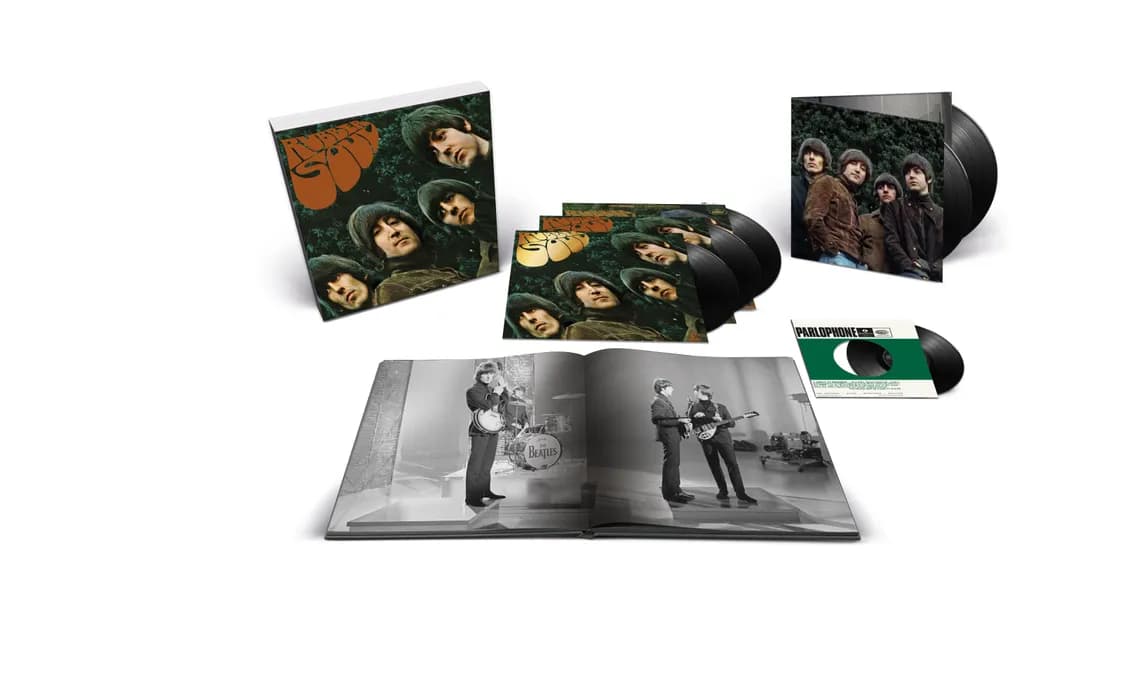
The Beatles Rubber Soul Super Deluxe boxed set arrives as the most comprehensive treatment the album has received since its original release, continuing the series of anniversary editions that has defined how Apple Corps and Universal Music have approached the catalog since the Sgt. Pepper fiftieth anniversary package in 2017. That template, established with producer Giles Martin reconstructing mixes from original session tapes, has proven both critically and commercially durable.
What the Rubber Soul Super Deluxe provides, in keeping with that lineage, is a layered listening experience rather than a simple repackage. The core of any such release in this series centers on new stereo and Dolby Atmos mixes derived from the original session elements — allowing instruments and voices that the original four-track recording process compressed into a single stereo field to breathe with spatial separation modern ears have never heard applied to this material. For a record as harmonically rich as Rubber Soul, where the interplay between John Lennon's rhythm guitar, Paul McCartney's increasingly assertive bass lines, and the sitar introduction George Harrison brought to "Norwegian Wood" defined the sonic signature of an era, that spatial openness is genuinely revelatory rather than merely technical.
Beyond the core album, Super Deluxe editions in this series have characteristically included session outtakes, alternate takes, and in some cases previously unreleased recordings from the period. Without overstating what a thin source summary can confirm about specific contents, the set's value to dedicated collectors rests on exactly this kind of archaeological access — hearing the four of them working through "In My Life" or "Michelle" in real time, before the final decisions locked the recordings into the versions that entered cultural memory.
Where Rubber Soul Sits in the Beatles' Discography Arc
By any credible critical accounting, Rubber Soul represents the pivot point in the Beatles' catalog — the hinge between the brilliant, commercially perfected pop of their early period and the studio art they would spend the second half of their career constructing. The preceding album, Help!, contained genuinely sophisticated songwriting alongside what were still, structurally, singles-driven pop records. Revolver, released nine months after Rubber Soul, is essentially a different kind of band: experimental, studio-dependent, conceptually bold in ways that would not have been possible without the confidence Rubber Soul developed.
That transition is audible in specific places. "Norwegian Wood" introduced modal sitar playing into mainstream Western pop. "In My Life" showed Lennon capable of the kind of reflective autobiographical writing that would define a generation of singer-songwriters. "The Word" played with drone structures and harmonic simplicity in ways that pointed forward to the psychedelic period. None of these tracks required studio manipulation to exist — they were recorded with the same basic equipment the early albums used. The leap was compositional and intellectual, not technological. That is what makes Rubber Soul foundational: it proves the growth came from within the songs before it came from the studio.
This is also why the album answers the "best Beatles album" question differently depending on what criteria you apply. For historical significance and transitional weight, it has a strong claim. For sonic achievement and production ambition, Revolver and Sgt. Pepper edge ahead. For emotional directness and stripped-back humanity, Let It Be has its partisans. Rubber Soul wins the argument about where the Beatles became the Beatles.
Is This Super Deluxe Edition Truly Essential?
The Beatles' Super Deluxe editions have established a reliable pattern: serious fans spend on them. The Sgt. Pepper fiftieth anniversary set, the White Album deluxe, the Abbey Road and Let It Be packages all found audiences willing to reinvest in recordings they had owned in multiple formats. The consistency of that response reflects something genuine about the catalog — these records reward close listening in ways few popular recordings from any era do, and improved audio presentation is not cosmetic.
For Rubber Soul, the case for the Beatles Rubber Soul Super Deluxe boxed set is arguably stronger than for some of the later releases in the series, precisely because the album has been comparatively underloved in the deluxe treatment department. Sgt. Pepper and the White Album arrived with decades of expanded documentation already in circulation. Rubber Soul remains, in some ways, more mysterious — recorded fast, released fast, and surpassed in the cultural conversation almost immediately by what followed it. An expanded edition that slows that record down and lets you hear the seams of its construction is a more genuinely revelatory artifact than a similar treatment for albums already exhaustively analyzed.
Whether it is the best Beatles album depends, as always, on the moment of asking. But in 2026, in this expanded form, Rubber Soul makes its case with more force and more audio fidelity than it has ever had before. That is not a small thing. For anyone serious about the Beatles catalog, sitting this one out would be the actual mistake.
Related coverage
Source: Variety