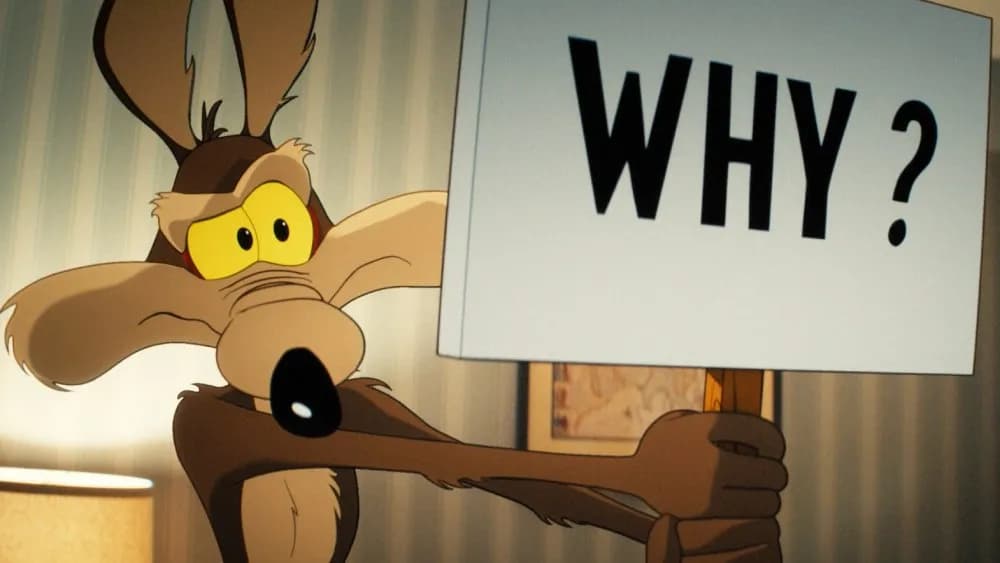
A cartoon coyote who spent decades failing to catch a roadrunner has, with some cosmic irony, succeeded in catching up to David Zaslav. Three years after Warner Bros. Discovery pulled the completed Looney Tunes comedy Coyote vs. Acme from its release slate and wrote it off as a tax liability, the film has crossed $100 million at the global box office — distributed not by one of Hollywood's largest studios, but by indie outfit Ketchup Entertainment. The result is one of the most embarrassing miscalculations in recent studio history, and a case study in what happens when financial engineering overrides creative and commercial judgment.
How Coyote vs. Acme Crossed $100 Million After Being Written Off
A $100 million global gross is not a blockbuster number by Marvel standards, but context is everything. For a film Warner Bros. deemed commercially worthless — so worthless that the studio chose to absorb a tax write-down rather than release it — the milestone is devastating to the original logic. Warner Bros. would have collected zero theatrical revenue from the write-off strategy. Ketchup Entertainment, stepping in as the film's distributor after acquiring rights to a shelved property, turned that zero into nine figures.
The achievement is not simply a feel-good story about a film finding its audience. It is empirical evidence that Warner Bros. Discovery's internal valuation mechanisms, as applied to this particular project, were wrong by at least $100 million in the wrong direction.
Zaslav's Gamble: The Logic Behind Shelving the Film

When David Zaslav took control of Warner Bros. Discovery following its 2022 merger, he inherited a debt load widely reported at approximately $50 billion and a cost structure that required aggressive action. The strategic response was, in part, an accelerated reliance on content write-offs — a mechanism that allows studios to take tax deductions on completed or partially completed projects by removing them from their release slates.
Read next 1963 : le tube yéyé qui a enflammé la France — reconnaîtrez-vous cette voix ?Coyote vs. Acme was not alone. The most prominent victim of this strategy was Batgirl, a completed DC superhero film with a reported production budget of roughly $90 million that was cancelled outright in August 2022. The decision shocked the industry: no studio had previously shelved a completed, ready-to-stream film of that scale purely for accounting purposes. Warner Bros. Discovery followed by cancelling or shelving additional projects, taking impairment charges that wiped hundreds of millions in content costs from its books.
The financial logic was defensible on a spreadsheet. Write-offs reduce taxable income, and for a company carrying Zaslav's level of debt, near-term cash and tax efficiency mattered enormously. Wall Street analysts who cover WBD largely acknowledged the fiscal rationale while expressing concern about the longer-term brand and talent implications. What the spreadsheet did not capture was audience demand — the animating variable that ultimately determines whether a film has commercial life.
Ketchup Entertainment and the Rise of Indie Film Rescues
Ketchup Entertainment's acquisition and release of Coyote vs. Acme belongs to a small but growing category of transactions: indie distributors acquiring discarded studio properties and finding audiences the studios claimed did not exist. Ketchup, a company with a track record of releasing films that larger players have passed on, took on a project attached to one of the most recognized animated brands in entertainment history. Looney Tunes has more than 80 years of audience familiarity. That is not nothing.
The distribution economics for an indie player on a recovered property differ substantially from a typical studio release. Ketchup's overhead on a film it did not produce from scratch is structurally lower, and the absence of a development write-off on its books means every dollar of revenue is measured against acquisition and release costs, not a sunken production investment. That financial structure allowed the company to be patient and strategic in ways a debt-pressured conglomerate often cannot be.
The broader implication is that a secondary market for shelved studio content is developing. When studios elect to take write-offs on completed films rather than releasing them, they create inventory for well-positioned independents. Whether intentionally or not, Warner Bros. Discovery subsidized Ketchup Entertainment's success.
Hollywood's Write-Off Addiction: A Systemic Problem
The practice of writing off content is not new, but the scale at which it was deployed by Warner Bros. Discovery between 2022 and 2023 was unprecedented in the streaming era. Industry analysts and entertainment finance reporters at publications including Deadline and The Hollywood Reporter documented a pattern in which content created for HBO Max was removed from the platform or from the release schedule in order to generate write-downs rather than to serve audiences or build the subscriber base.
The tension at the core of this approach is that content write-offs serve a P&L statement in the short term while potentially destroying long-term franchise value and talent relationships. Every creative professional who worked on Coyote vs. Acme — and on Batgirl before it — saw their work treated not as art or commerce but as a tax instrument. The reputational cost to Warner Bros. as a home for filmmakers and animated properties is harder to quantify than a write-off charge, but it is real.
Studios have historically written off content during restructuring, but typically as a last resort applied to projects genuinely unlikely to earn back their costs. What shifted under Zaslav was the threshold: projects were shelved not because they were commercially hopeless but because the write-off was more valuable, in the near term, than the uncertain revenue of a theatrical or streaming release. Coyote vs. Acme reaching $100 million suggests the threshold was set incorrectly.
What Coyote vs. Acme's Success Reveals About Studio Miscalculations
The failure of Warner Bros.' internal analysis here likely reflects a specific structural bias. Greenlight and release decisions inside large studios are typically modeled against theatrical performance projections that weight four-quadrant blockbuster performance heavily. A live-action Looney Tunes comedy for families — a mid-budget, brand-driven property in a category studios have increasingly deprioritized — may have scored poorly against those models while sitting on top of genuine audience appetite.
The Coyote vs. Acme box-office result raises a pointed question: how many other shelved projects contain similar disconnects between internal projections and actual demand? The answer is unknowable for films that will never be released. But for the films that reach audiences through secondary distributors or belated releases, the track record of studio write-off predictions should be examined with considerable skepticism.
There is also a franchise dimension. Looney Tunes is a Warner Bros. property. The goodwill generated by a successful Coyote vs. Acme theatrical run, the characters reintroduced to a new generation of families, the merchandise and licensing energy that follows — none of that accrues to Warner Bros. in the same way it would have under a direct release. The write-off decision was not a one-time accounting choice; it was a decision to cede value across multiple future revenue streams.
Could Warner Bros. Discovery Change Course After This Embarrassment?
Studio strategies rarely reverse cleanly on the basis of a single data point, however pointed. Warner Bros. Discovery faces the same balance sheet it carried into this situation, and Zaslav's mandate to deleverage has not dissolved. The structural incentives that made write-offs attractive in 2022 and 2023 have not fully disappeared.
But the industry is watching. Talent representation, production companies, and competing studios have all absorbed the signal that Coyote vs. Acme sends. The film's performance puts quantitative weight behind what critics of the write-off strategy argued from the beginning: that completed projects with recognizable IP carry real audience demand, and that demand does not evaporate because a studio declines to release the film.
Whether Warner Bros. Discovery recalibrates its content valuation process, tightens the criteria under which write-offs are pursued, or brings more creative and commercial voices into what has been a finance-dominated decision framework — those are institutional questions with no clean external visibility. What is visible is the scoreboard. A film that Warner Bros. valued at zero just proved, in the most public arena available, that the calculation was wrong.
Source: Variety


