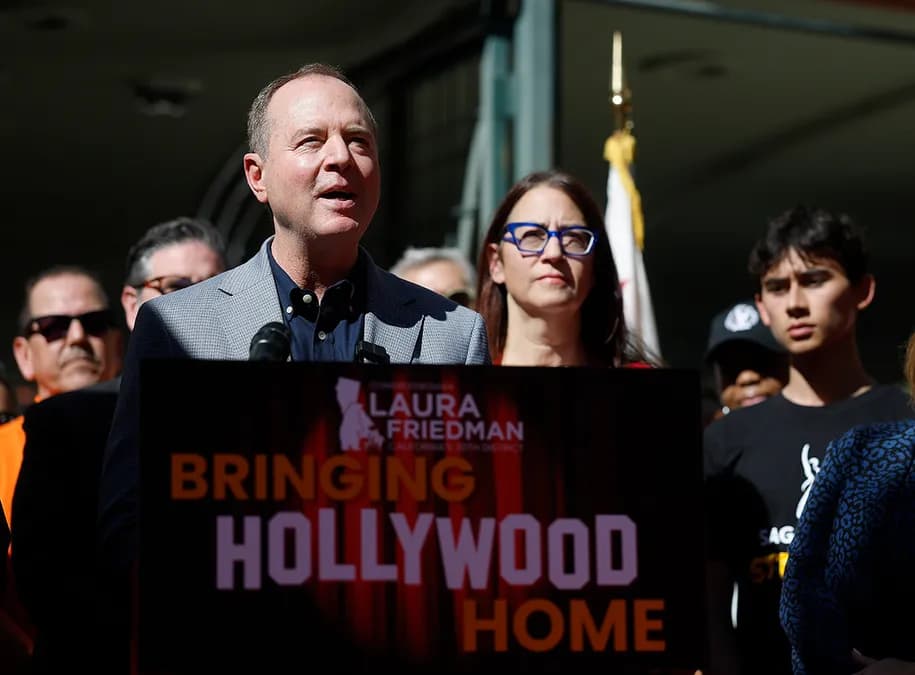
A coalition of California lawmakers and entertainment labor leaders descended on Washington this week with a unified message: the United States is hemorrhaging film and television production to foreign competitors, and a federal tax incentive is the most direct remedy available. With Sen. Adam Schiff leading a delegation that included eight Democratic representatives from Southern California, the campaign represents one of the most coordinated legislative pushes Hollywood has mounted in years — and supporters say the window to act is narrowing fast.
What Is the Federal Film Incentive and Why Does It Matter Now
The federal film incentive under discussion would establish a national tax credit designed to make American soil more competitive for large-scale film and television production. Unlike the patchwork of state-level programs that currently exist across the country — from Georgia's aggressive 30 percent transferable tax credit to New York's 25 percent production credit — a federal incentive would apply uniformly regardless of where in the United States a production chooses to shoot.
The stakes are measurable. According to the Motion Picture Association, the U.S. film and television industry supports more than 2.3 million jobs and contributes over $229 billion to the American economy annually. That figure encompasses not just studio executives and on-screen talent, but the sprawling supply chain of caterers, construction workers, transportation crews, accountants, and post-production technicians whose livelihoods depend on productions staying domestic. FilmLA, the nonprofit that tracks production activity in the Los Angeles region, has documented a steady decline in local shoot days over the past decade as productions migrate to jurisdictions with more attractive financial packages.
The timing of the current push reflects a sense of urgency inside the industry. The calendar year is running short, and supporters believe they have a genuine legislative opening before the session closes.
Democrats and Unions Join Forces to Build Momentum

Sen. Schiff's delegation was not operating in isolation. Union leaders from across the entertainment labor movement stood alongside the lawmakers, lending the effort credibility that transcends partisan politics. The presence of major craft unions — whose membership includes the electricians, camera operators, set decorators, and drivers who make productions physically possible — reframes the federal film incentive debate from a corporate subsidy conversation into a worker-protection argument.
Read next 1963 : le tube yéyé qui a enflammé la France — reconnaîtrez-vous cette voix ?That reframing matters politically. Incentive programs sometimes attract skepticism from progressive lawmakers who view them as giveaways to wealthy studios. But union leadership can credibly argue that without competitive incentives, their members lose work to Canadian, British, and Australian crews — not to automation, and not to corporate restructuring, but to deliberate government policy choices made by foreign competitors.
IATSE, which represents tens of thousands of behind-the-camera workers, has been among the most vocal advocates for federal action. Teamsters locals that cover transportation and location logistics have similarly supported the effort. SAG-AFTRA, representing on-screen performers, has a direct stake: when a production moves offshore, American actors lose not just the job but residual income and pension contributions that flow through union agreements.
The political coalition assembled Tuesday signals that advocates are trying to build the kind of bipartisan-adjacent momentum that could survive a divided legislative environment. Eight House Democrats from Southern California — a region where the film and television industry is not an abstraction but the economic backbone of entire communities — gives the effort geographic specificity and constituent urgency.
How the US Stacks Up Against 65 Countries Offering Film Incentives
The competitive landscape is stark. According to the delegation's framing, 65 countries currently operate film incentive programs of some kind. That number has grown substantially over the past two decades as nations from Hungary to New Zealand recognized the economic multiplier effect of hosting large productions.
The United Kingdom's film tax relief system, which offers qualifying productions a rebate of up to 25 percent of their UK expenditure, has drawn major Hollywood tentpoles and prestige television series with remarkable consistency. Canada's federal and provincial incentives, which can stack to exceed 40 percent in certain provinces, helped transform Vancouver and Toronto into North American production hubs. Australia's Location Incentive program was explicitly designed and funded to attract productions that might otherwise film in the United States.
The result is a global auction for production spend. Studios — which are ultimately accountable to shareholders — evaluate incentive packages as a core line item in greenlight decisions. A production with a $100 million budget shooting in a jurisdiction offering a 25 percent rebate effectively reduces its spend by $25 million compared to an unsubsidized location. Over a slate of productions, those numbers compound into strategic location policies.
What makes the current moment particularly pointed is that the U.S. federal government has historically left this competition entirely to states. Georgia's success in capturing Marvel productions and prestige television has been well-documented, but Georgia's incentive requires production to occur in Georgia. A federal program could create a baseline advantage for American production broadly, regardless of which state a project chooses.
What a Federal Film Tax Credit Could Mean for Hollywood Jobs
Entertainment economists who have studied incentive programs consistently find that the direct employment effects are substantial and geographically concentrated. Bureau of Labor Statistics data on motion picture and sound recording industries show that production employment is sensitive to location decisions in ways that differ from most other sectors — when a film shoots abroad, the below-the-line jobs do not follow workers across borders. They simply do not materialize for American workers.
The union argument, stripped to its core, is about this dynamic. A grip or a prop master cannot work remotely. Their employment is physically tied to wherever the camera is rolling. When productions migrate to jurisdictions with more favorable incentives, those workers face a choice between unemployment and relocation — neither of which is acceptable as a systemic outcome for a major American industry.
Advocates estimate that a meaningful federal credit could reverse some portion of the runaway production trend that has accelerated since the mid-2000s. FilmLA's annual production reports have tracked the decline in Los Angeles shoot days with granular detail, and the pattern is consistent: state and local production activity contracts as foreign incentives expand.
A federal incentive would not replace state programs but would layer on top of them, creating a more powerful combined offer for productions evaluating U.S. locations.
Obstacles Standing Between the Bill and the President's Desk
The case for a federal film incentive is not without critics, and any honest accounting of the legislative path must contend with the fiscal objections that have stalled similar proposals in the past.
Budget hawks in both parties have questioned whether targeted tax credits for a specific industry represent sound fiscal policy. The Congressional Budget Office has historically scored entertainment incentive proposals as revenue-negative, meaning the federal government foregoes more in uncollected taxes than it recovers in economic activity. Critics argue that the same logic used to justify film incentives could be applied to virtually any industry seeking preferential treatment — a position that, taken to its conclusion, results in a Swiss cheese tax code rather than coherent industrial policy.
There is also the question of economic capture: studies of state-level film incentives have produced mixed results on whether the promised economic multipliers materialize as advertised. Some academic analyses, including research published through the Pew Charitable Trusts' fiscal research arm, have found that states frequently overestimate the return on their incentive investments. Those findings give ammunition to legislators reluctant to expand a model at the federal level that has delivered uneven results at the state level.
The end-of-year timeline is itself an obstacle. Major legislation rarely moves through Congress without substantial negotiating time, and attaching a new targeted credit to any must-pass vehicle requires either bipartisan support or a reconciliation process that carries its own political costs.
What Comes Next for Federal Film Incentive Supporters
"We are so close to getting this done" — the phrase attributed to advocates at Tuesday's event captures both the optimism and the underlying tension of the current campaign. Legislative momentum is a real but perishable commodity, and the coalition assembled this week knows it.
The immediate next steps likely involve committee-level engagement and vote-counting among members who represent production-adjacent districts outside California. A federal film incentive with support limited to Southern California Democrats is a regional interest story; one that attracts co-sponsors from states like New Mexico, New York, Georgia, and Louisiana — all of which have active production sectors — becomes something closer to a national economic argument.
Union political operations, which demonstrated their electoral mobilization capacity in recent cycles, represent a significant asset if the campaign extends into a longer legislative battle. The ability to activate rank-and-file members in key districts as constituent voices — rather than just Washington lobbyists — changes the pressure dynamics on persuadable lawmakers.
What the coalition has accomplished in the short term is visibility. By pairing Senate leadership with House members and union officials at a single, coordinated event, advocates have signaled that the federal film incentive is no longer a background wish list item but an active legislative priority with organized backing. Whether that is enough to overcome the fiscal headwinds and calendar constraints before year's end remains the central unanswered question. The industry is watching closely.
Source: Variety


