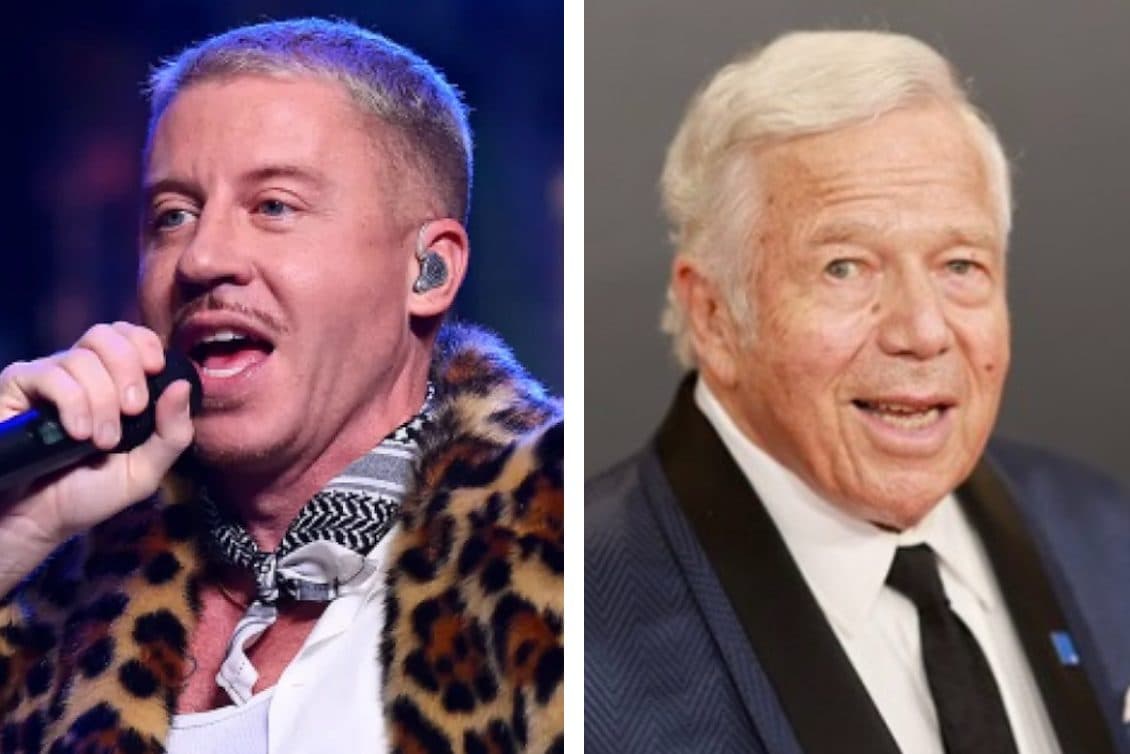
What Happened: Kraft Blocks Macklemore From Ed Sheeran Tour Dates
On September 14, 2026, New England Patriots owner Robert Kraft issued a public statement defending his decision to effectively bar rapper Macklemore from performing as a support act for Ed Sheeran at a series of stadium shows. The move followed remarks Macklemore made regarding Palestine during concerts in New Jersey on September 4 and 5, according to reporting by Variety. The Robert Kraft Macklemore ban amounts to one of the most prominent examples in recent memory of a venue owner using his commercial authority to sideline a performer over political speech.
Kraft's intervention is unusual for its scale. Sheeran's stadium tours rank among the highest-grossing live events in the world, and a support slot on such a run represents extraordinary exposure for any artist. Pollstar has repeatedly documented how stadium support slots can lift an artist's touring revenue by double-digit percentages in the following cycle, making the loss of those dates a material career event rather than a symbolic gesture. The ban does not rest on a single canceled night. It removes Macklemore from multiple stadium appearances tied to the Sheeran run.
The mechanics matter here. Private venues and promoters in the United States generally retain broad discretion over who performs on their stages. A stadium owner or lessee can decline to host an act without triggering the constitutional constraints that apply to government actors. That legal reality is what gives Kraft's decision its force — and what makes it a live case study in the long-running tension between artistic expression and commercial control.
Robert Kraft's Statement: Why He Called the Lyrics 'Hate Speech'

Kraft framed his decision in unambiguous terms, describing Macklemore's pro-Palestine lyrics as hate speech and stating his intention to keep the rapper off the Sheeran dates. The statement positioned the ban not as a business calculation but as a values-based line drawn by the owner of the venues and, by extension, the man whose name sits atop the Kraft Group's philanthropic apparatus.
Read next 1963 : le tube yéyé qui a enflammé la France — reconnaîtrez-vous cette voix ?That framing draws on a documented record. The Kraft Family Foundation and Kraft's broader philanthropy have long supported antisemitism education and Holocaust remembrance initiatives. Kraft has funded programs tied to combating hate, and he has spoken publicly about antisemitism as a personal and civic concern. Readers assessing his motivations have concrete institutional context to weigh, rather than speculation about private belief. Whether one agrees with his characterization of the lyrics or not, the stated rationale is consistent with a pattern of advocacy he has pursued for years.
The term "hate speech" carries legal and cultural weight that outstrips its everyday use. In U.S. law, hate speech as such is not a separate unprotected category; the First Amendment generally shields even offensive political expression from government censorship. But Kraft is not the government. As a private party controlling access to private and leased venues, he operates under different rules — a distinction that sits at the center of the dispute.
Macklemore's Track Record of Political Activism in Music
Macklemore is not a newcomer to politically charged material. His 2012 hit "Same Love," released during the campaign for marriage equality in Washington State, became one of the most commercially successful protest-adjacent singles of its era and was widely cited as a cultural accelerant for the marriage-equality movement. That track won Grammy Awards and performed strongly on the Billboard Hot 100, demonstrating that explicitly political music can reach mass audiences.
His catalog since then has continued to engage social issues, and his live shows have periodically served as platforms for statements beyond the setlist. The September 4 and 5 New Jersey concerts that prompted Kraft's response fit that pattern. The Palestine remarks were consistent with an artist who has treated the stage as a venue for political speech, not merely entertainment.
The commercial record complicates any simple narrative. Artists who take political positions risk audience fragmentation, but they can also deepen loyalty among fans who share their views. Billboard and Pollstar have both tracked how politically vocal acts sometimes see streaming spikes and ticket demand shifts after high-profile statements, with effects that vary sharply by market. Macklemore's situation now tests that dynamic at stadium scale.
The Broader Debate: Free Speech vs. Venue Owner Authority
Venue bans over political speech are not unprecedented, though they rarely involve figures of this stature. Industry databases and trade reporting have documented cases ranging from country artists dropped from fairs over Confederate flag imagery to rock acts removed from casinos over onstage criticism of owners or politicians. The pattern is consistent: private operators can and do refuse performers, and the First Amendment does not bind them.
Entertainment-law attorneys routinely draw the line this way. The First Amendment constrains state action, not private contract. A promoter or venue owner may decline to book an artist for almost any reason that does not violate anti-discrimination statutes or an existing contract. Where a binding performance agreement exists, the analysis shifts to contract terms, force majeure provisions, and damages — not constitutional doctrine. That is why the precise contractual relationship between Macklemore, Sheeran's touring operation, and Kraft's venues will determine whether this remains a booking decision or becomes a legal dispute.
The counterargument is cultural rather than constitutional. Critics contend that when a single owner controls enough stages, private discretion can function as de facto censorship, shrinking the space for political expression in the most visible venues. Defenders respond that owners bear the costs and risks of their properties and may associate — or decline to associate — with whomever they choose. Both positions have long histories in American entertainment, from blacklists of the mid-twentieth century to modern controversies over awards-show bookings.
Reactions From the Music Industry and Public
Public response has split along predictable lines. Supporters of Kraft's position have framed the ban as a principled stand against rhetoric they consider beyond the pale. Critics have framed it as an owner imposing political litmus tests on artists. The absence of a unified industry response is itself notable: trade organizations have historically been cautious about wading into political disputes involving members and venue partners.
For Sheeran — a global touring powerhouse whose stadium runs are massive commercial enterprises — the situation creates awkward optics regardless of his personal views. Losing a support act mid-cycle forces logistical reshuffling, and the surrounding controversy can shadow a tour's press coverage. Other artists watching the episode will weigh the risks of political speech against the security of high-value bookings.
What This Means for Artists Voicing Political Opinions on Tour
The practical lesson for touring artists is that the stage is not a legally protected forum when the stage belongs to someone else. Artists can speak, but owners can decline to host. That asymmetry has always existed; what changes is the scale at which it can now be applied. A ban tied to a single stadium run can erase millions of dollars in exposure and reshape an artist's touring trajectory.
Three factors will determine how far this precedent travels. First, the contract structure: if Macklemore had binding agreements, litigation is possible; if not, the ban stands as pure discretion. Second, the market response: if the Sheeran dates proceed smoothly and ticket demand holds, other owners may feel emboldened to apply similar filters. Third, artist solidarity: if major acts begin conditioning their own bookings on freedom for support acts, the calculus shifts back toward performers.
The Robert Kraft Macklemore ban is, at bottom, a reminder that in American entertainment, free speech and free markets are governed by different rules — and the people who own the rooms get to write the terms.
Source: Variety


