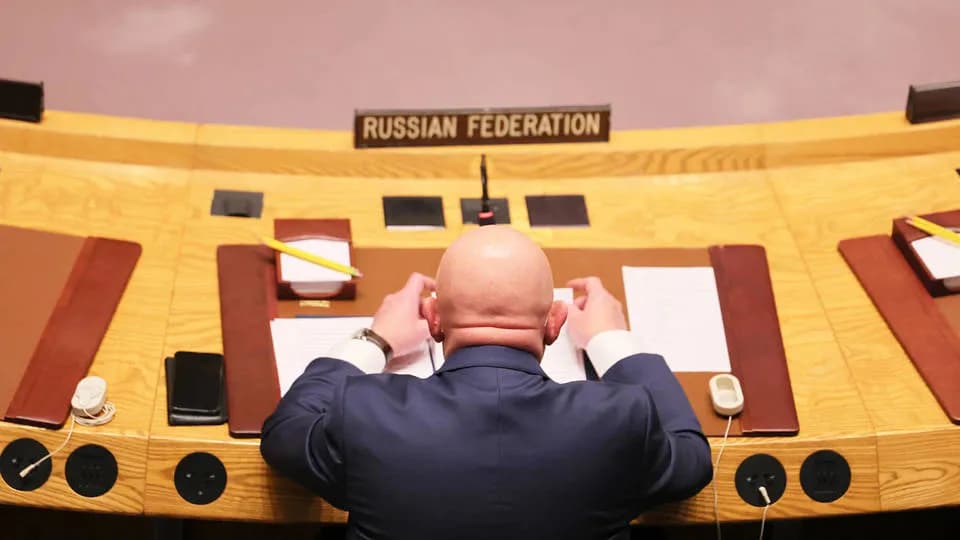
Russia's Security Council Seat: A Legal Fiction From the Start
On December 24, 1991, a letter arrived at the office of UN Secretary-General Javier Pérez de Cuéllar. Boris Yeltsin informed the United Nations that Russia would simply continue the Soviet Union's membership — including its permanent seat on the Security Council — without seeking approval from the General Assembly. No vote was held. No formal review was conducted. Fifteen sovereign successor states had just emerged from the Soviet collapse, yet only one claimed the most powerful chair in the international order. The question of Russia UN Security Council seat legality was never seriously litigated at the time. Thirty-four years later, amid a war of aggression in Ukraine and a veto record that has paralyzed collective security, it must be.
How the Soviet Union's UN Seat Was Supposed to Transfer
The UN Charter is explicit about how membership works. Article 4 stipulates that membership is open to peace-loving states that accept the obligations of the Charter and are judged capable of carrying them out — admission requires a recommendation from the Security Council followed by a two-thirds vote of the General Assembly. Chapter V governs the Council itself, specifying that the five permanent members are China, France, the Soviet Union, the United Kingdom, and the United States. The Soviet Union. Not Russia.
Read next France Is Dragging the Eurozone Toward a Debt CrisisPrecedent reinforces the procedural requirement. When the People's Republic of China replaced the Republic of China in 1971, it required General Assembly Resolution 2758, a full membership vote, and more than two decades of diplomatic effort. When Yugoslavia dissolved, each successor state applied for UN membership individually. Neither precedent permitted unilateral self-succession. The architects of the Charter understood that inheriting a permanent seat with veto power would demand formal procedure — not a letter asserting it.
The Quiet Usurpation: How Russia Claimed the Seat Without Consent

Russia did not follow this process. The Alma-Ata Declaration of December 21, 1991 — signed by eleven of the fifteen Soviet successor states — formally acknowledged the dissolution of the USSR and established the Commonwealth of Independent States. It said nothing about Russia inheriting the UN seat. Russia asserted the inheritance unilaterally, and the international community, exhausted by the Soviet collapse and hungry for stability, acquiesced without forcing the legal question.
The other former Soviet republics were treated entirely differently. Estonia, Latvia, and Lithuania were re-admitted as new members earlier in 1991. Ukraine and Belarus, which had held nominal UN memberships since 1945 as a concession to Stalin, retained those seats. The remaining republics applied as new members and were admitted through standard procedures during 1991 and 1992. Each went through the formal process Russia bypassed. The contrast is stark. It reflects a political decision made under pressure, not a legal determination made on principle.
International law scholars have contested this arrangement for decades. Questions around Russia UN Security Council seat legality were raised as early as the early 1990s by academics who noted that Russia's claim rested on political convenience rather than Charter compliance. The "continuing state" doctrine Moscow invoked — the legal theory that Russia was the USSR's continuation rather than a successor — has no firm grounding in the Charter text. That doctrine was developed primarily for treaty obligations and financial liabilities, not for the automatic conferral of extraordinary veto power within a constitutional international instrument.
Why This Legal Ambiguity Has Dangerous Real-World Consequences
Russia has cast more than twenty vetoes in the Security Council on matters relating to Syria, Georgia, and Ukraine since 2007 alone. Each represents the exercise of a power that may never have been legally conferred. The structural effect is that a state which gained its seat through procedural circumvention has been able to shield itself and its allies from the collective security mechanisms the Charter designed precisely to constrain aggressive behavior.
The full weight of Russia UN Security Council seat legality as a problem became impossible to ignore after February 24, 2022, when Russia launched its full-scale invasion of Ukraine. The Security Council — the body nominally responsible for international peace and security — was rendered structurally incapable of responding because the aggressor held one of its five veto-equipped chairs. The General Assembly passed a resolution condemning the invasion by 141 votes to 5 in March 2022, but General Assembly resolutions carry no binding force. The Council, paralyzed by the veto, did nothing.
This is not a procedural curiosity. A legally defective seat translates directly into a militarily unchecked war.
The Case for Revisiting Russia's Permanent Member Status
The legal argument is compact: the Charter names the Soviet Union, not Russia, as a permanent member. Russia is not the Soviet Union. The Soviet Union ceased to exist in December 1991. No formal amendment to the Charter substituted Russia's name. No General Assembly vote ratified the succession claim. What Russia occupies rests on a diplomatic convention that was never tested against the Charter's own requirements.
Applying the "continuing state" doctrine to permanent UN membership stretches it past any reasonable limit. That doctrine governs continuity of financial obligations and treaty commitments — not the extraordinary privilege of being able to single-handedly block binding resolutions of the world's primary security body. The two are categorically different.
Russia's conduct since 1991 raises a separate but convergent question. Two wars in Chechnya, military intervention in Georgia in 2008, the annexation of Crimea in 2014, and the full-scale invasion of Ukraine in 2022 collectively challenge whether Russia satisfies the Charter's foundational criterion: that members must be peace-loving states. The legal and the moral arguments arrive at the same destination.
What Reforming or Challenging Russia's Seat Would Take
Formal Charter amendment requires ratification by two-thirds of member states, including all five permanent members. Russia would veto any amendment threatening its own seat. That closed loop is why the issue has been treated as settled when it plainly is not.
Alternative paths exist. A General Assembly request for an International Court of Justice advisory opinion on the legality of Russia's succession would not require Security Council approval. ICJ advisory opinions are non-binding but carry significant legal authority — the 2004 opinion on Israel's West Bank barrier and the 2010 opinion on Kosovo's independence shaped international debate and diplomatic posture despite lacking enforcement mechanisms. A formal advisory opinion specifically addressing Russia UN Security Council seat legality would be a different matter entirely: it would place the foundational question on the record for the first time.
A coalition of member states could also formally raise the succession question in the General Assembly under Article 4 procedures. The political obstacles are formidable. But the legal case would be heard.
The argument is not that displacing Russia is easy. It is that the legal question was never honestly answered in 1991, and thirty-four years of silence have not transformed that defect into legitimacy. They have only allowed it to compound — one vetoed resolution, one shelled city, one civilian casualty at a time. When the reckoning comes, the procedural evasion of December 1991 will be where the accounting starts.
Related coverage
Source: Project Syndicate


