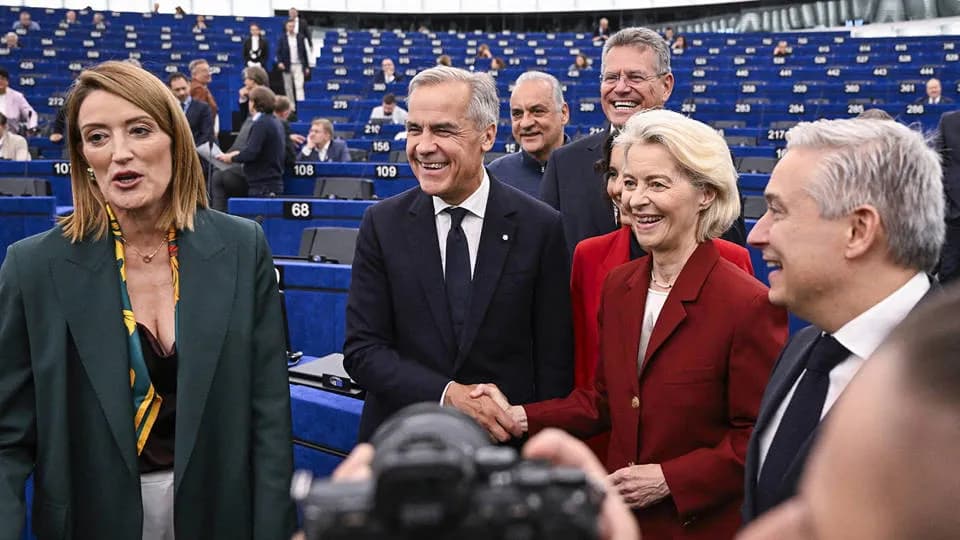
The communiqué is signed. The summit photographs are taken. Ministers fly home. And somewhere in the gap between the ceremonial handshake and the next election, the alliance quietly begins to decay. This is not a cynical observation — it is the documented history of most intergovernmental pacts crafted without genuine popular ownership. The question confronting Canada, Europe, and the broader constellation of liberal democracies is not whether they share strategic interests. They plainly do. The question is whether an alignment forged at the level of cabinets and trade ministers can survive the democratic volatility that has made every Western government's political calendar feel like a countdown to disruption.
Bertrand Badré, who served as Chief Financial Officer of the World Bank, and Guillaume Klossa, founder of the European think tank EuropaNova, have put forward a thesis that deserves serious attention: strategic convergence between governments is necessary but not sufficient. If a new transatlantic alliance civil society partnership is to endure, it needs roots that reach far deeper than any single administration's priorities. They are right. And the urgency of getting this architecture correct has rarely been greater.
Why Government Alliances Break at the Ballot Box
Governments are temporary. Societies, at least in functioning democracies, are not. This asymmetry is the core structural problem that elite-designed alliances consistently underestimate.
The Edelman Trust Barometer has tracked public confidence in governments across democratic nations for more than two decades. Its findings are not ambiguous: trust in government institutions has declined persistently across the United States, France, Germany, Canada, and the United Kingdom. In the 2024 edition, fewer than half of respondents in most Western democracies described their government as competent and ethical simultaneously. When the populations most affected by a partnership have no stake in its success — no cultural investment, no economic benefit they can point to, no voice in its design — that partnership is structurally vulnerable to the next populist wave, whichever direction it comes from.
The pattern is familiar. An administration negotiates a trade or security framework. The opposition campaigns against it. The opposition wins. The framework is weakened, abandoned, or renegotiated from a posture of hostility. The cycle repeats. What breaks this cycle is not better diplomacy at the governmental level. It is the construction of interests, relationships, and constituencies that persist regardless of who holds office. An alliance ratified only by governments will be relitigated with every election. One that has woven itself into the fabric of universities, businesses, civil organizations, and cultural institutions becomes far harder to unravel.
Trade, Finance, and Technology as Tools of Coercion

The strategic environment that makes this argument urgent is one in which the instruments of economic life have been systematically converted into weapons. Trade, finance, technology, and supply chains are no longer merely domains of comparative advantage and market efficiency. They are vectors of geopolitical pressure.
Read next France Is Dragging the Eurozone Toward a Debt CrisisThe OECD and WTO have documented the acceleration of this trend in granular detail. Export controls on semiconductors, restrictions on foreign investment in critical infrastructure, the deployment of sanctions regimes that reach into third-country banking relationships — these are not aberrations. They represent a deliberate strategic logic in which economic interdependence is treated as leverage rather than as a stabilizing force. The United States, China, and Russia have each, in different ways and for different purposes, demonstrated a willingness to weaponize supply chains and financial access.
For Canada and European democracies, this is an existential challenge. Nations that depend on open trade, stable financial systems, and unobstructed technology flows face an environment in which those flows can be interrupted, redirected, or held hostage with increasing frequency and sophistication. The threat is not hypothetical. It has materialized in energy dependencies exposed by Russia's invasion of Ukraine, in semiconductor shortages that traced back to chokepoints in a handful of Taiwanese and South Korean facilities, and in the realization that critical minerals essential for green-energy transitions are overwhelmingly controlled by a single competitor state.
The Case for Canada-Europe Strategic Convergence
Against this backdrop, the case for closer Canada-Europe alignment is compelling and multidimensional. Canada brings geographic position, natural resources, a highly educated workforce, and institutional credibility in multilateral forums. Europe brings market scale, regulatory authority that extends globally, technological capacity across key industrial sectors, and a sophisticated multilateral diplomatic tradition.
Together, they represent an economic and normative bloc with genuine weight. They share, at the systemic level, an interest in rules-based trade, in financial systems that are not subject to arbitrary coercion, and in technology governance that reflects democratic values rather than surveillance imperatives. These convergences are real. They are also, on their own, insufficient to generate a durable partnership.
What they are not is a substitute for the transatlantic alliance civil society architecture that would give this convergence popular legitimacy and operational resilience. Strategic interests align governments. Shared institutional ecosystems, people-to-people connections, and genuine economic participation by citizens and civil society actors are what make alliances durable.
Building an Alliance That Outlasts Election Cycles
Durability requires deliberate design. An alliance built to outlast electoral cycles must be engineered from the start to distribute its benefits and its ownership across society rather than concentrating them in a narrow stratum of political and corporate elites.
This means three things concretely. First, the economic benefits of any Canada-Europe partnership must be structured to reach workers, small and medium enterprises, and regions that have historically been excluded from the gains of globalization. Alliances that produce visible winners in financial centers and visible losers in industrial towns do not generate popular support — they generate the grievance that populists exploit.
Second, educational and research institutions must be enrolled as active stakeholders. University partnerships, student mobility programs, joint research funding in areas of shared technological priority — these create professional and intellectual communities that persist across political transitions and generate the expertise that policymakers on both sides will need for decades.
Third, civil society organizations — environmental groups, labor unions, consumer advocates, cultural institutions — must have genuine roles in shaping and monitoring the partnership's implementation. Not as fig leaves, but as actors with real standing. When civil society organizations across Canada and Europe have institutional skin in the game, they become a constituency for the alliance's survival.
Lessons from Alliances That Endured
History offers at least one instructive precedent. The Marshall Plan is remembered primarily as a governmental program — American dollars, European reconstruction. But its enduring impact on transatlantic solidarity was not simply economic. The plan was designed and implemented through mechanisms that engaged businesses, universities, labor organizations, and civic groups on both sides of the Atlantic. It created webs of professional relationship, intellectual exchange, and institutional trust that persisted for generations.
The NATO alliance, too, has proven more resilient than any purely transactional analysis of its member states' interests would predict. Part of its durability reflects the depth of military-to-military relationships, joint exercises, shared doctrine, and interpersonal trust built over decades among officers, officials, and defense communities across its membership. The institutional connective tissue was not incidental to the alliance's survival. It was central to it.
The lesson is not that governments are irrelevant. It is that governments are the starting point, not the finishing point.
A Roadmap for a Society-Rooted Transatlantic Partnership
A transatlantic alliance civil society framework between Canada and Europe would require sustained investment across several dimensions simultaneously.
On economic architecture: design trade and investment frameworks with explicit distributional mechanisms, ensuring that the gains are structured to support workers and communities in both regions rather than aggregating exclusively to capital holders. Transparency about who benefits is not window-dressing — it is the foundation of political durability.
On institutional connectivity: establish or expand joint research programs in critical technology areas — clean energy, artificial intelligence governance, advanced manufacturing — with funding structures that require genuine collaboration rather than parallel work streams. Build student exchange and professional mobility programs at scale sufficient to create real transatlantic professional communities rather than token exchanges.
On civil society engagement: create formal consultation and monitoring roles for civil society actors in the partnership's governance structures. These roles must carry weight. If civil society engagement is performative, sophisticated civil society actors will recognize it as such, and the partnership will lose rather than gain credibility.
On democratic communication: elected officials in Canada and across Europe must be willing to make the affirmative case for this partnership to their own publics — not as an elite project imposed from above, but as a concrete response to concrete threats that citizens already feel. The weaponization of trade, finance, and technology is not an abstraction. It has material consequences for ordinary people. The case for collective response can be made clearly and persuasively, if governments are willing to make it.
The alternative — an alliance that lives entirely in joint statements and ministerial communiqués, untethered from the societies it claims to represent — is an alliance on a timer. It will not outlast the next wave of electoral disruption, wherever it arrives. The work of building something more durable is harder, slower, and less photogenic than a summit. It is also the only work that matters.
Source: Project Syndicate


