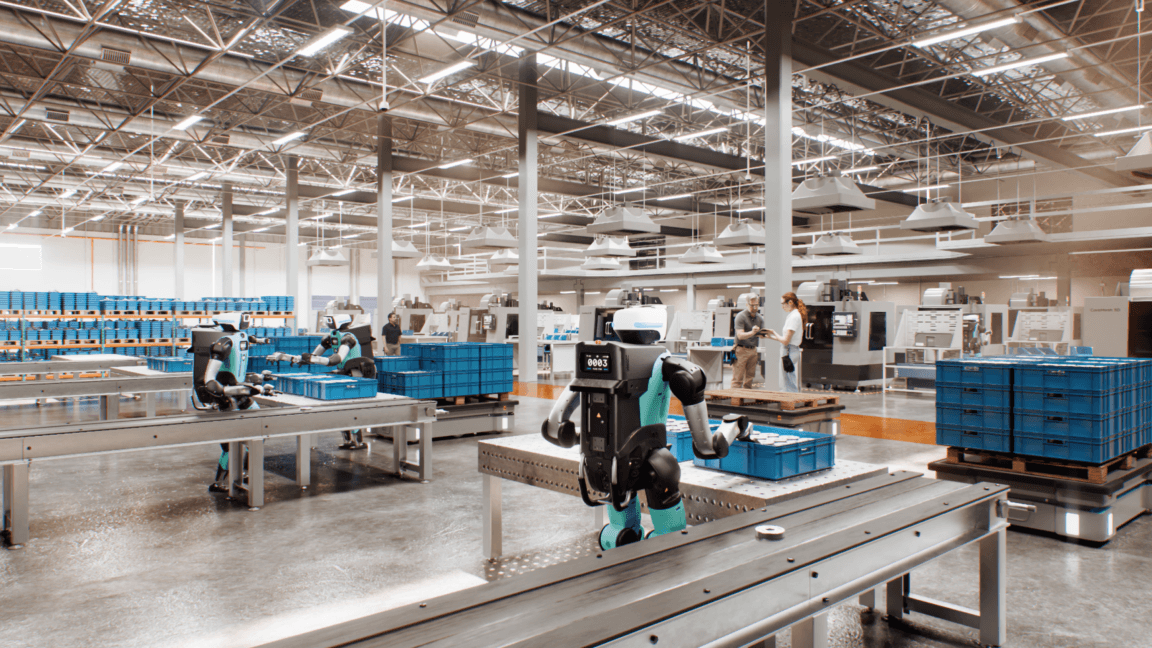
Agility Robotics Unveils Digit 5 With Human-Safe Motion System
Most industrial robots earn their keep behind locked cages. Venture too close and the machinery stops — not because it sensed you, but because a light curtain or proximity fence tripped a circuit. That blunt safety model has defined factory floors for decades, and it carries a steep price: floor space consumed by barriers, workflows interrupted by exclusion zones, and a hard ceiling on how many robots can share a building with human workers.
Agility Robotics wants to break that ceiling. The company has publicly introduced the Agility Digit 5 humanoid robot, its first machine engineered from the ground up to coexist with workers without requiring physical separation. Rather than stopping blindly when a sensor trips, Digit 5 reads the situation and responds proportionally — moving aside, freezing in place, or lowering itself into a squat depending on how close a person has come and what the context demands.
"The robot was designed with a complex safe motion system that can take a variety of different mitigations depending on exactly what sort of human presence is detected," Pras Velagapudi, chief technology officer at Agility, told Ars Technica.
That distinction between a binary stop and a graduated response is what separates a genuinely collaborative robot from one that merely tolerates proximity.
How Digit 5 Detects and Responds to Human Presence

The capability rests on a tiered detection and response architecture. When Digit 5 registers a person at a distance, the robot has two initial options: reposition to give the person a clear path, or hold position so the worker can pass without the machine moving unpredictably in their direction. Neither response requires human intervention. The robot decides.
Read next Top Technology Trends in 2026 You Need to KnowAt closer range, the calculus shifts. If a worker moves into the robot's immediate vicinity, Digit 5 can autonomously transition into a squatting, seated posture. A lower center of mass reduces the robot's effective reach and momentum, limiting the force it could transfer to a nearby person if something unexpected happens. It is a mechanical act of deference.
This graduated approach maps directly onto frameworks increasingly embedded in international safety standards. ISO 10218 — the primary international standard governing industrial robot safety — distinguishes between fixed guarding and collaborative operation, requiring robots working alongside humans to demonstrate the ability to limit speed, force, and contact energy. OSHA's general industry guidelines similarly emphasize hazard hierarchy: engineer the risk out before relying on administrative controls. Digit 5's squat is an engineered mitigation, not a policy workaround.
The system also addresses the ambiguous middle zone that conventional robots cannot handle: a human who is not yet close but is moving toward the machine. Distance detection lets Digit 5 begin adjusting before a person enters a dangerous proximity band, rather than triggering a hard stop only after the threshold is already crossed.
Implications for Warehouses and Automotive Factories
Warehouses and automotive plants are the two sectors Agility explicitly identifies as targets for Digit 5. Both share characteristics that make human-sensing navigation especially valuable.
Warehouse operations are inherently mixed-traffic environments. Human pickers, forklifts, automated guided vehicles, and now humanoid robots share the same aisles under schedules that shift hourly. Permanent barriers around robot work zones lock in floor layouts that may need to change seasonally. The cost is not only capital expenditure — it is operational rigidity that penalizes scale.
Automotive final assembly presents a different version of the same challenge. Tasks involving irregular geometries, delicate components, and trim-level variation have resisted full automation for years. Humans and robots working at adjacent stations — rather than alternating behind barriers — could improve throughput. But that arrangement demands robots that yield predictably to human movement, not ones that operate until a hard stop is triggered.
The International Federation of Robotics has tracked accelerating humanoid robot investment across both sectors in its annual World Robotics reports. Analysts at Goldman Sachs have projected the addressable market for humanoid robots in logistics and light manufacturing running into the tens of billions of dollars before the end of this decade — contingent largely on whether robots can operate without the overhead of dedicated, isolated work cells.
Eliminating Isolated Robot Work Cells and Physical Barriers
A typical safety cage installation for a single industrial robot arm can consume several hundred square feet of production floor. Integration costs for fencing, interlocked access gates, safety laser scanners, and validation documentation can add tens of thousands of dollars per installation, according to manufacturing integration consultants. Multiply that across dozens of robot stations in a large facility and the overhead becomes a significant fraction of the deployment budget.
Collaborative robots — cobots — have chipped away at this model over the past decade, operating near humans under speed-and-force-limiting protocols. But cobots have generally been constrained in payload capacity and task range. Humanoid robots operating at full capability — carrying loads, navigating varied terrain, using tools — represent the next tier, one that the old safety architecture cannot accommodate without reverting to the cage model.
Digit 5's autonomous proximity management offers a different path. If the robot can handle proximity risk through its own motion decisions, facility designers can treat robots and humans as co-occupants of shared space rather than inhabitants of segregated zones. That changes both the economics and the pace of deployment.
The Broader Race Toward Human-Robot Collaboration in Industry
Agility is not the only company pursuing this milestone. Several major robotics programs have identified human-safe operation as a prerequisite for broad deployment, recognizing that warehouses and factories cannot be physically restructured at scale with new barriers for every robot added.
What distinguishes the Agility Digit 5 humanoid robot's introduction is specificity. Rather than announcing a general intent to work near people, the company has described a concrete behavioral repertoire — avoidance, stillness, and postural lowering — and attributed it to a named technical system. Velagapudi's framing of "a variety of different mitigations" signals that the system is not a single proximity trigger but a decision layer that reads context and selects an appropriate response.
That specificity is what facility safety officers, regulators, and insurance underwriters will want to evaluate. Broad claims about safety are common in robotics marketing. Documented, testable behaviors are what enable deployment.
What This Means for the Future of Humanoid Robots at Work
The significance here is not the squat itself — it is what the squat represents. A robot that can lower its profile, that distinguishes between a distant worker and an approaching one, is a robot that treats human presence as a condition to be managed rather than an emergency to be halted.
That shift — from "stop when a person is detected" to "respond appropriately given how a person is present" — is arguably the defining transition in industrial robotics right now. It mirrors the evolution in automotive safety from passive crumple zones to active collision avoidance, and it will similarly require years of real-world validation before it earns broad institutional trust.
Digit 5 is a concrete step toward that trust. The work ahead involves proving the system performs reliably across the full range of conditions warehouses and factories actually present: shift changes, crowded aisles, fast-moving workers, variable lighting, and the thousand unpredictable micro-situations that structured testing cannot fully anticipate. The robot can squat. Whether it squats at the right moment, every time, is what deployment will answer.
Source: Ars Technica - All content


