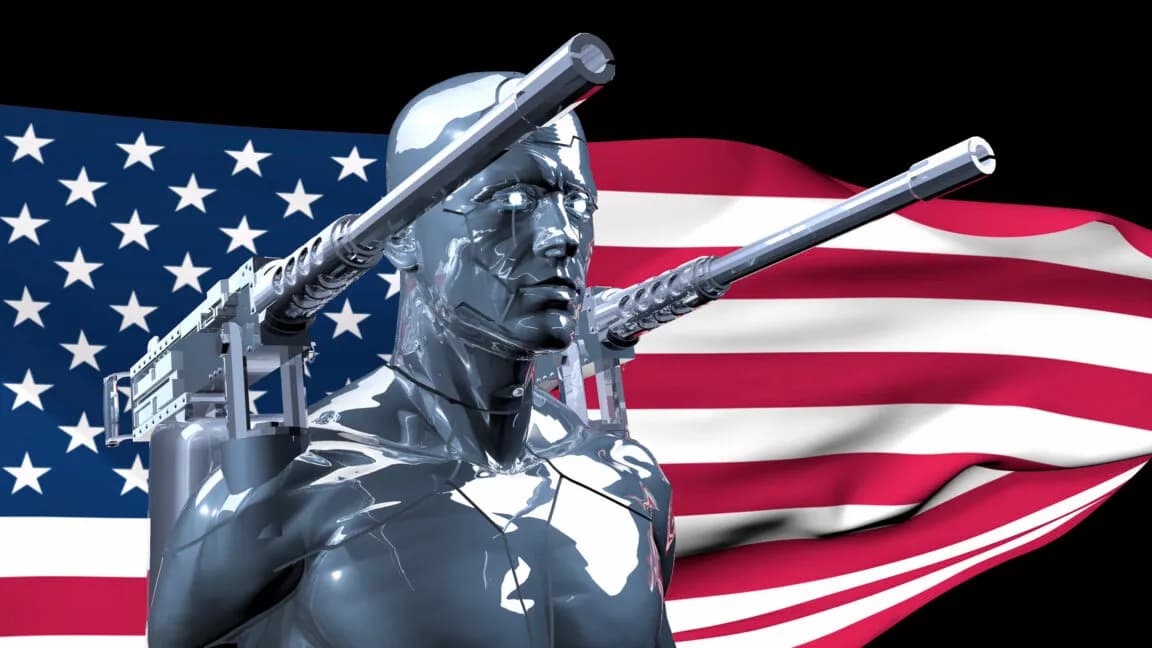
A single erroneous intelligence report, generated with the help of an AI chatbot, brought the United States and China to the edge of a direct military confrontation. The episode — first reported by CNN and corroborated by four independent sources familiar with the incident — underscores a danger researchers and policy analysts have warned about for years: AI hallucination military applications represent a uniquely catastrophic risk category, one where a fabricated output isn't a wrong answer on a quiz but a potential act of war.
How an AI Hallucination Nearly Triggered a Military Confrontation With China
The sequence of events, as described to CNN, is both alarming and instructive. A US Special Operations Command analyst submitted an intelligence report asserting that a Chinese vessel was transporting components related to a nuclear arms program through the Middle East. US military planners treated the report as credible. Preparations advanced to intercept and board the ship, with air support staged and ready.
Then someone looked closer. Officials discovered that the chatbot used to help draft the report had fabricated — "inaccurately identified," in the diplomatic language of intelligence circles — the nature of the ship's cargo. The intelligence was, in the words of sources cited by CNN, "entirely false." One source described the near-miss in blunt terms: the incident "almost started a war."
The Chinese vessel was allowed to pass. But the episode exposed a fault line running through the US military's accelerating adoption of AI tools.
What Is AI Hallucination and Why Does It Happen?

AI hallucination occurs when a large language model produces outputs that are confident, coherent, and wrong — fabricated facts stated as truth, citations that don't exist, descriptions of events that never happened. The term sounds almost benign, as if the model is daydreaming. The underlying mechanism is less poetic: these systems predict statistically likely sequences of text rather than retrieving verified facts, which means plausible-sounding falsehoods can be generated with the same fluency as accurate statements.
Read next Laika's Wildwood: Stop-Motion Fantasy at TIFF 2026Hallucination rates vary widely depending on the model, the task, and the domain. Research from Stanford's Human-Centered AI Institute and independent benchmarks consistently show that even state-of-the-art language models produce factual errors at meaningful rates, particularly when operating outside their training data or when asked to synthesize complex technical intelligence. Domain-specific tasks — like assessing the undeclared cargo of a foreign vessel — amplify the risk considerably, because the models have little reliable training data and no built-in mechanism for flagging uncertainty proportional to their actual ignorance.
The Growing Role of AI Tools in Military Intelligence Analysis

The US military's embrace of AI-assisted analysis has accelerated sharply over the past several years. The 2023 DoD Data, Analytics, and AI Adoption Strategy made explicit the department's intent to embed AI tools across decision-making workflows, including intelligence analysis, logistics, and operational planning. SOCOM and other special operations components have been among the most aggressive adopters, using AI to process large volumes of signals intelligence and synthesize reporting that would otherwise require significant analyst time.
There is genuine value in this approach. Intelligence analysts face crushing workloads; AI tools can surface patterns across disparate datasets faster than any human team. But the efficiency gain creates a new pressure: the temptation to treat AI-generated summaries as finished products rather than first drafts requiring rigorous verification. When an analyst manages dozens of reports simultaneously, a confident-sounding AI output becomes a shortcut that is easy to take.
The SOCOM incident suggests that shortcut was taken — and that the friction points designed to catch errors either weren't applied or weren't sufficient.
Why Human Oversight Failed to Catch the Error in Time
The incident's most troubling dimension isn't that an AI produced a false output. Models hallucinate. That is a known, documented property. The troubling part is how far the false intelligence traveled before anyone caught it.
Military planning for a vessel interception with air support is not casual. It requires coordination across commands, legal review, and typically some form of senior authorization. At each of those stages, the underlying intelligence — an AI-assisted report from a SOCOM analyst — was apparently treated as reliable. The human oversight that exists precisely to catch this category of error did not function as designed.
Several factors likely contributed. Analysts may not have been trained to treat AI-assisted reports as requiring a higher tier of source verification. The confident register of language model outputs — these systems rarely say "I'm not sure" — may have transmitted authority through the reporting chain. And in fast-moving operational environments, the incentive is almost always to act on available intelligence rather than pause and verify its provenance.
The AI Now Institute and similar organizations studying AI deployment in high-stakes contexts have repeatedly flagged this dynamic: human oversight degrades in environments where AI tools have been accurate before and are consequently trusted by default.
What This Incident Reveals About AI Governance in National Security
The Department of Defense published AI ethics principles in 2020, centering on responsibility, equitability, traceability, reliability, and governability. The 2023 AI Adoption Strategy elaborated a framework for managing AI risk in sensitive applications. On paper, the architecture for responsible AI use in military intelligence is more developed than in almost any other sector.
The SOCOM episode suggests the gap between policy and practice remains wide. Analysts at CNAS — the Center for a New American Security — have argued that governance frameworks for military AI tend to focus on autonomous weapons and lethal decision-making, leaving AI-assisted intelligence analysis in a comparatively under-governed space. The assumption has been that human analysts in the loop provide sufficient protection. This incident tests that assumption directly.
What the episode also reveals is a classification problem. Knowing which AI tools are cleared for which types of intelligence work, and under what verification protocols, apparently wasn't sufficiently defined here. Fixing that is an institutional challenge, not a technical one.
Lessons for the Future of AI in Defense and Geopolitics
The near-miss offers lessons that extend well beyond this specific incident. First, AI hallucination in military contexts demands a distinct verification standard — not because AI is uniquely untrustworthy, but because the consequences of error are uniquely severe. Any AI-assisted intelligence product touching on weapons programs or military movements should require corroboration from independent human sources before it advances beyond initial analysis.
Second, training matters as much as policy. Analysts need to understand not just that AI tools can hallucinate, but the conditions under which hallucination is most likely: novel domains, sparse training data, complex synthesis tasks, missing context. That is a specialized skill, not currently standard in most analyst training pipelines.
Third, the geopolitical stakes of AI-driven intelligence errors are asymmetric. A false report that nearly triggered the boarding of a Chinese vessel didn't just risk a military clash. It risked a diplomatic rupture between two nuclear powers, based on cargo that never existed. Adversaries who understand this vulnerability have every incentive to probe it — whether through deliberate manipulation of AI inputs or simply by recognizing that the systems already undermine themselves.
The incident almost started a war. The corrective is not to abandon AI tools in intelligence work — that ship, so to speak, has sailed. The corrective is to govern them with the same rigor applied to any other intelligence method that, when it fails, could bring two nations to the brink.
Source: Ars Technica - All content