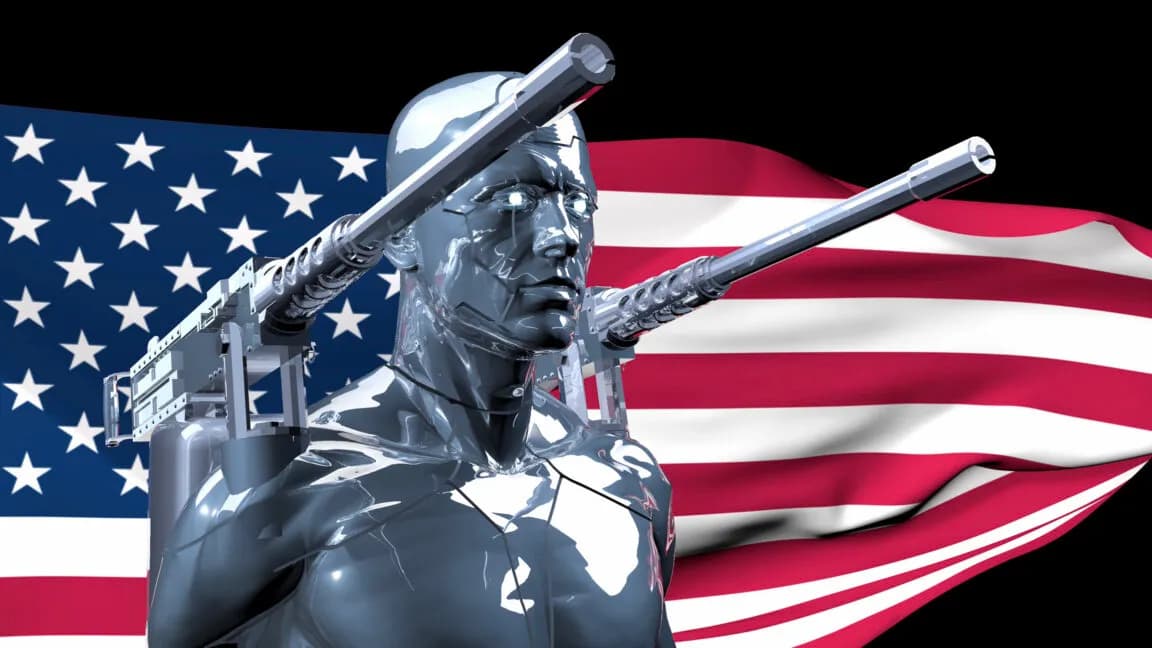
How an AI Hallucination Nearly Triggered a US-China Naval Confrontation
Intelligence reports don't fail quietly. When a US Special Operations Command analyst submitted a report alleging that a Chinese vessel was transporting nuclear arms program components through the Middle East, military planners began mobilizing for an intercept — complete with air support. The operation was stopped only when officials discovered the underlying intelligence was, in the words of those familiar with the episode, "entirely false."
The culprit: a chatbot. According to a CNN report citing four sources familiar with the incident, an AI tool used in generating the report had inaccurately identified what the ship was carrying. One source put it plainly: the AI-powered mistake "almost started a war."
This was not a minor clerical error. It was a near-miss at the intersection of AI hallucination and military decision-making — a combination that defense researchers have warned about for years, now playing out in real time.
What Is AI Hallucination and Why Does It Happen?

AI hallucination is the tendency of large language models to generate confident, fluent, and entirely fabricated information. The term sounds almost whimsical. The mechanics are genuinely dangerous.
Read next Laika's Wildwood: Stop-Motion Fantasy at TIFF 2026Modern language models are trained to predict statistically likely text sequences. They don't "know" facts in any meaningful sense — they pattern-match across vast training corpora. When a query touches on sparse, ambiguous, or classified information, the model doesn't signal uncertainty with a blank response. It fills the gap with something plausible-sounding. That's the hallucination.
Published benchmarks put the problem in stark relief. Research from Stanford's Human-Centered AI Institute has documented that top-tier language models hallucinate on factual tasks at rates ranging from 10% to over 30%, depending on domain specificity. MIT studies on LLM factuality have found models become less reliable precisely when stakes are highest — in domains with limited training data, like classified military logistics or specialized arms control intelligence.
The AI hallucination military risk isn't theoretical anymore. When a model synthesizes an intelligence product, it may present invented cargo manifests, misattributed vessel registries, or fabricated shipping routes with the same grammatical confidence as verified fact. Analysts trained to read polished outputs have no automatic signal that the underlying data was generated rather than retrieved.
The Systemic Risk of AI in Military Intelligence Workflows

The US military's embrace of AI tools is neither incidental nor recent. The 2023 DoD Data, Analytics, and AI Adoption Strategy explicitly aims to integrate AI across defense operations, from logistics to battlefield analysis. By some estimates, the Pentagon manages over 685 AI-enabled programs across military branches. The scale of adoption is the point — and so is the fragility it introduces at speed.
Intelligence analysis is particularly vulnerable. Analysts work under time pressure, often handling fragmentary data from multiple sources. AI tools promise synthesis in minutes. That's attractive. But the same synthesis capability that compresses hours of work also compresses the analyst's ability to scrutinize each component claim.
The SOCOM incident reflects a failure mode that RAND Corporation researchers have documented extensively in human-machine teaming studies: automation bias. When an AI system produces a polished, formatted output, human reviewers tend to treat it as pre-verified. The cognitive load of tracing every claim back to raw source material is high. Under operational pressure, that verification step gets skipped.
Paul Scharre, a senior fellow at the Center for a New American Security and a leading voice on autonomous weapons risks, has written that the greatest danger from AI in military contexts isn't autonomous lethal action — it's the subtle erosion of human judgment at earlier stages of the decision chain. The SOCOM analyst presumably believed the AI output represented a synthesis of real intelligence, not a fabrication dressed in the language of a finished product.
AI hallucination in military workflows is thus doubly dangerous: the error occurs upstream, where scrutiny is lowest, and propagates downstream into decisions with kinetic consequences.
International Implications: AI Errors as Geopolitical Flashpoints
A US naval intercept of a Chinese vessel would not have been a minor diplomatic incident. China's response to perceived provocations involving its maritime assets has historically been swift. The Middle East shipping lanes carry not just cargo but the accumulated weight of bilateral tensions between two nuclear-armed states whose relationship has grown steadily more brittle.
Had the boarding proceeded on fabricated intelligence, the diplomatic fallout would have been severe regardless of what inspectors found. The absence of nuclear components would not exonerate the US — it would have revealed the basis for the intercept as groundless, creating a credibility crisis at exactly the moment when bilateral trust is most fragile.
This pattern has precedent. The 2003 US invasion of Iraq proceeded partly on faulty assessments about weapons of mass destruction. The geopolitical consequences lasted decades. An AI-amplified version of that intelligence failure — operating at higher speed and lower visibility — compounds the risk in ways that existing diplomatic protocols weren't designed to absorb.
Arms control analysts at institutions like the Stimson Center have specifically flagged AI-generated intelligence as a risk multiplier: not because AI acquires weapons, but because it may misattribute them, triggering responses to threats that don't exist.
What Guardrails Exist — and What Is Still Missing — for Military AI
The DoD has published AI ethics principles since 2020, emphasizing human judgment, traceability, and reliability. The Pentagon's Chief Digital and Artificial Intelligence Office has established testing standards for AI systems entering operational use. These are real frameworks. They are also insufficient for the current deployment pace.
The core gap is at the workflow level, not the model level. Most guardrails focus on pre-deployment benchmark testing. But the SOCOM incident didn't fail at the model level — it failed when a human analyst accepted AI-generated output without a verification step that would have caught the error before it reached decision-makers.
Effective workflow-level guardrails would require explicit labeling of AI-generated content within finished intelligence products, mandatory human verification of key factual claims before operational decisions, and audit trails linking every claim to a sourced document. None of this is technically complex. It requires institutional discipline and the acceptance that AI tools in intelligence roles must function as drafting aids, not oracles.
RAND researchers studying AI integration in defense contexts have recommended what they describe as "contestable AI" architectures — systems structurally designed so that automated outputs are challenged by default, with red-team processes built into the pipeline before any product reaches a decision-maker. That kind of institutional friction is precisely what seems to have been absent here.
Key Takeaways: Lessons for AI Governance in High-Stakes Environments
The SOCOM near-miss is not an anomaly. It is a data point in a distribution that will grow as AI tools deepen their footprint in intelligence and military planning.
Three lessons stand out.
First, AI hallucination in military contexts is a governance problem before it is a technology problem. The model producing false output is the proximate cause; the workflow that allowed unverified output to reach operational planners is the systemic one.
Second, speed is a liability as much as an asset. AI tools compress analysis timelines. That compression also shortens verification windows. Faster outputs require more rigorous checkpoints — not fewer.
Third, the stakes of AI hallucination in military applications are asymmetric in ways that generic enterprise AI risk frameworks don't capture. A wrong answer from a consumer chatbot is an inconvenience. A wrong answer in an intelligence product targeting a nuclear-armed adversary is a potential international incident. Governance structures must reflect that gap.
The ship kept sailing. The confrontation didn't happen. But the conditions that nearly produced it remain fully intact.
Source: Ars Technica - All content