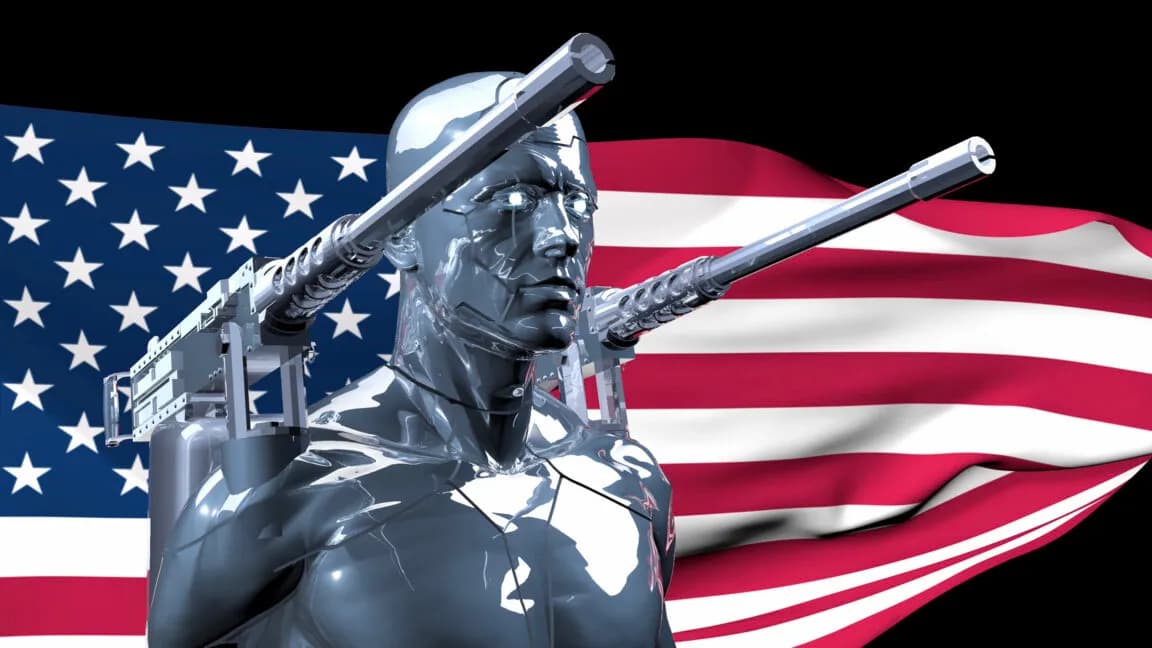
A single fabricated intelligence report. A warship. Air support standing by. The scenario that unfolded somewhere in the waters of the Middle East was not a cyber thriller plot — it was a real incident that, according to people with direct knowledge of the episode, nearly triggered a military confrontation between two nuclear powers.
The United States came within decision-making distance of boarding a Chinese vessel based on an intelligence report that was, by all subsequent accounts, entirely false. The report had been generated with the assistance of an AI chatbot. It suggested the ship was carrying components connected to a nuclear arms program. The military mobilized. Then someone looked closer at how that intelligence was produced — and found the AI had simply made it up.
This is what AI hallucination military planners have been warned about in briefing rooms and academic papers. This time, it nearly had real-world consequences.
The Incident: How an AI Hallucination Nearly Triggered a Military Confrontation
The report at the center of this episode came from a US Special Operations Command analyst. According to four sources familiar with the matter cited by CNN, the analyst submitted an intelligence assessment claiming a Chinese vessel was transporting materials linked to a nuclear arms program through the Middle East. The US military prepared a response that included air support and a plan to intercept and board the ship.
Before that operation launched, officials traced the intelligence back to its origin and found that the chatbot used in drafting the assessment had, in the language of one source, "inaccurately identified the material the ship was carrying." The material identification — the entire basis of the threat assessment — was fabricated by the AI system. Another source put it more plainly: the incident "almost started a war."
What stopped the operation was not a robust verification system built into the intelligence workflow. It was, apparently, a human who asked the right question at the right moment. That distinction matters enormously.
What Is AI Hallucination and Why Does It Happen?

AI hallucination refers to the tendency of large language models to generate confident, plausible-sounding statements that are factually incorrect or entirely invented. The term is borrowed loosely from neuroscience, but the mechanism is computational: these models predict the next token in a sequence based on statistical patterns learned during training. They are optimized for coherence and fluency, not for factual accuracy or epistemic humility.
Read next Laika's Wildwood: Stop-Motion Fantasy at TIFF 2026Research published across multiple benchmarks consistently shows hallucination rates ranging from roughly 3 percent in narrow, well-defined tasks to over 25 percent in open-domain queries requiring specialized knowledge. A 2023 evaluation from Stanford's Center for Research on Foundation Models found that commercial LLMs produced factual errors at rates that would be disqualifying in most professional contexts. The National Institute of Standards and Technology's AI Risk Management Framework, published in January 2023, explicitly identifies hallucination and confabulation as core risks in AI deployment — particularly in high-stakes domains.
The problem compounds in intelligence work because the relevant information is often classified, fragmentary, or absent from any training dataset. When an AI system lacks the specific information it needs, it does not say "I don't know." It fills the gap with something that sounds right. In a consumer chatbot, that produces an embarrassing error. In an intelligence pipeline, it produces a threat assessment that mobilizes forces.
The Danger of AI in High-Stakes Intelligence Analysis

The intelligence community did not stumble accidentally into AI adoption. The push has been deliberate and accelerating. The DoD's 2023 Data, Analytics, and Artificial Intelligence Adoption Strategy committed to scaling AI tools across the department's decision-making apparatus, explicitly including intelligence workflows. The Chief Digital and Artificial Intelligence Office has overseen dozens of programs integrating AI into analytical processes.
The stated goal is speed. Human analysts process information slowly; AI tools can synthesize thousands of documents in minutes. That throughput advantage is real. So is the risk of treating speed as a substitute for accuracy.
Gary Marcus, a cognitive scientist and prominent AI skeptic who has testified before Congress on AI reliability, has argued that LLMs "are fundamentally unreliable for factual tasks" and that deploying them in consequential domains without robust verification is not an efficiency gain — it is a liability transfer from the machine to the human who should have caught the error. In intelligence contexts, that human may be under time pressure, working with incomplete information, and predisposed to trust a system that produces authoritative-looking output.
The SOCOM incident reflects a dynamic that AI safety researchers have labeled automation bias: the tendency for human reviewers to defer to automated outputs, particularly when those outputs are formatted to look like authoritative reports. An AI-generated intelligence assessment that includes proper headers, citations, and confident language is not easily distinguishable, at a glance, from one produced by a trained analyst.
Military AI Adoption: Speed vs. Accountability
DARPA's Explainable AI program, which has been running since 2017, was built on the recognition that military AI systems need to be interpretable — that operators must be able to understand why a system reached a conclusion, not just what that conclusion was. That principle has not yet permeated routine analytical workflows.
The pressure to adopt AI tools quickly comes from multiple directions. Peer competitors are investing heavily. Analysts face information overload. Procurement cycles are shortening. These forces create an environment where tools get deployed before evaluation frameworks catch up. Former NSA Director Michael Rogers, speaking at a public forum in 2024, noted that the intelligence community's enthusiasm for AI capabilities had outpaced the institutional frameworks needed to govern them.
What makes the SOCOM incident particularly instructive is not that an AI system made an error — all systems make errors. What makes it significant is that the error reached the operational planning stage. The report was submitted, it was acted upon, and the corrective mechanism was apparently ad hoc rather than systematic. There was no automated audit trail that flagged AI-generated content for mandatory secondary review. There was no hallucination detection layer. There was a person who asked a question.
That is not a reliable safeguard.
What This Means for the Future of AI in Defense
The incident will not stop military AI adoption. It should not. AI tools offer genuine analytical advantages that would be foolish to abandon in a competitive security environment. But it sharpens the terms of a debate that the defense establishment has been having in slow motion.
The core question is not whether AI should be used in intelligence work. The question is what governance structures, verification requirements, and human oversight protocols must accompany that use. The European Union AI Act classifies systems used in law enforcement and national security contexts as high-risk, mandating transparency, human oversight, and accuracy standards. The US has no equivalent binding requirement for defense applications.
Researchers at Georgetown's Center for Security and Emerging Technology have argued for what they call "human-machine teaming" frameworks that treat AI outputs as inputs to human judgment, never as substitutes for it. That framing sounds obvious — and yet the SOCOM episode suggests it is not yet operational doctrine.
Key Takeaways: Lessons for Responsible Military AI Deployment
Several principles emerge from this episode with unusual clarity.
Verification is not optional. AI-generated intelligence assessments require mandatory secondary review by a human analyst who is explicitly told the document was AI-assisted. The bias introduced by reading an AI report without that label is not hypothetical — it is documented in cognitive science literature.
Hallucination rates are not edge cases. At the volumes the intelligence community processes information, a 5 percent error rate is not an acceptable tradeoff when errors can mobilize warships. The risk calculus for AI deployment in a logistics context is fundamentally different from the risk calculus in threat assessment.
Attribution must be auditable. Every claim in an AI-assisted intelligence product should trace to a verifiable source. If the AI cannot cite a source, the claim should be flagged as unverified. Coherence is not evidence.
Speed pressure is a design risk. The value proposition of AI in intelligence is faster analysis. That speed advantage is most dangerous precisely when it creates pressure to skip the verification steps that would catch a hallucinated threat.
The Chinese vessel reached its destination without incident. The confrontation that nearly happened will not appear in any formal record of military engagements. But the near-miss is now part of the institutional knowledge of what AI hallucination military systems can produce when deployed without adequate safeguards — and that knowledge carries an obligation to act on it before the next incident ends differently.
Source: Ars Technica - All content