On October 3, 2026, Variety published its review of "Behemoth!," and the trade's framing was unusually elastic for a film with a movie star at its center. The publication described Tony Gilroy's latest as four things at once: a classical-musician movie, a midlife-crisis movie, a romantic mystery, and an exercise in pure cinematic form. That Variety—the industry's paper of record since 1905—chose to lead with taxonomy rather than plot says something about the film's ambitions.
What Is Behemoth? Tony Gilroy's Genre-Bending Music Drama Explained
"Behemoth!" arrives as a classical-musician movie, which places it in one of prestige cinema's most reliable but least populated subgenres. The lineage matters. "Tár," Todd Field's 2022 portrait of a conductor's unraveling, earned six Academy Award nominations, including Best Picture, and won Cate Blanchett a raft of critics' prizes en route to a global gross north of $30 million—modest by blockbuster standards, substantial for a dialogue-driven art film. "Whiplash" (2014) turned conservatory percussion into a thriller and collected five Oscar nominations with a $49 million worldwide haul against a $3.3 million budget. The pattern holds: films built around serious musicians routinely outperform their financing by ratios that would embarrass mid-budget studio dramas, because the setting supplies built-in stakes—rehearsal, audition, performance—without requiring explosions.
Gilroy's film, per Variety's summary, folds that musical spine into a midlife-crisis narrative and a romantic mystery simultaneously. It is not a biopic of a real cellist, nor an adaptation the trade identifies. Instead, it is described as an original construction, one in which the director is "fiddling around with pure movie form"—a phrase that signals structural play rather than conventional three-act development. That combination places "Behemoth!" in rare company: a star vehicle that refuses to behave like one.
Pedro Pascal as a Classical Cellist: Performance and Character Breakdown
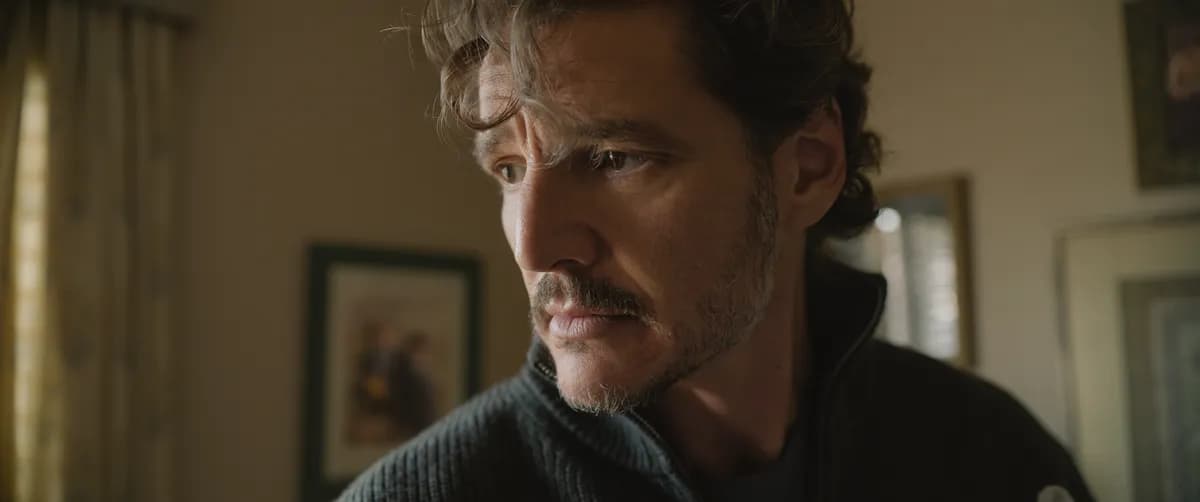
Pedro Pascal anchors the film as a cellist navigating midlife crisis, and the casting carries its own logic. Pascal's post-2019 filmography is a study in scale—the Mandalorian's helmet, Joel Miller's post-apocalyptic sprawl in "The Last of Us," the operatic grief of "The Unbearable Weight of Massive Talent." A cellist in a chamber-scale drama inverts every one of those choices. The instrument itself matters: the cello sits between the violin's virtuosic exposure and the double bass's anonymity, requiring the player to be seated, embraced, and physically intertwined with the instrument for hours. It is, in performance terms, the least armored position a leading man can occupy.
Read next 1963 : le tube yéyé qui a enflammé la France — reconnaîtrez-vous cette voix ?Variety frames the role within a midlife crisis, which is a well the movies have drawn from since at least "American Beauty" (1999, five Oscars including Best Picture) and "Lost in Translation" (2003, four nominations). What distinguishes the classical-music framing is the discipline it imposes. A crisis expressed through scales, bowings, and ensemble etiquette reads differently than one expressed through a red convertible. The cellist's crisis is audible—in intonation, in tempo, in the decision to play a passage at all. Pascal's challenge, and presumably the film's central performance gambit, is to make interior collapse register through an art form that punishes visible emotion. Professional orchestras do not reward tears; they reward precision.
Tony Gilroy's Directorial Approach: Form Over Formula
Tony Gilroy's credentials are not in dispute. He wrote or co-wrote the first four Bourne films, a franchise that grossed roughly $1.6 billion worldwide across its original run and redefined the action grammar of the 2000s. He directed "Michael Clayton" (2007), which earned seven Oscar nominations and won Tilda Swinton a Best Supporting Actress statuette. He co-wrote "Rogue One: A Star Wars Story" (2016), which cleared $1 billion globally. And he created "Andor" for Disney+, a series widely treated by critics as the most formally serious piece of Star Wars storytelling yet produced, with a second season arriving to sustained acclaim.
That résumé matters because it establishes Gilroy as a craftsman who moves between mass entertainment and controlled authorship without visible strain. Variety's characterization of "Behemoth!"—a director "fiddling around with pure movie form"—reads less like experimentation for its own sake and more like a writer-director testing how much structure a film can shed while remaining legible. Gilroy has spent two decades building tension through procedure: surveillance logs, legal depositions, intelligence protocols. A classical-music setting offers a parallel system of procedure—score, rehearsal mark, downbeat—that he can exploit with the same rigor he applied to Bourne's tradecraft.
Behemoth as Romantic Mystery: Layers Beneath the Music Drama
The romantic-mystery layer is the least documented in the available reporting, and that opacity is itself informative. Variety's summary does not name a co-star, a plot mechanism, or a central question. It simply asserts the category. A romantic mystery built around a cellist in midlife crisis suggests a film that withholds as a matter of design—where the mystery may be another person, or may be the protagonist's own history, or may be the question of whether the music will hold.
This is where the "Behemoth!" title earns its exclamation point. A behemoth is something enormous, and the film's formal ambition appears to be matching that scale against a protagonist whose world has shrunk to a practice room. The genre-blending Variety identifies—musician film, midlife film, romantic mystery—is not indecision. It is accumulation. Each layer raises the stakes on the others: the romance makes the crisis consequential, the mystery makes the music suspenseful, and the music makes the romance legible.
Critical Reception: Is Behemoth an 'Elevated Bauble' or a Genuine Triumph?
Variety's own phrasing cuts both ways. Calling a film an "elevated bauble" is a compliment with a raised eyebrow—an acknowledgment of craft and pleasure that stops short of canonization. The trade's review treats "Behemoth!" as a director's divertissement: a film made by a serious filmmaker that does not demand to be taken as seriously as "Michael Clayton."
That verdict lands within a recognizable critical pattern for musician dramas. "Tár" was received as major art and rewarded accordingly. "Whiplash" was received as a thrilling genre piece that transcended its premise. Films in this space rarely fail outright; they fail by being merely competent. The relevant question for "Behemoth!" is whether Gilroy's formal play produces discovery or decoration—whether the genre-mixing reveals something about a cellist's midlife that a straight drama could not.
The "elevated bauble" framing, notably, is not dismissal. Prestige cinema has an honored place for the well-made entertainment that a major director makes between monuments. Steven Soderbergh has built a late career on exactly this mode. If "Behemoth!" is Gilroy's version, it joins a respectable lineage.
Why Behemoth Matters for Pedro Pascal's Career and Prestige Cinema in 2026
Pascal's trajectory since 2019 has been expansionist: franchise television, franchise film, awards-adjacent prestige. A chamber-scale musician drama is a consolidation play. It signals that his name can carry a film without armor, mythology, or a helmet—the purest test of whether a star's appeal survives at close range.
For prestige cinema broadly, "Behemoth!" is a data point in an ongoing argument about what mid-budget adult filmmaking looks like in 2026. Classical-music dramas have repeatedly demonstrated favorable returns relative to budget, and star-driven auteur projects remain one of the few reliable paths to theatrical relevance for non-franchise material. If "Behemoth!" works—critically, commercially, or both—it strengthens the case that the format Variety describes is not a curiosity but a viable template.
Variety's review, published October 3, 2026, frames the film as Gilroy's formal playground and Pascal's unshielded close-up. Both claims are worth testing in a theater.
Source: Variety