How the Right Won Brazil's First Round
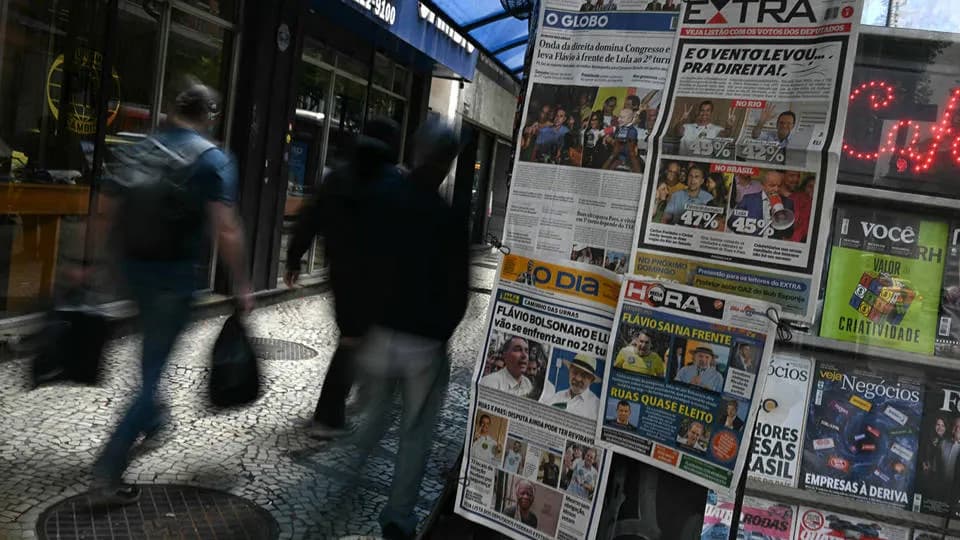
The results from Brazil's first-round presidential vote in October 2026 landed like a verdict the left had been refusing to read for years. A right-wing candidate aligned publicly and ideologically with Donald Trump turned in a performance strong enough to reshape the race — and to force a reckoning inside the ruling Workers' Party (PT) that polling data had been demanding for some time.
The story that many international observers reached for was one of democratic backsliding, of a populist surge riding disinformation and culture-war grievances to the ballot box. That story is not entirely wrong. But it is incomplete. What the Brazil election 2026 actually revealed is a governing left that ran the country's institutions while losing the country's voters — a party that confused administrative competence with political connection, and found on election night that they are not the same thing.
The right did not conjure this opening. The left vacated it.
The Changing Face of the Brazilian Electorate

Brazil is not the country the PT built its coalition around in 2002. Demographic and cultural shifts — documented in successive IBGE census rounds and tracked closely by Pew Research Center — have altered the terrain beneath the party's feet. The electorate is older on average than it was a generation ago. It is significantly more evangelical Christian. And it is, by every credible measure, more consumed with questions of crime and personal security than with the redistributive agenda that once powered the PT's electoral machine.
Read next France Is Dragging the Eurozone Toward a Debt CrisisThe growth of evangelical Christianity in Brazil is among the most consequential political facts of the last two decades. Pew Research has documented the transformation of Brazil from an overwhelmingly Catholic country into a genuinely pluralist religious landscape, with evangelical and Pentecostal denominations claiming an ever-larger share of the faithful — and the vote. These communities have developed robust political networks, media ecosystems, and candidate pipelines. They do not vote as a monolith, but they do respond to signals about moral conservatism, family values, and law-and-order credibility that the PT has been slow — sometimes unwilling — to send.
Simultaneously, Brazil's population is aging. An older electorate tends to be more risk-averse, more attuned to neighborhood safety, and more skeptical of structural reform that promises long-term gains while imposing short-term disruption. The PT governed, in part, as though the 2000s — a decade of commodity boom, rising incomes, and social program expansion — were a permanent condition. They were not.
How the Left Lost Touch With Its Own Base

Political scientists who study incumbent left parties in Latin America have long noted a pattern: governments that come to power on movements of the urban poor tend, over time, to govern through technocrats and NGO networks, gradually replacing the organized street-level presence that got them elected. Oliver Stuenkel of the Fundação Getulio Vargas in São Paulo has written and spoken extensively about the way Latin American left parties accumulate institutional legitimacy while haemorrhaging social embeddedness. The party becomes the state. The movement dissolves.
That process appears to have advanced considerably inside the PT. The party built Bolsa Família, transformed Brazil's poverty numbers, and put millions of Brazilians into the formal economy. Those achievements are real. But achievements in governance are not automatically converted into political loyalty. Loyalty requires presence — in communities, in churches, at kitchen tables. The right has been doing that work. The ruling left, occupied with the machinery of government, has not done it at the same scale.
There is also a generational dimension. The PT's emotional core — its founding story of labor organizing and resistance to military dictatorship — resonates less with younger Brazilians who have no direct memory of those decades. For a voter in their twenties, what matters is whether their street is safe and whether they can afford to start a family. Abstract solidarity has limited electoral force when competing against concrete fear.
Crime and Personal Security as the Defining Issue
Datafolha and IBOPE — the two most credible polling institutions operating in Brazil — have consistently placed crime and personal security among the top concerns of Brazilian voters across multiple electoral cycles. This is not a new finding. What is new is the intensity of the demand and the right's success in owning the issue.
Brazil's homicide rates, concentrated in urban peripheries and secondary cities, impose daily costs on the populations the PT has always claimed to represent most urgently. These are not abstract statistics for voters in Fortaleza's outer neighborhoods or the sprawling suburbs of São Paulo. They are the texture of everyday life — the calculation of which route home is safer, the anxiety about a child on a moped after dark.
The right-wing candidate framed personal security in blunt, affective terms that cut through. The PT, alert to civil liberties concerns and wary of being seen to endorse punitive policing, struggled to articulate a position that was both credible on crime and consistent with its own values. The result was a message that felt hedged to voters who wanted clarity. The right offered clarity. The tradeoff was everything else, but at the ballot box, in the first round, that tradeoff looked attractive to a significant share of the electorate.
Brazil in the Global Populist Wave
The Brazil election 2026 does not exist in isolation. It is one episode in a longer sequence that has run through Hungary, Italy, Argentina, the United States, and across much of Western Europe: a structural challenge to center-left and social democratic parties whose policy achievements have outpaced their political reach.
Researchers at institutions like IUPERJ have mapped how economic anxiety, cultural displacement, and distrust of expert governance combine into a political substrate on which populist right movements grow. The specific triggers vary by country. The underlying sociology — a sense among large portions of the working and lower-middle class that the parties nominally representing them have drifted toward the professional class and the university-educated — is remarkably consistent.
What distinguishes Brazil is scale and intensity. A country of more than 210 million people, with profound regional diversity and a democracy that is barely four decades old, cannot afford the kind of prolonged exhaustion of legitimacy that Europe's older polities have weathered. The institutional memory of authoritarian rule is recent enough that the stakes of democratic competition feel existential to both sides. That raises the temperature of every electoral result.
What Comes Next for Brazilian Democracy
A strong first-round showing for the right is not yet a settled outcome. Brazil's two-round system was designed precisely to require a broader coalition than any first-round result can produce. The path to the second round involves negotiation, realignment, and — for the PT — a confrontation with its own internal diagnostics.
The question the ruling party must answer honestly is whether it can recover the connection to the older, more devout, more security-conscious electorate that it has lost without abandoning the commitments that define it. There is no easy formula. Parties that lurch toward the cultural positions of the right tend to lose their base without winning converts. Parties that ignore the shift tend to lose elections.
What is not available is the option of explaining the results away. Brazil's voters did not move right in some mysterious or irrational way. They moved toward the candidate who appeared to see them as they are now — not as they were twenty years ago. Recovering from that requires more than a better campaign. It requires a party willing to reconnect with a changed country, on that country's terms.
Source: Project Syndicate