Brazil's 2026 Election: A Divided Nation Goes to the Polls
Brazil's electoral rules are unforgiving. Under the country's two-round system, administered by the Tribunal Superior Eleitoral (TSE), a candidate must capture more than 50 percent of valid votes in the first round to avoid a runoff. That threshold has proven difficult to clear in polarized cycles — and October 4, 2026 is no exception.
President Luiz Inácio Lula da Silva, 80, is fighting for a second consecutive term — and a fourth overall — against Flávio Bolsonaro, the eldest son of jailed former president Jair Bolsonaro. The race is tight. If neither clears the majority threshold, Brazilians will return to the polls on October 25 for a direct contest between two men who have come to personify the country's deepest political fault line.
The Brazil election 2026 is, at its core, a referendum on two incompatible visions: one rooted in redistributive social democracy, the other in the nationalist, socially conservative movement that Jair Bolsonaro built and his son now inherits. Neither vision commands a majority. That is the problem — and the drama.
Lula's Record Under Scrutiny

Lula returned to the presidency in January 2023 after defeating Jair Bolsonaro by the narrowest margin in Brazil's democratic history — less than two percentage points. Governing with a slim majority in a fractious Congress, he entered 2026 with a complicated balance sheet.
Read next Medicaid Work Requirements Strand Cancer SurvivorsOn the credit side: real wage growth among lower-income workers, continued expansion of Bolsa Família social transfers, and a measurable reduction in extreme poverty. The flagship social architecture Lula championed in his earlier terms retained broad popular legitimacy. Datafolha, the São Paulo-based polling institute that serves as one of Brazil's most closely watched public-opinion barometers, tracked his approval through a cycle of modest highs and persistent headwinds — a pattern familiar to governing incumbents managing a divided electorate.
The liabilities are real. Inflation pressures have squeezed middle-class households. Criticism of fiscal management intensified through 2025, and opponents hammered Lula on corruption narratives that have shadowed the Workers' Party (PT) since the Lava Jato investigations of the mid-2010s. For swing voters — a decisive constituency in every Brazilian election — the question has never been purely ideological. It is about trust and economic tangibility.
The Shadow of the Jailed Former President

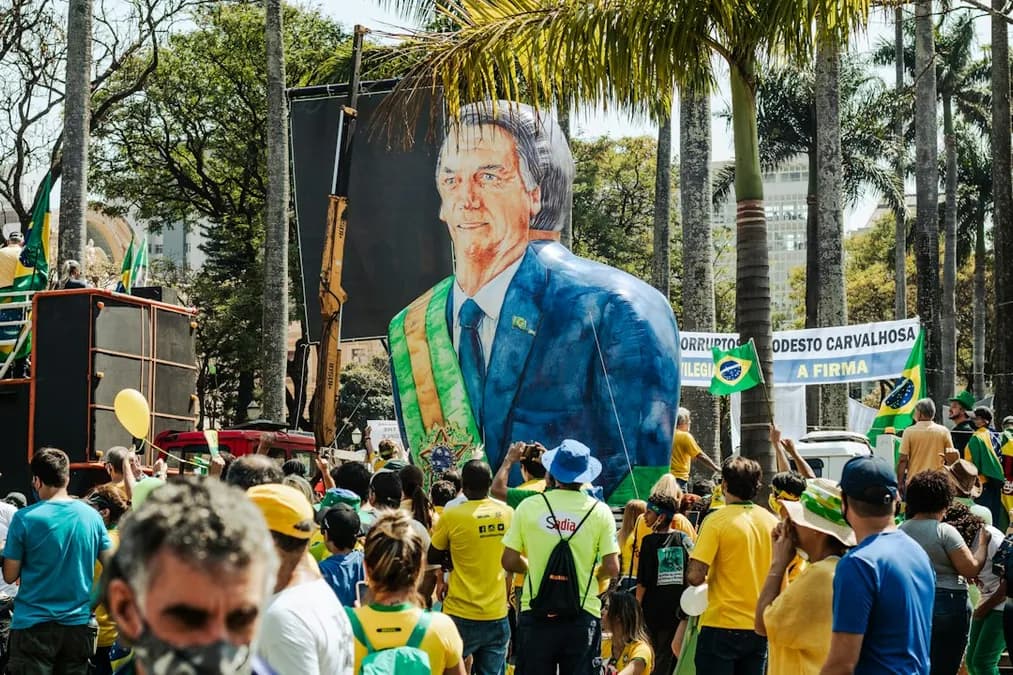
Jair Bolsonaro is not on the ballot. He is in prison. Yet his presence saturates the Brazil election 2026 campaign.
Following his imprisonment, the former president was barred from running for office. That legal barrier did not dissolve the movement he built. It may have hardened it. His supporters cast his prosecution as political persecution — a narrative that energizes a base already primed for grievance.
Flávio Bolsonaro, a federal senator and the eldest of Jair's sons, stepped into that vacuum. He carries the surname, the iconography, and the political network his father assembled over a decade. Analysts at institutions including IUPERJ — the prestigious Rio de Janeiro political science institute — have noted that Bolsonarismo operates less as a traditional party machine and more as an identity coalition, binding together evangelical Christians, agribusiness interests, security-sector voters, and citizens who feel culturally alienated from the urban left.
That coalition proved durable in 2022, when Jair Bolsonaro came within two percentage points of defeating Lula. Flávio is now attempting to persuade those same millions of voters that the torch has passed — not extinguished.
What a Potential October 25 Runoff Would Mean
Should no candidate clear 50 percent on October 4, the TSE will formally convene the second round for October 25. Historical precedent suggests Brazilian runoffs sharpen, rather than resolve, national divisions.
In 2022, the first round produced a fragmented result across multiple candidates; the runoff compressed the electorate into two hostile camps with almost no margin for error. Turnout mechanics favor Bolsonarismo in that format. The movement's base votes at high intensity. Lula's coalition — broader and more heterogeneous — can lose organizational momentum during the three-week interval between rounds.
A runoff would also trigger intense negotiations over endorsements from first-round eliminated candidates. Regional parties, centrist factions, and evangelical political blocs command significant influence in bellwether states. Brazil election 2026 outcomes in Minas Gerais, São Paulo, and Rio de Janeiro are historically determinative; whichever candidate consolidates those endorsements fastest typically enters October 25 with structural advantage.
Brazil's Deepening Political Polarization
Nearly four decades after Brazil's return to democratic rule, the country's political center has thinned to a sliver.
Journalists at Folha de S.Paulo and independent Brazilian political scientists have documented the acceleration of affective polarization — the phenomenon by which voters oppose the rival camp not merely on policy grounds but with visceral personal hostility. Survey data from Brazilian research institutes has found sizable shares of both PT supporters and Bolsonaristas unwilling to socialize across the partisan divide. The January 8, 2023 attacks on government buildings in Brasília — when Bolsonaro supporters stormed the presidential palace, Congress, and Supreme Court — were that polarization's most explosive expression.
But the underlying current flows through everyday Brazilian life: newsrooms, churches, WhatsApp family groups, and corporate boardrooms. Legislative gridlock, sustained misinformation campaigns, and repeated judicial confrontations with democratic institutions have all fed from that same source.
Flávio's candidacy is a test of whether Bolsonarismo retains electoral viability as a son rather than a patriarch. Lula, for his part, must hold together a coalition stretching from the traditional labor left to centrist oligarchic parties that back him not from ideological sympathy but from strategic calculation.
What Comes Next: Implications for Brazilian Society
The outcome of the Brazil election 2026 — whether settled on October 4 or October 25 — carries consequences well beyond electoral arithmetic.
A Lula victory would consolidate a third consecutive Workers' Party term and signal that Brazilian democratic institutions, tested severely across 2022 and 2023, have absorbed the shock of Bolsonarismo without structural collapse. It would simultaneously renew pressure on the PT to deliver tangible economic results for a base that has endured difficult years.
A Flávio Bolsonaro victory would be without precedent in modern Brazilian democracy: the return of a jailed former president's political project through a family surrogate. Analysts would immediately scrutinize which judicial appointments, policy reversals, and institutional postures would follow — and whether Jair's imprisonment would itself become a political variable.
Whatever the result, Brazil does not exit this cycle unified. The fractures run too deep for one election to seal. What voters decide in the coming weeks will shape the country's democratic trajectory for a generation.
Source: NPR Topics: News