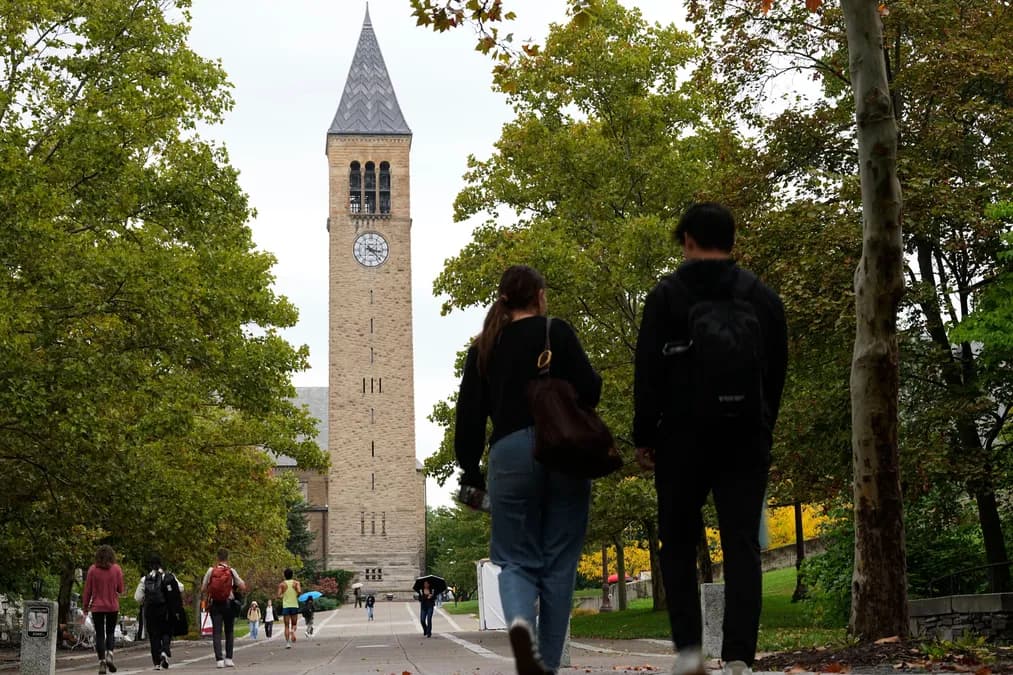
Cornell's Leadership Under Scrutiny After Gang Rape Allegations
One in five women experiences sexual assault during their college years, according to the Rape, Abuse & Incest National Network (RAINN). That statistic has rarely felt more pressing than it does now, as Cornell University finds itself at the center of a crisis that has drawn direct comment from its president. Michael I. Kotlikoff released a video statement in response to the Cornell gang rape allegations, acknowledging plainly that the university "must do better." The statement was unambiguous in its gravity: "This is a defining moment in Cornell's history," Kotlikoff said.
For an institution of Cornell's stature — a member of the Ivy League with a global reputation for academic rigor and research excellence — words like those carry institutional weight. They also carry an obligation. When a university president publicly frames a sexual violence crisis as a defining historical moment, the administration has, whether intentionally or not, set a benchmark against which every subsequent decision will be measured.
The question that now hangs over Ithaca is not whether Cornell's leadership recognizes the seriousness of the allegations. Kotlikoff's statement makes clear that they do. The question is whether recognition will be followed by the systemic, survivor-centered reform that moments like this demand.
A 'Defining Moment': What That Phrase Signals to Survivors and the Campus Community

Language matters enormously in the aftermath of sexual violence. When a university president calls something a "defining moment," survivors and advocates hear both an acknowledgment and a promise — and they have learned, through decades of institutional failures at schools from Baylor to Michigan State, to be cautious about both.
Read next Medicaid Work Requirements Strand Cancer SurvivorsThe phrase signals that leadership understands the stakes have shifted. It suggests awareness that the institution's credibility is in the balance. But for survivors navigating a campus in the wake of gang rape allegations, presidential rhetoric is not a resolution. It is an invitation — to watch, to demand, and, if necessary, to hold administrators to account.
Advocacy organizations such as Know Your IX and End Rape on Campus have consistently documented the gap between university statements and university action. Both groups have tracked cases where formal declarations of commitment to survivor safety were followed by inadequate investigations, retaliatory treatment of complainants, or disciplinary processes that prioritized institutional reputation over accountability. Cornell's moment is not unique in its genesis. What remains to be seen is whether its response will be.
The Cornell gang rape allegations have surfaced a dynamic familiar to anyone who works in campus sexual violence policy: the tension between a university's instinct toward self-protection and its legal and moral obligation to protect its students.
What University Leaders Are Expected to Do When Allegations Emerge

Title IX of the Education Amendments of 1972 prohibits sex-based discrimination in any educational program or activity receiving federal financial assistance. Under binding guidance from the Department of Education's Office for Civil Rights, universities are required to respond promptly and equitably when they receive notice of sexual harassment or assault — including gang rape allegations.
The regulatory framework is specific. Schools must offer supportive measures to complainants, conduct a fair and impartial grievance process, and ensure that decision-makers are free from conflicts of interest. The 2022 proposed rules under the Biden administration further reinforced the expectation that schools must not create a hostile environment through inaction. Failure to comply can trigger federal investigations, loss of funding, and public accountability proceedings.
Beyond the regulatory baseline, higher education policy experts argue that truly effective institutional responses require proactive infrastructure — not just reactive compliance. That means trained investigators, accessible counseling, transparent reporting systems, and survivor advocates who operate independently of university administration. It means ensuring that the campus adjudication process does not feel like a second assault.
A university president's video statement, however genuine, is the beginning of this process. It is not the end.
Campus Sexual Violence: A Persistent Challenge Across Higher Education
The Cornell gang rape allegations exist within a pattern that has been documented with clinical precision. The Centers for Disease Control and Prevention reports that approximately 26 percent of female undergraduate students and 6.8 percent of male undergraduate students experience rape or sexual assault through physical force, violence, or incapacitation. Among transgender, genderqueer, and nonbinary students, the rates are even higher.
Gang rape specifically — which involves coordinated perpetration and often occurs in fraternity or party contexts — carries particular psychological severity for survivors and particular institutional risk for universities. Research published in peer-reviewed journals has consistently found that gang rape is associated with higher rates of victim-blaming, lower rates of formal reporting, and greater organizational cover when perpetrators belong to recognized campus groups.
The cases that have reshaped American higher education's relationship with sexual violence — Penn State, Baylor, Michigan State — share a common thread: the institution prioritized its own continuity over the safety of the people it was supposed to protect. In each case, the cover-up metastasized into a far greater crisis than the original incidents might have produced had they been handled with transparency.
Cornell's administration now faces the same structural choice that confronts every university when allegations of this gravity emerge. The decision made in the coming weeks and months will define not the allegations themselves, but the institution's character.
What 'Doing Better' Actually Requires at Cornell and Beyond
"Must do better" is a phrase that demands a definition. President Kotlikoff's statement offered a commitment without yet specifying its content. That specificity will be where accountability lives or dies.
Doing better, at a minimum, means ensuring that any formal investigation into the Cornell gang rape allegations is independent, adequately resourced, and transparent in its process to the extent permitted by privacy law. It means centering the needs of the survivors throughout — not as a public relations posture, but as an operational commitment. It means making clear to every student on campus that reporting sexual violence will not result in retaliation, dismissal, or institutional indifference.
End Rape on Campus, which has provided direct support to survivors at dozens of institutions, has outlined what substantive reform looks like in practice: mandatory bystander intervention training with teeth, survivor advisory boards with genuine influence over policy, and annual transparency reports that track the outcomes of sexual misconduct proceedings. These are not radical demands. They are baseline expectations in a sector that has had decades to learn from its failures.
For Cornell, doing better also requires examining the structural conditions — housing arrangements, social hierarchies, alcohol culture, and reporting barriers — that create environments where gang rape can occur and go unreported. A statement from the president's office addresses none of that on its own.
Why Institutional Credibility Hinges on Action, Not Rhetoric
Universities are credibility-dependent institutions. Their value proposition rests on the assumption that they are environments where students are educated, supported, and protected. When gang rape allegations breach that assumption, the damage to credibility is not merely reputational. It is functional. Students — particularly women, LGBTQ+ students, and others at elevated risk — make enrollment decisions based on perceived campus safety. Faculty make hiring decisions. Donors make giving decisions. All of those calculations now involve Cornell's response to this crisis.
President Kotlikoff's framing of a "defining moment" is, in that sense, accurate. Defining moments are not defined by the words spoken during them. They are defined by what institutions do after the cameras stop rolling and the news cycle moves on. The survivors at the center of the Cornell gang rape allegations will still be living with the consequences of those allegations long after the university's official response has been filed and archived.
What Cornell does in the months ahead — not what it says — will determine whether this moment is defined by accountability or by the kind of institutional failure that has preceded it at so many other campuses. The benchmark has been set in plain language, by the president himself. Meeting it is now the only option that matters.
Source: NPR Topics: News