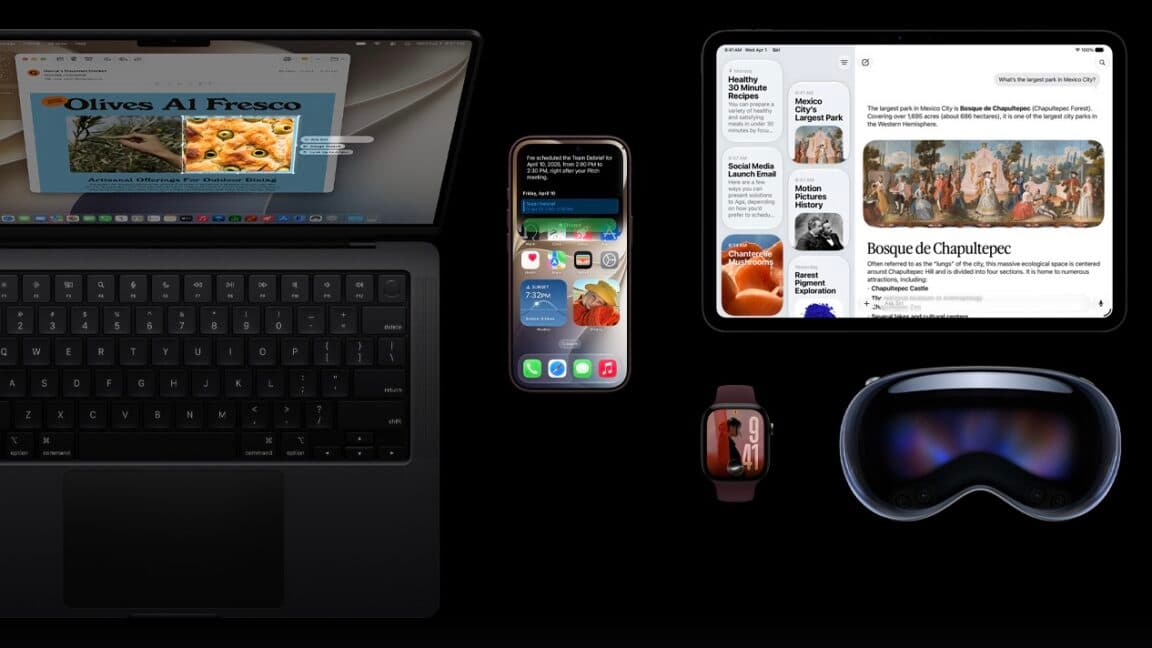
Apple shipped five operating system updates on September 14, 2026, and one of them contains the most consequential change to the iPhone in years. iOS 27, macOS 27 Golden Gate, watchOS 27, visionOS 27, and tvOS 27 all arrived today, and Siri AI—a large language model-based, context-aware rebuild of Apple's long-struggling assistant—sits at the center of every one of them except tvOS. That exception is telling. Apple has spent a decade and a half defending Siri's limits; now it is leading its entire platform strategy with the assistant.
iOS 27 Is Official: What Apple Released Today
Five platforms, one flagship feature. Apple released iOS 27, macOS 27 Golden Gate, watchOS 27, visionOS 27, and tvOS 27 simultaneously, continuing the company's practice of synchronized fall releases that dates back to the 2013 rollout of iOS 7 and OS X Mavericks. The company had previously signaled this release window, and today's launch confirms the schedule held.
The headline item across four of the five platforms is Siri AI, which Apple describes as a large language model-based overhaul of its voice and text assistant, and one that is now context-aware. That combination—LLM reasoning plus awareness of what the user is doing at any given moment—is the defining architectural shift in this release cycle.
tvOS 27 stands apart. Apple's set-top platform does not receive Siri AI in this wave, a gap worth noting given that the Apple TV box has historically been one of the most natural homes for voice interaction. Whether that omission reflects hardware constraints, a staged rollout, or a different roadmap for the living room is not something today's release clarifies.
What matters for the roughly 1.4 billion active iPhone users Apple reported in its most recent fiscal disclosures is simpler: the update is free, it is available now, and it touches the software layer users interact with hundreds of times a day.
The New LLM-Powered Siri: What Changed and Why It Matters

Ask the old Siri "what's my sister's flight status, and can I still make the 6 p.m. train if I leave after pickup?" and you got a deflected web search. The premise of an LLM-based, context-aware assistant is that you get an actual answer, assembled from the flight data in your email, your calendar, and the drive time your phone already knows. That is the promise Apple is now shipping, and the difference between those two experiences is not incremental. It is categorical.
Read next Top Technology Trends in 2026 You Need to KnowThe old Siri was a command matcher. It mapped utterances onto a fixed library of intents, which is why it could set a timer flawlessly but stumble on anything requiring inference, memory, or multi-step reasoning. LLM-based assistants behave differently: they hold conversational context across turns, handle ambiguity, and combine information from multiple sources before responding. Applied to a phone that already holds a user's messages, calendar, location history, and photos, the ceiling is considerably higher than what Siri could reach on a good day.
Apple's framing of Siri AI as both voice and text matters too. The text interface places Siri in direct competition with typing into a chat window—the interaction pattern OpenAI normalized with ChatGPT and Google adopted with Gemini. On an iPhone, where typing is often faster than talking, a text-capable assistant is arguably the more important of the two modes.
Years in the Making: Apple's Long Road to AI Siri

Siri debuted in October 2011, bundled with the iPhone 4S. For its first few years it was genuinely ahead of anything on a phone. Then the gap closed, and eventually it inverted.
ChatGPT's public launch in November 2022 reset user expectations for what a conversational assistant could do. Within roughly 100 days it reached an estimated 100 million users, a adoption pace academic research later described as unprecedented for a consumer application. Google moved quickly to fold Gemini into its products, and by 2024 both Samsung and Google were marketing generative AI as a primary reason to buy a flagship Android phone.
Apple's position during that stretch was awkward. The company shipped incremental Siri improvements while its competitors shipped assistants that could draft, summarize, reason, and hold a thread. Industry analysts at firms including Gartner and IDC repeatedly identified on-device AI capability as a top-three factor in premium smartphone purchase decisions—which made Apple's lag a commercial problem, not just a reputational one. Siri became the standard example critics reached for when arguing Apple had missed a platform shift.
The delays that preceded today's release were widely reported and, by Apple's own standards, unusually long. An LLM Siri slipping multiple times signaled how hard it is to retrofit a stateless command system into a reasoning engine without breaking the privacy posture Apple has sold for years. That tension—between cloud-scale models and on-device processing—is almost certainly the reason the rebuild took as long as it did. Today's release is the resolution of that tension, or at least Apple's first public attempt at one.
Liquid Glass Refinements and Other iOS 27 Highlights
Apple is describing the design language work in iOS 27 as refinements to Liquid Glass rather than a new direction. That word choice is deliberate. Major visual overhauls tend to generate more complaints than gratitude in year one, and Apple has historically spent the second and third cycles sanding down edges—iOS 7's flat design took until iOS 9 to feel settled, and the notch-era layout adjustments played out similarly.
Refinement, in practice, means legibility, contrast, and consistency work on a translucent interface layer, plus the performance tuning that always accompanies it. The reported summary does not enumerate specific changes, but the framing tells you what Apple wants users to expect: the same interface, less friction.
Alongside Siri AI and the design polish, iOS 27 continues Apple's pattern of spreading features across the device ecosystem—which is precisely why watchOS 27 and visionOS 27 also gain Siri AI. On Apple Watch, an LLM assistant that understands abbreviated, half-spoken requests is a meaningful upgrade over one that demands precise phrasing. On Vision Pro, where voice and gaze are already primary inputs, context-aware Siri is closer to a necessity than a bonus.
The tvOS omission stands out by contrast. Apple TV is a device people talk at while sitting on a couch with their hands full—exactly the profile Siri AI is designed for. Its absence suggests either a technical constraint or a deliberate sequencing decision, and neither is explained in today's announcement.
Should You Update? Compatibility and Practical Advice
Approximately 80 percent of actively used iPhones run an OS release less than two years old, based on Apple's long-standing developer-relations figures—a adoption rate Android manufacturers have never approached. That matters here because Apple's annual updates typically arrive for devices spanning five to seven hardware generations. If you're on hardware from the last several years, the update is almost certainly waiting for you in Settings.
Two practical cautions before you tap install. First, major annual releases arrive with bugs; the first point update historically lands within two to four weeks and resolves the worst of them. Second, LLM-based features are compute-hungry. Siri AI will run best on recent silicon, and users on older supported devices should expect the most demanding capabilities to be either throttled or absent.
For anyone whose daily workflow depends on Siri—car commutes, accessibility use, hands-free messaging—this release is worth installing promptly. For everyone else, waiting for iOS 27.1 is a defensible strategy with almost no downside.
What iOS 27's AI Siri Means for the Broader Smartphone Landscape
The premium smartphone market is now an AI feature race with roughly three credible entrants. Apple, Google, and Samsung each ship an LLM-native assistant tied to their hardware; Huawei and Xiaomi are pushing comparable features in China. When every flagship has a capable assistant, the assistant stops being a differentiator and becomes table stakes—and competition shifts to execution: latency, privacy, and how deeply the assistant is wired into the operating system.
That is where Apple's structural advantage lives. Google can match Apple on model capability, but nobody else controls the full stack the way Apple does—silicon, OS, assistant, and services. If context-aware Siri works as described, it will know things about a user's day that no third-party assistant can access, which is a moat built from integration rather than model benchmarks.
The risk is equally clear. Apple delayed this release for years while competitors shipped. Users who switched to ChatGPT or Gemini for everyday tasks are not guaranteed to come back, and a first-generation LLM assistant judged merely adequate will read as another Siri miss. Retention economics are unforgiving: switching costs between iOS and Android remain high, but switching costs between assistants are close to zero.
Today's release answers the question of whether Apple could ship an LLM Siri. The next twelve months answer whether it shipped one worth using.
Source: Ars Technica - All content


