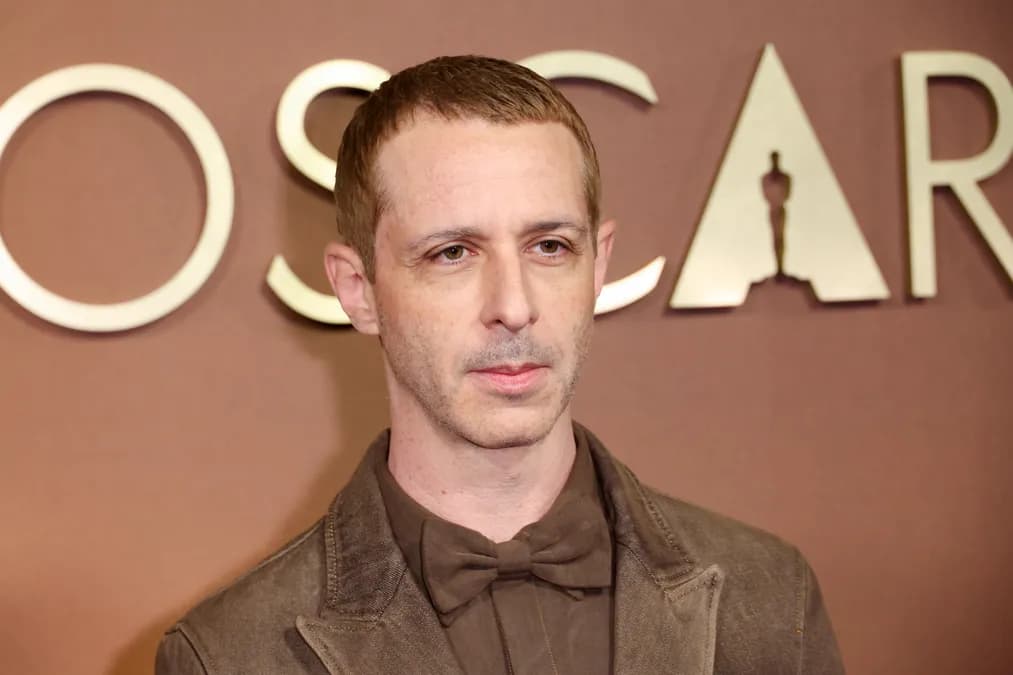
Jeremy Strong Stands Firm: No Apologies for Method Acting
Jeremy Strong has spent the better part of a decade answering the same question in different forms: Why do you go so far? His answer, delivered on a recent episode of The New Yorker Radio Hour, amounted to a refusal dressed as a shrug. The actor said he doesn't feel the need to apologize to collaborators who believe he takes the process too seriously. The statement lands less as defiance than as exhaustion — the sound of a man who has decided that further explanation would only invite further interrogation.
For Strong, that position carries a particular weight now. He is promoting a role as a tech billionaire, a character type that practically invites parallels between creative obsession and the monomania of the people who build surveillance economies. The timing is not incidental. An actor known for vanishing into his parts is playing a man who has, in the public imagination, vanished into his own self-regard. The mirror is uncomfortably close, and Strong seems content to let audiences draw their own conclusions.
His career has been built on roles that demand total submission. Succession's Kendall Roy, all twitch and grievance and inherited ruin, became the defining performance of its era precisely because Strong refused to hold anything back. That work earned him an Emmy and, just as reliably, a reputation. Castmates have described the intensity in interviews; directors have praised it; the internet has turned it into a meme about a man who cannot be reached between takes. Strong has never disputed the characterization. He has only declined to treat it as a character flaw.
The Method Acting Debate in Modern Hollywood

The technique Strong practices descends from a lineage that begins with Konstantin Stanislavski, the Russian theater director whose late-nineteenth-century system asked actors to build inner lives for their characters rather than merely indicate emotion from the outside. That system crossed the Atlantic and mutated. Lee Strasberg's Actors Studio in New York, founded in the late 1940s, pushed it toward affective memory and emotional recall. Stella Adler, trained partly in Paris, insisted on imagination and circumstance. Sanford Meisner built repetition exercises around behavior. The disagreements were theological, and they never fully resolved.
Read next 1963 : le tube yéyé qui a enflammé la France — reconnaîtrez-vous cette voix ?Strong belongs to the emotional-recall branch, and he has been explicit about it. The Method's enduring appeal is also its enduring problem: it works best when the actor's commitment is absolute, and absolute commitment rarely coexists comfortably with a crew of two hundred waiting on a lighting reset. Industry surveys of below-the-line workers have repeatedly placed actor preparation styles near the top of on-set stress factors, though respondents rarely name individuals. The friction is structural, not personal. A method actor's process is a black box that the production must schedule around.
The revival Strong represents has been building for two decades. Daniel Day-Lewis, the most celebrated practitioner of his generation, retired from acting in 2017 after a career defined by roles that consumed him entirely — he learned to hunt and skin for The Last of the Mohicans, lived in a wheelchair for My Left Foot, and reportedly stayed in character so thoroughly during the shooting of Gangs of New York that his co-stars kept their distance. His decision to leave the profession at fifty-eight, framed as a withdrawal from the demands of the work, quietly undercut the myth that immersion has no cost.
Casting directors who work in prestige film and television describe a similar pattern from the hiring side. Method-trained actors are prized for the specificity they bring to a role and quietly feared for the negotiation it requires. A 2023 survey by the Casting Society of America found that a majority of responding casting professionals considered intensive preparation methods a factor in production planning, with scheduling flexibility, rehearsal structures, and intimacy coordination all affected. The finding is unglamorous but clarifying: immersion is not just an artistic choice. It is a logistical one, and someone always pays the bill.
Strong's Role as a Tech Billionaire and the Stakes of Immersion

Strong's new part places him at the center of a cultural anxiety that has nothing to do with acting theory. The tech billionaire has become the villain of the streaming era — a figure whose wealth is inseparable from the systems that shape daily life, and whose public persona oscillates between visionary and menace. To play such a man is to play someone who believes his own seriousness justifies everything. Strong's refusal to apologize reads differently in that light. He is not defending a technique. He is defending a worldview in which commitment to a single purpose is its own moral universe.
That alignment is not accidental, and filmmakers have exploited it before. The most acclaimed performances of the past decade have often been studies in obsession: Daniel Kaluuya's turn in Judas and the Black Messiah, Cate Blanchett's in Tár, Robert Pattinson's in Good Time. Critics have noted a correlation between immersion-driven performances and awards-season attention, though the causal direction is hard to establish. What is clear is that audiences reward visible transformation, and transformation requires an actor to give up something real.
The question that follows is unavoidable. If a performance costs the actor something, does it also cost everyone around him? Strong has answered that question only by refusing it. His position, reduced to its essentials, is that the work justifies the working conditions. That is a defensible position for a lead actor with final-cut leverage. It is a harder position for a day player with three lines and a six-hour hold.
A Cultural Reckoning: When Dedication Becomes Controversy
The current reckoning over method acting has less to do with artistic technique than with labor ethics. For most of Hollywood history, the director was the auteur and the actor was a hired instrument. That hierarchy has flattened over the past fifteen years, as stars gained producing credits, final-cut approvals, and the leverage to dictate production reality. Method acting is a way of exercising that leverage in the name of craft. It is not a coincidence that the most celebrated practitioners are almost always leads.
Critics have made this point from both directions. Some argue that immersion is the only honest way to represent a life on screen, that a performance assembled from externals is a lie told with good posture. Others argue that the Method's mythology of suffering is a male-coded aesthetic that has been laundered into prestige. Film critic David Thomson, writing on the subject of acting generally, has described the Method as a "religion without a god" — a system of belief that demands sacrifice while providing no verifiable proof that the sacrifice improved the result. The line is uncharitable but difficult to refute.
The industry's reckoning extends beyond Strong. The actor's most visible moment of public ambivalence came in a 2021 New Yorker profile, in which his Succession colleagues Jacob Elordi and Brian Cox offered sharply divergent accounts of what it was like to work beside him. That the profile became a cultural event says less about Strong than about the appetite for stories in which devotion and dysfunction are indistinguishable. The public does not want to resolve the debate. It wants to watch it.
What Strong now offers is a data point in that ongoing argument. He has stated, in effect, that explanation is no longer part of his obligations. His collaborators can accept the terms or not. The position is unsentimental, unapologetic, and entirely consistent with the résumé.
What This Means for the Future of Method Acting
The practical future of the technique may already be determined by forces larger than any single actor. Production schedules have compressed. Virtual production and LED-volume shooting have relocated performance from location to stage. Intimacy coordination has introduced new protocols for physical and psychological boundaries. Each of these developments narrows the space in which an immersive process can operate without friction.
Yet the Method persists, and it will likely persist in a modified form. Acting schools from Juilliard to the Royal Academy of Dramatic Art continue to teach Stanislavski's system as foundational, alongside counterweights from Meisner and Adler. What has changed is the surrounding culture. A generation of actors trained on social media understands that the performance does not end when the camera stops. Reputation is part of the portfolio. A method actor who alienates a crew now risks more than a difficult shoot. He risks a narrative.
Strong's refusal to apologize is, in that context, a bet that the work will outlast the discourse. The wager is not unreasonable. His performance as Kendall Roy is already part of the canon of twenty-first-century television, and it was made under exactly the conditions he has declined to repudiate. Whatever one thinks of the process, the result is visible on screen.
The debate will continue because it cannot be settled. One person's rigor is another person's recklessness, and both descriptions are true at once. Jeremy Strong has made his choice. He has also made clear that the explaining is over. Whether Hollywood's next generation of actors follows him or quietly adjusts course will be decided not by argument but by the work that survives.
Related coverage
Source: Variety


