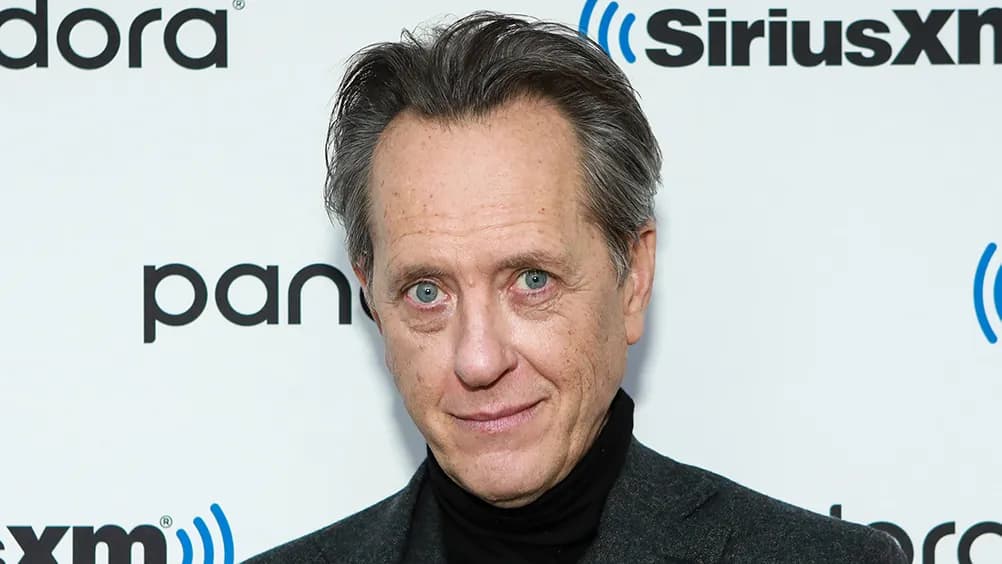
The first rule of The Traitors is that you do not talk about being a Traitor. Richard E. Grant, a man who has spent four decades performing other people's secrets with precision, broke that rule inside the first episode of Celebrity Traitors — and he knew it almost the instant the words left his mouth.
Richard E. Grant's Self-Inflicted Downfall on Celebrity Traitors
The U.K. version of The Traitors has become something close to a national ritual. The BBC's inaugural Celebrity Traitors season drew consolidated audiences in the range of 8 to 9 million viewers per episode in the U.K., with the finale peaking above 10 million — numbers that place it alongside the biggest entertainment events on British television in the past decade. For context, that is roughly the same audience share commanded by the most-watched Christmas Day specials, and it made the celebrity edition one of the most-discussed nonfiction programs on British social media during its run. When a show operates at that scale, every misstep is magnified. Grant's came early enough to be replayed in every recap package for the rest of the season.
According to Variety, Grant was selected in the opening episode as one of the two original Traitors, joined by Love Island host Maya Jama. The premise of the format — adapted from the Dutch series De Verraders and produced in the U.K. by Studio Lambert — asks a subset of players to deceive the rest while completing missions, avoiding banishment by the group, and surviving to the end. Traitors must lie fluently, repeatedly, and under constant observation by people who are actively hunting for inconsistencies. Faithfuls only have to tell the truth.
Grant, by his own account, could not hold the line. He described the moment as the "biggest mistake I've made in my life" — a phrase that lands with a particular weight coming from an actor whose career has spanned Withnail & I, Gosford Park, and an Oscar-nominated turn in Can You Ever Forgive Me? — a film, incidentally, about a woman who forges literary letters and is ultimately undone by her own compulsions. The irony is not lost on anyone who has seen it.
The 'Biggest Mistake of My Life': Grant's Own Words
Grant's self-assessment is unusually blunt for a celebrity promotional cycle. Reality contestants typically describe their exits as "a tough call" or "a learning experience." Grant went straight to the superlative: the biggest mistake of his life. That register tells you something about how the betrayal registered internally — not as a game move gone wrong, but as a personal failure of the kind he has spent his career examining in other people's characters.
Read next 1963 : le tube yéyé qui a enflammé la France — reconnaîtrez-vous cette voix ?There is a documented pattern here. Grant has spoken and written extensively — across interviews, his published diaries, and his memoir-adjacent collections — about his instinct toward over-disclosure and his discomfort with concealment. He has described himself as someone who processes anxiety by narrating it. That temperament is an asset in confessional acting and in the kind of press tour where charm depends on apparent spontaneity. It is close to disqualifying in a game built on sustained deception.
Social psychologists who study deception have a term for what likely happened: cognitive load. Lying is more mentally expensive than truth-telling because it requires simultaneously constructing a false narrative, monitoring the listener for skepticism, suppressing the impulse to correct the record, and remembering what you have already claimed. Research associated with the University of Portsmouth's psychology department and the broader deception-detection literature has repeatedly shown that this load degrades performance on secondary tasks — and that it intensifies when the liar believes they are being watched. On The Traitors, players are always being watched.
Maya Jama and the Traitors Alliance
Grant entered the game with a co-Traitor who is, by professional training, almost his inverse. Jama built her public reputation hosting Love Island, a format that requires her to manage live emotional volatility, read group dynamics in real time, and maintain a composed public-facing persona across months of production. She is practiced at the specific skill the Traitors need most: saying things on camera that are true to the moment while concealing what sits underneath.
The pairing, in other words, was structurally unbalanced from the start. Grant's instincts run toward candor; Jama's run toward calibrated disclosure. The format rewards the latter and punishes the former, and the punishment is delivered by the group. In The Traitors, Traitors are not eliminated by producers or by a judging panel — they are banished by a majority vote of fellow players who have spent the day parsing micro-behaviors. There is no appellate process. A single slip, observed by enough people, becomes consensus.
Variety's report does not detail how the alliance unfolded beyond that first choice, but the mechanics of the format make the stakes legible. Two Traitors who cannot coordinate their deception are more vulnerable than one Traitor operating alone, because each becomes a liability to the other. Grant's early admission effectively converted his co-Traitor's advantage into a shared exposure.
Why Celebrity Traitors Exposes Even Seasoned Performers
Actors are frequently assumed to be natural Traitors. The assumption is wrong, and the research explains why. Screen performance is scripted, rehearsed, and performed for an audience that has agreed to the fiction. Reality competition is unscripted, unrehearsed, and performed for an audience that is actively trying to detect the fiction and will vote on the basis of that detection. The skills overlap less than viewers assume.
There is a well-documented precedent in the U.S. celebrity edition of the same format, where accomplished performers have been banished in early rounds after overplaying their hand — behaving with the visible confidence of someone who believes they are controlling the room. Overconfidence is its own tell. So is underconfidence, and so is any deviation from a player's established baseline.
Grant's dilemma was more specific. He was cast in a role he did not want, opposite a partner whose strengths did not complement his weaknesses, in a game that rewards sustained concealment. Trained actors are also, as a group, unusually attentive to how they are being perceived. That attentiveness can read as anxiety to a suspicious group. Watching Grant try not to look like a Traitor, viewers were watching a man trying not to look like a man trying not to look like a Traitor — three layers of self-monitoring where a single truth would have sufficed.
Cultural Moment: What Grant's Gaffe Says About Reality TV
The most revealing thing about Grant's exit is not that he failed. It is that he described the failure in the language of personal regret rather than gameplay. That is a category error the format invites and then punishes.
The Traitors asks participants to treat deception as a tactic while the show's editing, music, and confessionals frame it as moral drama. Players are encouraged to feel things about lying, then eliminated for feeling them visibly. Grant, who has spent his career playing characters consumed by guilt — and who has written candidly about his own — walked into a machine designed to manufacture exactly that emotion and then broadcast it.
About 8 to 10 million people watch this happen in the U.K. That scale means the show functions less as a game and more as a recurring national experiment in what people do when honesty is a liability. The audience is not watching for the missions. It is watching for the moment a person's face admits something their mouth has not.
For Grant, that moment arrived in episode one. He called it the biggest mistake of his life. The more accurate description might be that he made the mistake the show was built to extract — and he made it before anyone had to work for it.
Source: Variety