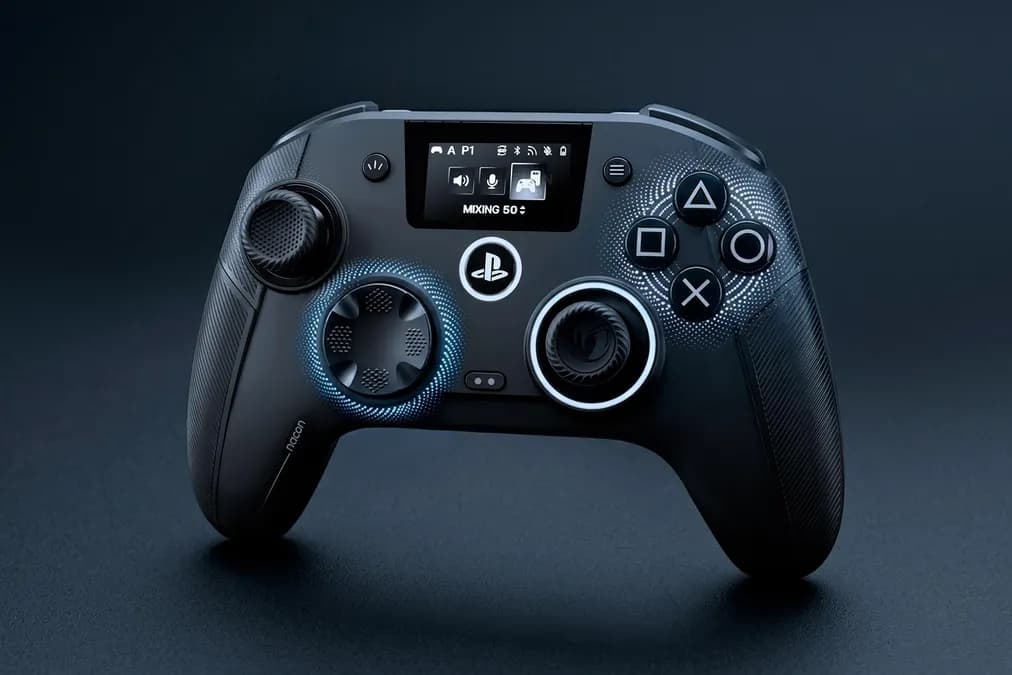
Nacon announced on October 2, 2026, that it has built what the company describes as the world's first officially licensed PlayStation 5 controller with a built-in display. The Nacon Revolution 5 Unlimited carries a screen that handles joystick sensitivity adjustments, button remapping, and — perhaps more intriguingly — audio mixing between a phone and a console. The announcement, reported by The Verge, positions Nacon against a small but growing field of premium PS5 peripherals, and it raises a question worth examining: what does a screen on a gamepad actually solve?
Nacon Revolution 5 Unlimited: The PS5 Controller with a Built-In Screen
Sony's licensing program has historically been a gatekeeper for third-party PlayStation hardware. Roughly 30 percent of PlayStation accessories sold at major North American retailers carry the official "PlayStation Licensed" mark, according to retail shelf-tracking data compiled by peripheral industry analysts — a figure that reflects how heavily both manufacturers and consumers rely on that badge. The badge is not cosmetic. Licensed products must pass Sony's compatibility testing, which covers everything from the DualSense's adaptive trigger resistance profiles to the console's firmware handshake during system updates. An unlicensed controller can work fine on launch day and break after a firmware patch three months later.
The Nacon Revolution 5 Unlimited enters that ecosystem with the licensed designation already attached. Nacon's earlier Revolution line — the Revolution Unlimited and Revolution Pro controllers for PS4 and PS5 — established the brand as a maker of modular, tournament-oriented gamepads with swappable sticks and weights. The Revolution 5 Unlimited extends that lineage with one addition no competitor in the licensed PS5 space has shipped: an onboard screen.
It is worth being precise about what Nacon has and has not said. The company's October 2026 announcement confirmed the screen's existence and its two headline functions — settings adjustment and audio mixing. Nacon did not, in the reported materials, disclose screen size, resolution, price, or a release date. No hands-on impressions exist yet. Everything below is framed around what has been officially reported.
The Built-In Screen: Adjusting Settings Without Leaving Your Game
Consider a common scenario: you are three rounds into a ranked match, and your aim feels off. The right stick is drifting slightly, or the dead zone is too tight for the weapon you just picked up. On a standard DualSense, fixing that means opening the PS5's settings menu, navigating to accessories, and interrupting your session. On a DualSense Edge, Sony's $199 pro controller, you can remap buttons and adjust stick sensitivity through an on-screen menu — but you still go through the console's interface, and your game keeps running behind it.
Read next Laika's Wildwood: Stop-Motion Fantasy at TIFF 2026The Nacon Revolution 5 Unlimited's screen moves that adjustment onto the controller itself. The reported function set covers joystick sensitivity and button remapping, both configurable directly on the gamepad. That matters more than it sounds. Competitive players routinely maintain multiple profiles — one for a twitch shooter, another for a racing game, a third for a fighting title — and switching between them on console hardware typically involves either menu dives or, on some third-party controllers, companion apps on a phone. Moving the controls to an integrated display shortens the loop from "pause, navigate, adjust, resume" to "glance down, tap, resume."
The broader pro controller market has validated this appetite for hardware-level customization. Scuf's Reflex line, which starts around $170 and climbs past $250 with options, built its reputation on mechanical remapping and trigger stops rather than software menus. Sony's DualSense Edge includes two back paddles, swappable stick modules, and four onboard profile slots. Nacon's screen is a different bet: instead of adding more physical controls, it adds an interface layer. Whether players prefer fiddling with a small display mid-session or keeping their eyes on the screen is an open question — one that hands-on testing will eventually answer.
Audio Mixing from Multiple Sources: Phone and Console in One Headset
The more unusual feature is the audio mixing. According to the reported announcement, the screen can blend audio from multiple sources, so a player wearing a headset can hear both console game audio and phone audio simultaneously. Nacon's framing suggests a scenario familiar to anyone who has tried to take a call during a raid: your phone rings, you either mute the game or fumble for a second device, and either way you lose situational awareness.
Multi-source audio mixing is not a new concept in streaming hardware. Capture cards and audio interfaces like the Elgato Wave XLR and GoXLR have offered software-based mixing for years, letting streamers blend game audio, microphone input, and chat into a single output. What Nacon is proposing is that same concept compressed into a controller — no PC, no capture card, no secondary device. If it works as described, a player could take a phone call through their gaming headset while continuing to hear footsteps, callouts, or race engine audio underneath.
The practical value depends on execution details Nacon has not yet published. Latency is the obvious concern: any audible delay between game audio and phone audio would make conversation awkward. The other question is whether mixing happens onboard the controller or through a companion app, and how volume balancing is controlled — presumably through the same screen that handles sensitivity settings, though Nacon has not confirmed that. For the moment, the feature is best understood as a promise rather than a demonstrated capability.
It is also worth noting what this means structurally. Once a controller becomes an audio routing device, it sits in the same signal chain as a DAC or a wireless headset base station. That puts Nacon in territory occupied by companies like SteelSeries and Astro, whose PS5-compatible headsets already handle multi-source mixing through their own base stations. The difference is that those solutions require buying a specific headset. Nacon's approach, per the announcement, works with a pair of headphones — which suggests broader compatibility, though again, specifics are pending.
What It Means to Be an Officially Licensed PlayStation 5 Controller
The "officially licensed" designation carries concrete implications that a spec sheet does not capture. Sony's partner program requires manufacturers to submit hardware for compatibility verification, and licensed products receive firmware support coordinated with PlayStation system updates. For consumers, that is the difference between a controller that still works after a console firmware revision and one that becomes a paperweight. Community forums for unlicensed third-party controllers are littered with reports of devices that functioned for months and then lost features — rumble, gyro, or wireless pairing — after a system update.
Licensing also shapes what a manufacturer can and cannot do. Licensed PS5 controllers must include certain baseline functionality to be recognized natively by the console; features beyond that baseline, like Nacon's screen, run through the manufacturer's own firmware and hardware. That is why the screen approach is notable: it is a self-contained feature that does not depend on Sony opening up new APIs. Nacon does not need PlayStation to support a screen. It needs the console to recognize the controller, and everything else happens in Nacon's own silicon.
For buyers, the licensed badge is a signal about longevity. Third-party accessories without it can be cheaper — often by 40 to 60 percent — but carry compatibility risk. Products in the licensed tier, including Nacon's prior Revolution controllers, Sony's DualSense Edge, and Scuf's official PS5 offerings, trade that discount for verified integration. The Revolution 5 Unlimited enters that tier with an unusual differentiator, but the tier itself is well established.
Who Should Consider the Revolution 5 Unlimited
The clearest fit is a player who already juggles two audio sources during sessions — someone who takes calls, listens to podcasts, or coordinates with teammates over a phone app while playing. For that person, a controller that merges both audio streams into one headset removes a genuine friction point. The second fit is the tinkerer: the player who adjusts stick curves and remaps buttons regularly and resents leaving the game to do it.
The less obvious fit is anyone who has been burned by unlicensed controllers. The licensing designation makes the Revolution 5 Unlimited a lower-risk purchase than a comparable no-name gamepad with similar features, regardless of what the screen does.
Two caveats apply. First, pricing and availability are unknown. Second, the feature set is announced, not demonstrated. Nacon has a track record in this category — its prior Revolution controllers reviewed competently, if not spectacularly — but a screen and an audio mixer are new engineering challenges, and no independent testing exists yet.
Frequently Asked Questions About the Nacon Revolution 5 Unlimited
When was the Nacon Revolution 5 Unlimited announced?
Nacon announced the controller on October 2, 2026, according to reporting by The Verge.
What makes it different from other PS5 controllers?
It is the first officially licensed PS5 controller with a built-in screen, per Nacon's claim, used for adjusting settings and mixing audio from multiple sources.
Can it really mix phone audio and console audio?
That is the announced function — a headset connected to the controller can, per Nacon, receive audio from more than one source simultaneously.
Is it the same as the DualSense Edge?
No. The DualSense Edge is Sony's first-party pro controller, offering swappable stick modules and onboard profiles through the PlayStation interface. The Revolution 5 Unlimited is a third-party licensed controller whose differentiator is its integrated screen.
Does "officially licensed" guarantee it will work with future PS5 updates?
Licensed products undergo compatibility testing and receive firmware coordination with PlayStation updates, which is why the designation matters for long-term reliability — though Nacon has not published specific support commitments for this model.
How much will it cost, and when does it launch?
Nacon has not disclosed pricing or a release date in the reported announcement.
Source: The Verge