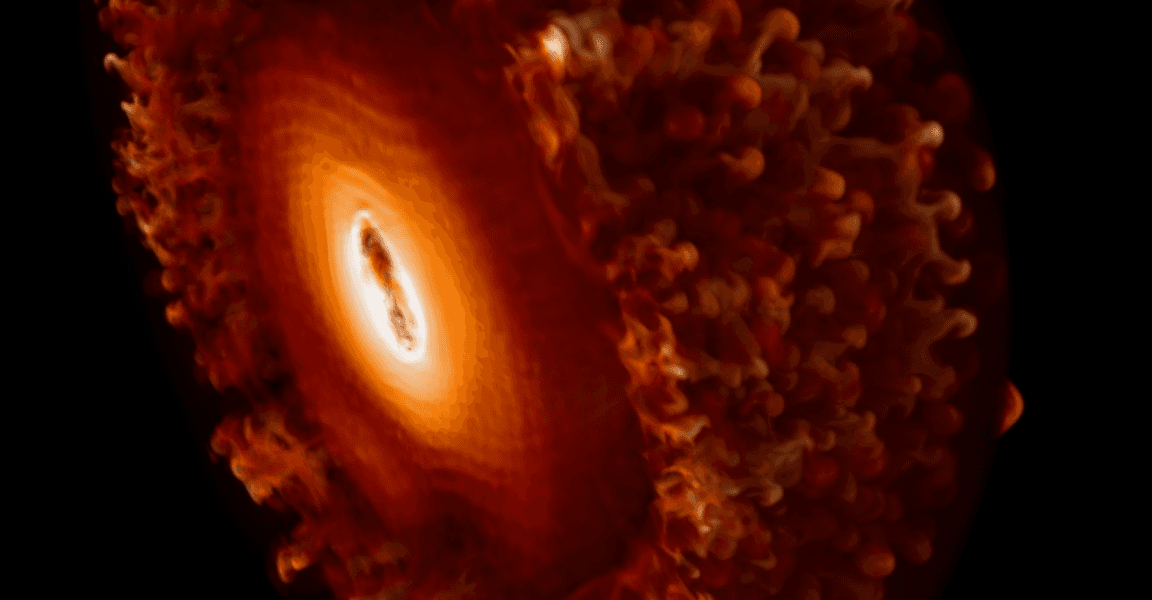
The physics of stellar death sounds deceptively simple. A massive star runs out of fuel, its core implodes under its own gravity, and the resulting shockwave tears the rest of the star apart in one of the most energetic events the universe produces. That sketch of core-collapse supernovae has held for decades. The problem is that the observational data keeps poking holes in it — and a new study published in Physical Review D, one of the most authoritative peer-reviewed journals in physics, suggests the culprit may be hiding in one of the strangest properties of the universe's most elusive particles: neutrinos.
Why Our Supernova Model Has a Neutrino-Shaped Gap
Every second, roughly 100 trillion neutrinos from the Sun pass through your body without interacting with a single atom. They are electrically neutral, nearly massless, and interact with ordinary matter only through the weak nuclear force — which is, as the name suggests, extremely weak. That makes them almost impossible to detect. It also makes them almost impossible to model with full confidence inside an exploding star.
Current theoretical frameworks for core-collapse supernovae treat neutrinos as critical energy couriers. When a stellar core collapses, it releases an enormous amount of gravitational energy — on the order of 10⁴⁶ joules — and the vast majority of that energy, roughly 99 percent, escapes in the form of neutrinos. Those neutrinos are supposed to deposit enough of their energy into the surrounding stellar material to drive the outward shockwave that produces the visible supernova explosion. Without that neutrino-driven kick, the shockwave stalls. The star doesn't explode. It just... collapses quietly.
And here is the observational tension: the statistics of supernovae we have actually recorded suggest that something is off with the standard model. The predicted rates and energy profiles don't always match what telescopes show. This discrepancy has long been recognized but remained unresolved. The new Physical Review D paper proposes a specific mechanism that current models have consistently overlooked — neutrino flavor oscillation — as a significant missing piece of the puzzle.
What Neutrino Flavor Oscillation Actually Means

Neutrinos come in three varieties, called flavors: electron neutrinos, muon neutrinos, and tau neutrinos. In the standard model of particle physics, these were long assumed to be distinct, fixed identities. A particle produced as an electron neutrino would travel across the cosmos and arrive, still, as an electron neutrino.
Read next Top Technology Trends in 2026 You Need to KnowThat turned out to be wrong. The discovery that neutrinos can spontaneously change from one flavor to another — a process called neutrino flavor oscillation supernova physicists now have to contend with — earned Takaaki Kajita and Arthur B. McDonald the 2015 Nobel Prize in Physics. Their experiments demonstrated that if neutrinos oscillate between flavors, they must have mass, contradicting the original standard model. This was a landmark revision in particle physics, confirming that the universe's rulebook needed an update.
The mechanics of oscillation arise from quantum mechanics. A neutrino doesn't travel through space in a pure flavor state; it travels as a superposition of mass states that correspond to different probabilities of being detected as each flavor. As the neutrino propagates, the relative phases of these mass states shift, and the probability of finding the particle in a given flavor changes over distance and time. Under normal conditions in space, this process is subtle and gradual.
Inside a supernova, however, conditions are anything but normal. The density of matter is extraordinarily high, and the flux of neutrinos is so intense that neutrinos are interacting not just with matter but with each other. This creates a feedback environment where the collective behavior of billions of neutrinos can drive rapid, coherent flavor transformations. These are sometimes called fast flavor instabilities or collective oscillation effects, and they can occur on timescales and length scales far shorter than those typically used in supernova simulations.
How Flavor-Swapping Neutrinos Could Change Everything

The core problem is straightforward once you understand how the models are built. Simulations of core-collapse supernovae track how neutrinos of each flavor deposit energy into the stellar material. Electron neutrinos and their antiparticles interact more readily with protons and neutrons than muon or tau neutrinos do. If you swap a significant fraction of your electron neutrino population into muon or tau neutrinos mid-journey, you fundamentally alter how much energy gets transferred to the shockwave material — and where.
That change in energy deposition could be the difference between a successful supernova explosion and a failed one. It could also alter the composition of the material ejected into space, since the ratio of neutrons to protons in the outgoing material is partly governed by neutrino-induced reactions. This matters for nucleosynthesis — the production of heavy elements that eventually get incorporated into new stars, planets, and, eventually, biochemistry.
The Physical Review D study brings this possibility into sharper focus. By modeling what happens when neutrino flavor oscillation supernova dynamics are included in the overall energy-transfer equations, the authors find that the effects are not negligible. Treating neutrinos as fixed-flavor particles — as the overwhelming majority of published simulations still do — is, according to this work, a significant approximation that may account for some of the tension between theoretical predictions and observational data.
This is not a fringe suggestion. The theoretical groundwork for collective neutrino oscillations in dense astrophysical environments has been developing for years, and consensus is building that these effects are real and consequential. The challenge has been computational: fully including quantum oscillation dynamics in a three-dimensional simulation of a collapsing star is extraordinarily demanding, and shortcuts have been necessary. The new paper represents a push to close that gap.
Unresolved Questions: Do All Core Collapses Produce Supernovae?
One of the thorniest uncertainties in supernova physics is whether every core collapse actually produces a visible explosion. The standard narrative assumes it does, but the observational evidence is ambiguous. Some studies have pointed to a population of "failed supernovae" — massive stars that simply disappear from optical surveys without a bright transient event, presumably having collapsed directly into black holes without generating a successful outward shock.
If a substantial fraction of core collapses produce no visible supernova, that has profound consequences for how we estimate star formation rates, black hole populations, and the chemical enrichment history of galaxies. Estimates of how often this might occur vary, and the uncertainties are large — but even a modest rate of failed supernovae would require significant revision of galactic evolution models.
This is where neutrino flavor oscillation supernova research intersects with the bigger picture. If flavor swapping affects the efficiency of neutrino energy deposition, it may determine whether any given core collapse sits above or below the threshold for a successful explosion. The same physical process that changes a star's fate from "spectacularly visible death" to "quiet collapse" might be governed in part by quantum oscillation effects happening on millisecond timescales inside the proto-neutron star.
The new Physical Review D paper doesn't resolve this question — it sharpens it. It provides a mechanism, grounded in established particle physics, that could explain why our models have struggled to reproduce the observed statistics of stellar death.
Implications for Astrophysics and Future Observations
Pinning down the role of neutrino flavor oscillation supernova dynamics requires two things working in concert: better simulations and better detectors. On the computational side, the astrophysics community is pushing toward simulations that can incorporate quantum neutrino transport without the extreme simplifications currently required. This is a hard problem; the relevant physics spans many orders of magnitude in scale simultaneously.
On the observational side, the next nearby supernova — whenever it happens — will be an extraordinary opportunity. Detectors like IceCube at the South Pole and Super-Kamiokande in Japan are specifically designed to capture the neutrino burst that arrives before any optical signal from a collapsing star. A sufficiently close supernova would allow physicists to study the neutrino flux in real time, potentially revealing the fingerprints of flavor oscillation directly in the data. The last such event close enough to detect was Supernova 1987A in the Large Magellanic Cloud, whose neutrino burst was captured by three separate detectors — a landmark moment that confirmed the basic neutrino-driven model but left plenty of open questions.
The Physical Review D study adds a specific, testable prediction to that list of open questions. It points toward a part of supernova physics that has been sitting in plain sight, largely set aside for computational convenience, and argues that the consequences of ignoring it are significant. The fundamental model of stellar death may be correct in its broad strokes. But inside the collapsing core, neutrinos are quietly swapping identities — and that, it turns out, may matter enormously.
Source: Ars Technica - All content


