Oracle's 2 GW Renewable Energy Pledge Explained
Two gigawatts. That is enough electricity to power roughly 1.5 million average American homes, and on September 8, Oracle asked the renewable energy industry to help it find that capacity. The company issued a solicitation for proposals to develop 2 GW of renewable generation tied to its New Mexico operations, framing the move as an effort to match the emissions of the Project Jupiter data center it is building for OpenAI.
The timing matters as much as the number. Oracle Stargate data center renewables spending would represent one of the largest single corporate renewable procurement requests in the country's history if fully realized. For scale, the entire state of New Mexico had about 1.9 GW of installed utility-scale solar capacity as of recent federal tracking, according to U.S. Energy Information Administration data. Oracle's request roughly equals that fleet.
But the announcement is a request for proposals, not a signed power purchase agreement. No projects have been selected, no construction timelines exist, and no contracts bind Oracle to the full 2 GW. The solicitation signals intent. It does not yet deliver electrons.
The structure Oracle chose also deserves scrutiny. Rather than contracting directly for power delivered to the data center, the company appears to be pursuing a matching arrangement — buying renewable energy credits or funding projects elsewhere on the grid to offset the emissions associated with its actual consumption. That distinction sits at the heart of the dispute now unfolding in southern New Mexico.
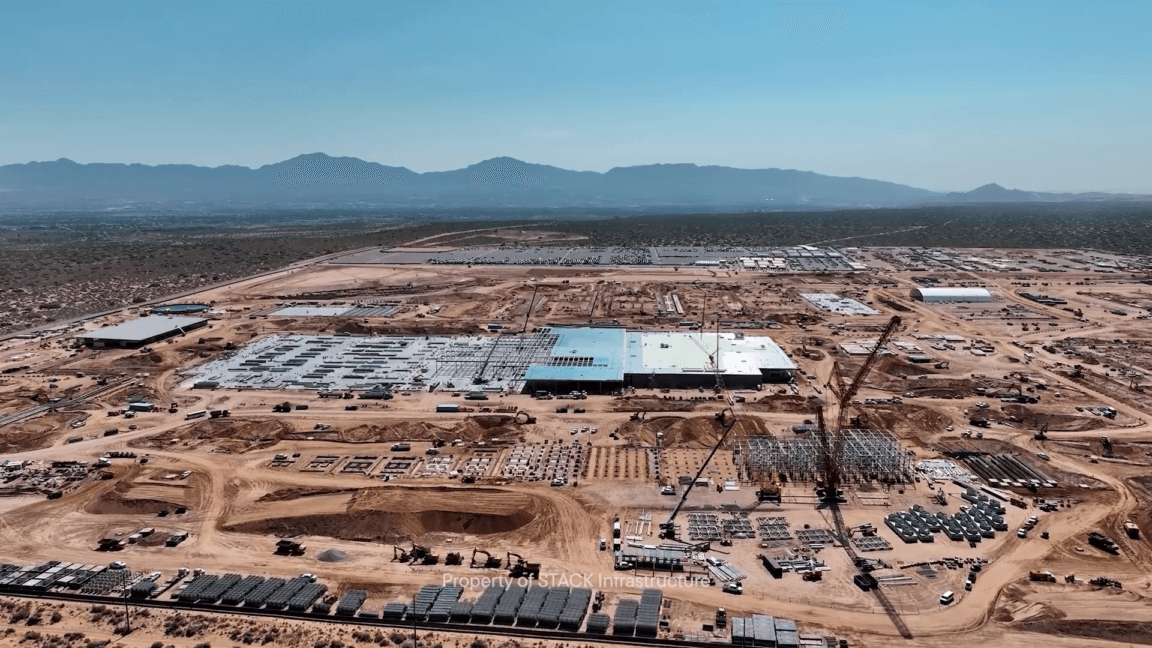
Project Jupiter: The Stargate Data Center at the Center of Controversy
The facility Oracle wants to offset carries a $165 billion price tag. Project Jupiter, under development in Santa Teresa, New Mexico, is a joint venture between Oracle and OpenAI and forms part of the broader Stargate AI infrastructure initiative that President Donald Trump announced in 2025. The program positioned itself as a national answer to the compute demands of frontier AI models, and its price tags reflect the extraordinary capital now flowing into machine learning infrastructure.
Read next Top Technology Trends in 2026 You Need to KnowSanta Teresa sits in Doña Ana County, hard against the Mexican border and the El Paso metropolitan area. The location offers land, relatively cheap power, and proximity to interstate fiber routes. It also sits in a desert with constrained water resources — a fact that has animated much of the local resistance.
The numbers behind AI data centers explain why projects of this size keep appearing. Data centers already consume roughly 4 percent of all electricity generated in the United States, according to the Department of Energy's Lawrence Berkeley National Laboratory, and that share is projected to climb sharply by the end of the decade as AI training and inference workloads expand. Some industry forecasts place data center demand growth at two to three times current levels by 2028. Each new gigawatt-scale campus adds pressure to grids that in many regions have not added major generation in years.
Local Opposition and Environmental Concerns

Residents and advocacy groups in Doña Ana County have mounted protests and pursued court battles over Project Jupiter's environmental footprint. The objections center on several fronts: water consumption for cooling, air quality impacts from on-site generation, strain on regional electrical infrastructure, and what opponents describe as an insufficient environmental review process.
This pattern is not unique to New Mexico. Data center fights have intensified across the country — in Georgia, Virginia, Arizona, and Wisconsin — as communities weigh tax revenue and construction jobs against water drawdowns, noise, and rising utility bills. In some jurisdictions, local governments have renegotiated tax abatement deals or imposed new water-use conditions. New Mexico's battle lines follow a familiar script, with the added dimension that Project Jupiter's power supply depends heavily on fossil generation.
Court challenges carry real risk for schedules. Litigation over permits and environmental impact statements can delay construction by months or years, and for a $165 billion build tied to OpenAI's model training roadmap, delay translates directly into competitive exposure. Oracle's renewables solicitation landed three days after the September 8 announcement date in the middle of that friction, which is difficult to read as coincidence.
The Natural Gas Problem: Why Critics Aren't Satisfied
Here is the tension at the core of Oracle's announcement: the renewable energy solicitation does not change how Project Jupiter will actually be powered. The data center will run on fuel cells that consume natural gas, according to reporting on the project. Those fuel cells provide firm, always-on power — the kind AI workloads need — but they emit carbon dioxide on site.
That gap between marketing and physics explains why the 2 GW pledge has not quieted opponents. Matching programs work by accounting, not by wire. When a company buys renewable energy credits, it pays for generation somewhere on the regional grid, and the physical electricity powering its facility may still come from a gas plant next door. The emissions reduction is real at the system level only to the extent the renewable project would not have been built otherwise — a concept known as additionality, and one that critics argue is rarely verified rigorously.
"Like all matching programs, this would be synthetic in the sense that 2 GW of renewables wouldn't directly power the data center," wrote Michael Thomas, CEO of the Cleanview data platform, which tracks renewable energy and data center projects, in a LinkedIn post responding to the announcement. Thomas's assessment captures the technical reality precisely: matching is an accounting instrument, and its environmental value depends entirely on how the credits are sourced and retired.
Oracle is not alone in this approach. Microsoft, Google, and Amazon have all relied on renewable energy certificates and power purchase agreements to claim carbon neutrality or reduction targets while their facilities draw from mixed grids. The Securities and Exchange Commission's climate disclosure rules, adopted in 2024 and subsequently challenged in court, sought to bring more rigor and transparency to exactly these claims. The regulatory environment remains unsettled.
Synthetic Renewables vs. Direct Clean Power: The Broader Industry Debate
The disagreement over matching programs is fundamentally a disagreement about what "powered by clean energy" means. Under one interpretation, a company that pays for 2 GW of renewable generation anywhere on its grid has neutralized its consumption. Under another, only electrons physically delivered to the facility, or generation that would not exist without the company's money, count as genuine progress.
The Environmental Protection Agency's Green Power Partnership program recognizes both approaches but distinguishes among them. Its tiers separate renewable energy certificates from on-site generation and from direct green power purchases. Data center operators have gravitated toward the certificate model because it is cheaper and faster than building generation, and because grid interconnection queues for new projects now stretch four to seven years in many regions, according to Berkeley Lab's interconnection queue tracking.
There is also a reliability argument. AI training runs require continuous, high-density power. Solar and wind are intermittent. Fuel cells burning natural gas provide constant output. Oracle can sign all the renewable contracts it wants, but the data center still needs firm capacity behind the meter — and in Santa Teresa, that capacity is gas. Nuclear and enhanced geothermal could change this calculus over the next decade, but neither is available in the time frame Project Jupiter requires.
The deeper question is whether offset-style procurement accelerates the energy transition or delays it by giving operators a cheaper alternative to direct investment in firm clean power. Evidence points in both directions. Corporate procurement has driven substantial renewable buildout — the business sector accounted for a large share of new U.S. wind and solar capacity added over the past decade, per American Clean Power Association data. But it has also allowed companies to make bold claims while their facilities run on fossil electrons.
What Comes Next for Stargate and Oracle in New Mexico
Oracle has not published a selection timeline for the 2 GW solicitation, and no developers have been named. Whether the company converts the request into binding contracts, and whether those contracts prioritize additionality over least-cost certificates, will determine how much the announcement actually changes Project Jupiter's environmental profile.
The litigation in Doña Ana County will proceed regardless. Court calendars do not move faster because a company issues a procurement request. The $165 billion investment remains exposed to permitting delays, and OpenAI's compute roadmap depends on capacity arriving on schedule.
For the broader Stargate program, New Mexico functions as a test case. If Oracle Stargate data center renewables procurement turns out to be a genuine 2 GW buildout with verifiable additionality, it becomes a template other operators can follow. If it becomes a certificate purchase dressed in gigawatt language, it will join a long list of corporate climate commitments that looked impressive in press releases and thin in practice. The fuel cells will burn gas either way. The question is what Oracle builds to compensate — and whether anyone will be able to verify it.
Source: Ars Technica - All content


