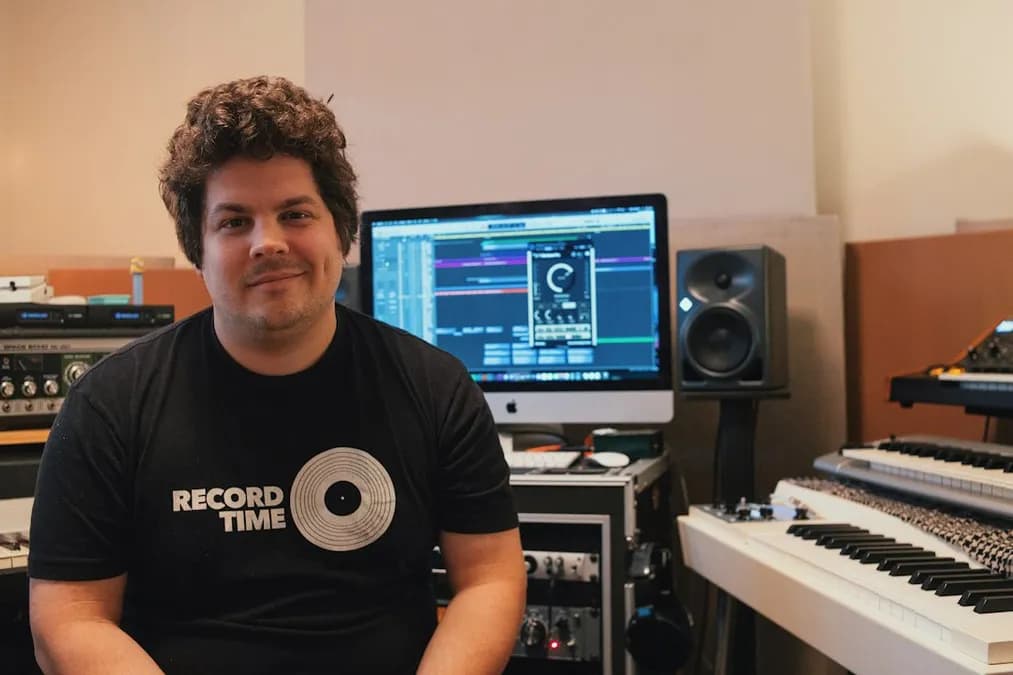
Sean Parker, who once taught the music industry what asking for forgiveness looks like, is now back with the labels' blessing and money. That single sentence, reported by TechCrunch on October 2, 2026, captures one of the more improbable reversals in recent tech history. The man who helped dismantle the record industry's distribution model as Napster's co-founder is now positioned as a partner to the very institutions he once disrupted — and he is doing it through Stability AI, the generative model company he has been steering through a difficult restructuring.
Sean Parker Returns to Music — This Time With the Labels on His Side
In 1999, Napster gave millions of users free access to music the labels had spent decades building into a licensing fortress. The Recording Industry Association of America sued within months. A federal court shut Napster down in 2001. Parker's next act, Facebook, made him a billionaire, but his reputation in music industry boardrooms remained toxic for years — a fact he has acknowledged publicly in interviews since.
The contrast in 2026 could hardly be sharper. According to TechCrunch, Parker is now rebuilding Stability AI around music, and he is doing so with the labels' explicit cooperation and their capital. That is not a small detail. It signals that rights holders have concluded they cannot litigate generative AI out of existence, and that working with a known quantity — even a controversial one — beats fighting an open-ended legal war.
The strategic logic runs deeper than Parker's personal redemption arc. Music rights holders spent 2024 and 2025 filing suit against generative AI companies over training data. Those cases remain unresolved or settled on undisclosed terms. Stability AI, which faced its own litigation pressure over image-generation training data, has an incentive to avoid repeating that fight in audio. Bringing labels in as partners rather than adversaries removes the most expensive legal risk from the business model.
What Stability AI's Music Pivot Actually Means
Goldman Sachs projected in a 2024 research note that generative AI could account for a meaningful share of global music revenue by 2030, with estimates in the tens of billions of dollars across creation tools, licensing, and distribution. The IFPI, in its 2025 Global Music Report, confirmed that global recorded music revenue had crossed $29 billion, with streaming growth flattening in mature markets. The industry needs new revenue lines. AI is the most plausible one.
Read next Laika's Wildwood: Stop-Motion Fantasy at TIFF 2026Stability AI's pivot is therefore not an opportunistic side project. It is a bet that licensed, label-approved AI music generation will become a standard production input — for film scoring, advertising, game soundtracks, and personalized audio. The technical challenge is substantial: music generation requires temporal coherence that image models do not, and rights clearance requires granular metadata that most catalogs still lack. But the commercial challenge is harder still, and that is where Parker's relationships matter.
What TechCrunch does not specify is the exact product architecture, revenue split, or which labels are participating. Readers should treat those specifics as unconfirmed until the company or its partners disclose them. What is confirmed is the direction: Stability AI is no longer positioning itself as a broad platform competing across image, video, and audio. It is narrowing toward music, where licensing deals can be structured and where a returning founder with scar tissue on both sides of the table can broker terms.
The Record Labels' Surprising Role in This Venture

Universal, Sony, and Warner have each signed AI-related agreements since 2024, though the terms of most remain private. The pattern is consistent: labels want consent-based training, artist opt-ins where contracts allow, and revenue participation. Stability AI's willingness to accept those terms — reportedly with label investment rather than merely label permission — is what distinguishes this arrangement from the adversarial posture taken by other AI developers.
That cooperation comes with strings. Labels historically have demanded approval rights over outputs that imitate identifiable artists. They have pushed for watermarking and provenance standards. Any Stability music tool built with their money will almost certainly embed those controls. For the labels, the calculation is straightforward: if AI music is coming regardless, better to own a piece of the pipe than to sue the water company.
Case in point: the 2024 settlement between the RIAA and several AI music startups established that training on copyrighted recordings without license carries real liability, and subsequent deals have trended toward licensing rather than fair-use defenses. Parker's return fits that arc. He is not the outside agitator this time. He is the intermediary the labels believe they can control.
Stability AI's Broader Struggles and Why Music Could Be Its Lifeline
Stability AI's recent history reads as a cautionary tale about generative AI economics. The company, best known for Stable Diffusion, cycled through leadership turmoil in 2024 after founder Emad Mostaque's departure. Reports at the time described strained finances, difficulty retaining research talent, and pressure from better-capitalized competitors including OpenAI, Midjourney, and Adobe. Compute costs for training frontier models are punishing, and Stability lacked the distribution advantages of a platform giant.
A narrow, licensed music business changes that equation. Music generation does not require the same gigascale training runs as frontier language models. Revenue can come from per-track licensing, enterprise API access, and label-partnered tools rather than consumer subscriptions alone. Most importantly, it offers a defensible moat: signed rights deals that competitors cannot replicate overnight. In that reading, the music pivot is less an expansion than a survival strategy — trading a commodity model business for a rights-mediated one.
What This Means for Artists, Creators, and the Future of AI Music
Session musicians, composers, and producers have watched AI tools move from novelty to nuisance in under three years. A 2024 study by the UK's Intellectual Property Office found that a majority of surveyed musicians were concerned about AI's impact on their income. Yet the same tools are already used in professional workflows for stem separation, mastering assistance, and ideation. The question is not whether AI enters music production. It is who gets paid when it does.
A label-backed Stability AI points toward a model where rights holders capture a share and, in theory, artists receive contractual pass-throughs. Whether those pass-throughs materialize depends on contract language most artists have never seen. Independent creators, meanwhile, may gain access to licensed generation tools that reduce legal exposure compared with unlicensed alternatives — but at a price and under usage terms set by majors.
The Bigger Picture: AI, IP Rights, and the New Music Economy
The Parker-Stability arrangement is a test case for a broader question: can generative AI be built inside the intellectual property system rather than around it? The image and text model world largely answered no, absorbing lawsuits and relying on fair-use arguments. Music, with its concentrated rights ownership and aggressive litigation history, may force a different answer. If licensed AI music proves commercially viable, it becomes a template for film, publishing, and software.
If it fails, it becomes evidence that rights clearance costs make generative AI in copyrighted domains unworkable at scale. Either outcome matters well beyond Stability AI. And either outcome will be read as a verdict on Parker's second act — the Napster founder who came back not to burn the house down, but to hold the deed.
Source: TechCrunch


