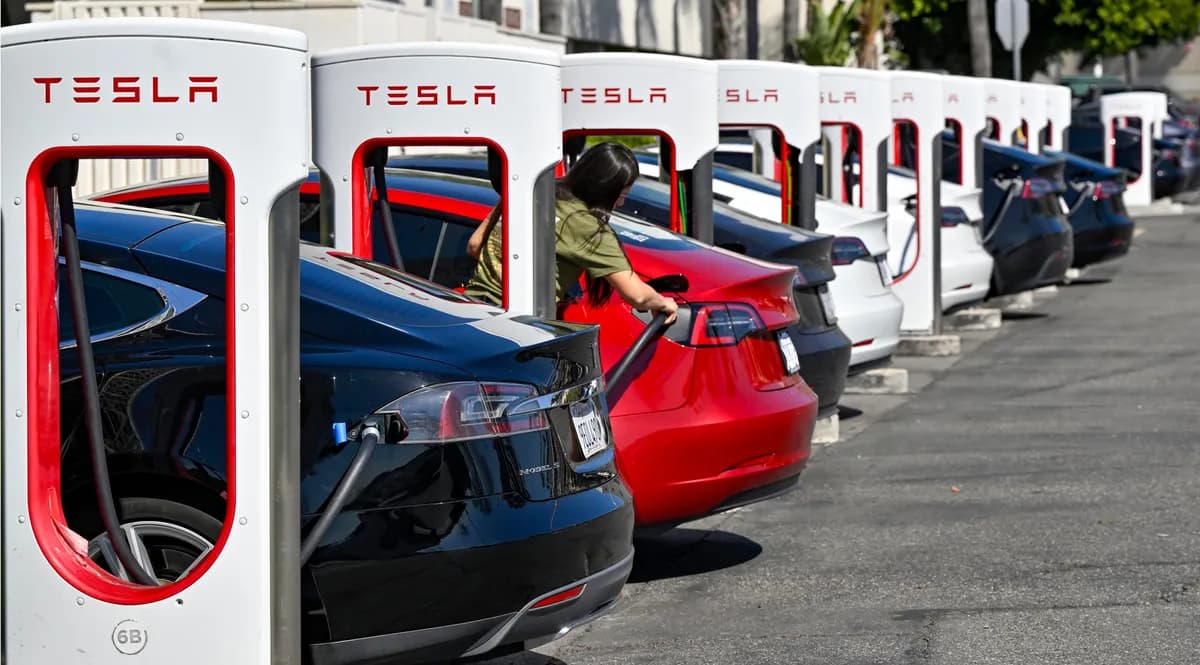
On a summer evening in Idaho, drivers plugged their Teslas into a bank of Superchargers and walked toward a nearby store. What happened next left four people dead and seven wounded — and turned a routine charging stop into the deadliest act of violence ever recorded at a public EV charging site. Now, two months later, Tesla is responding with a software feature that lets drivers pull away mid-charge when every second counts. The company calls it an emergency charging release, and it represents one of the first times a major automaker has redesigned a core vehicle function explicitly in response to a mass shooting.
Tesla's New Emergency Charging Release Feature Explained
Tesla's new Tesla emergency charging release feature directly addresses a safety gap that most drivers never think about. Under normal conditions, a Tesla disables the drivetrain and locks the connector to the charge port while the battery is drawing power. That design keeps the vehicle from rolling away with a live cable attached and protects both the car and the charging equipment. But it also means that during an emergency, a driver cannot simply press the accelerator and flee.
The emergency charging release changes that. When engaged, it lets the driver break the physical and software connection between vehicle and charger so the car can be driven off immediately, without first completing a manual stop-charge sequence. Tesla introduced the capability in response to the August shooting, according to reporting from The Verge, which confirmed that the feature was built specifically for situations where staying parked poses a greater risk than leaving abruptly.
The company has not published a full technical breakdown of how the release interacts with the locking pin, the onboard charger, or the high-voltage contactors. What is clear is the intent: Tesla wants owners to have an escape route that does not depend on a touchscreen menu or a phone app. In a crisis, the difference between fifteen seconds and two seconds can be the difference between getting out and not.
The Idaho Supercharger Shooting That Prompted the Change
In August, a gunman opened fire at a Supercharger location in Idaho. Four people were killed and seven were wounded, making it the worst violent incident tied to EV charging infrastructure on record. Victims were caught in an open, exposed environment — exactly the kind of setting where vehicles are stationary, occupants are distracted, and escape routes are not obvious.
Read next Laika's Wildwood: Stop-Motion Fantasy at TIFF 2026The Idaho attack fits a broader pattern that criminologists have studied for years: places where people are briefly but predictably immobilized become attractive targets for attackers seeking defenseless victims. Parking lots, transit platforms, and queue lines all share this trait. Charging stations add a new wrinkle because the vehicle itself becomes a temporary cage. The car is tethered, the software is in a restricted state, and the driver has been conditioned to wait.
Public safety researchers have long argued that product design shapes behavior during emergencies. Doors that cannot be opened from the inside, elevators that lock during fires, and cars that disable themselves at charging stalls all create the same problem: the moment a threat appears, users must solve a puzzle before they can move. Tesla's new feature does not prevent violence, and the company has not claimed it will. What it does is remove one artificial barrier between a driver and the exit.
Why EVs Lock the Charging Plug in the First Place
The locking mechanism exists for good reasons. During DC fast charging, hundreds of amps flow through the connector. If the plug were pulled while current was flowing, the result could be arcing, melted contacts, and a serious electrical hazard for anyone nearby. The interlock also prevents accidental disconnection that could damage the charge port, the cable, or the charger itself — repairs that can run into the thousands of dollars per incident.
Automotive safety engineers describe the lock as a fail-safe, not a convenience feature. It is part of a system designed around the assumption that drivers will behave normally and that the biggest risk is a mistake, not an attack. That assumption holds in the overwhelming majority of charging sessions. It breaks down in the rare cases where the threat comes from outside the vehicle.
Tesla's emergency release essentially introduces a second assumption: that sometimes the safer choice is to accept the mechanical and electrical risk of an abrupt disconnect in order to escape a greater danger. That trade-off is unusual in automotive engineering, where design decisions are typically optimized for the most probable scenario rather than the most catastrophic one. The Idaho shooting forced a reordering of those priorities.
Safety Implications for Tesla Drivers at Public Chargers
Tesla's Supercharger network is the largest fast-charging system in the world. The U.S. Department of Energy tracks tens of thousands of public DC fast-charging ports nationwide, and BloombergNEF has projected continued double-digit annual growth in public charging sessions as EV adoption climbs. Individual Supercharger stalls can log dozens of charging sessions per day at high-traffic locations, which means the total number of driver-minutes spent tethered to a cable is enormous.
That scale matters. Even extremely rare events become statistically inevitable when millions of charging sessions occur each year. The Idaho attack was an outlier, but it exposed a vulnerability that applies to every Tesla driver who has ever sat in a parked car at a public charger late at night. A single incident at a single site produced a product change that will now affect drivers across the entire fleet.
For drivers, the practical implications are straightforward. The emergency release gives them a physical and software path out of a bad situation. But it does not replace situational awareness. Safety experts consistently recommend parking in well-lit stalls, positioning the vehicle so it can exit without reversing into a crowd, and keeping doors unlocked while charging. The new feature adds a tool; it does not add a guarantee.
Broader Context: Public EV Charging Infrastructure and Security
Charging stations occupy an awkward position in the built environment. They are often located at the edges of parking lots, far from store entrances, with limited foot traffic and inconsistent camera coverage. That layout serves electrical infrastructure and land costs, not personal security. As EV adoption grows, the number of people who spend time in these spaces will grow with it.
The Idaho shooting is likely to accelerate a conversation that has been building quietly among urban planners and public safety officials: how to design charging sites that are both functional and defensible. That could mean better lighting, emergency call buttons, clearer sightlines, and coordinated response protocols with local law enforcement. Some of those changes fall on charging network operators; others fall on the property owners who host the equipment.
Tesla's move also raises a question for the rest of the industry. Rival automakers and charging networks have not announced comparable features. If emergency releases become an expected safety standard, they may face pressure to follow. If they do not, drivers may start choosing vehicles and networks based partly on how quickly they can leave.
What Tesla Owners Should Know Right Now
Tesla has confirmed the feature exists and that it was developed in response to the Idaho shooting. The company has not detailed which models or software versions will receive it, or whether it will roll out globally or region by region. Owners who want to know whether their vehicle has it should check their software release notes and any in-car notifications rather than assume availability.
What is certain is the underlying logic. The Tesla emergency charging release exists because a company decided that the standard safety trade-off — keep the car locked and stationary during charging — was no longer acceptable in every circumstance. That decision will not stop the next attack. But it may give the next driver a few extra seconds to get away. In Idaho, that would have mattered.
Related coverage
- Tesla Q3 2026: Cybertruck Sales Drop 40%
- Tesla Q3 2026: Cybertruck Sales Plunge 39.8%
- Gemini 4 Argon: Too Powerful to Release Publicly?
Source: The Verge