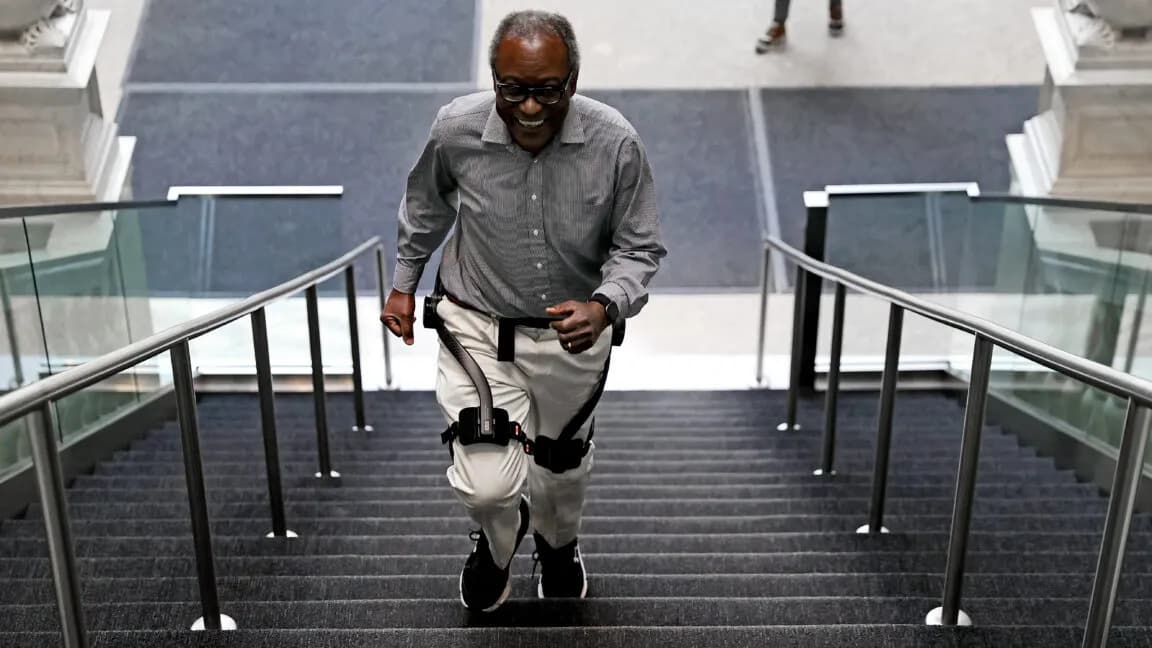
Seattle Mountain Rescue volunteers have spent this year carrying an extra piece of equipment into the Pacific Northwest backcountry: powered frames strapped to their hips and legs. The devices are designed to add lower-body strength on climbs and under heavy loads, and the teams are testing whether that boost translates into faster, longer searches when a stranded hiker's survival window is measured in hours. The experiment is small in scale but large in significance. Human exoskeleton technology, long confined to laboratory gait studies and rehabilitation clinics, is now being worn by people whose jobs involve saving lives in terrain that punishes every extra kilogram.
What Is a Human Exoskeleton?
A human exoskeleton is an external mechanical structure that attaches to the body and works alongside it. The name comes from the biological exoskeleton—the rigid outer shell that supports insects and crustaceans—but the engineering goal is different: rather than replacing biology, these frames supplement it. Sensors detect the wearer's movement, software interprets intent, and actuators supply torque at the joints, typically the hip and knee. The result is a machine that shares the load with muscle and bone.
The concept is older than most people assume. General Electric built a hydraulic full-body suit called Hardiman in the 1960s; it was powerful enough to lift 1,500 pounds but so unstable that it was never practical. What changed in the decades since is not the ambition but the toolkit—lightweight materials, dense batteries, and control algorithms fast enough to synchronize with human gait in real time.
That synchronization matters more than raw power. Research published in Science Robotics and Nature has shown that well-tuned lower-body exoskeletons can reduce the metabolic cost of walking by double-digit percentages, with some studies reporting reductions in the range of 10 to 20 percent depending on the device, the terrain, and the wearer. A 2021 Stanford University study found that a carefully optimized ankle exoskeleton let participants walk faster while expending less energy than they did unaided—a rare combination, since humans normally burn more calories when they move faster. The finding reframed the field's central question. The hard problem is not building a strong machine. It is building one that cooperates with human biomechanics closely enough that the body accepts the help rather than fighting it.
Exoskeletons Enter the Field: Search and Rescue Applications
Search and rescue is an unusually demanding proving ground. Crews hike miles of elevation gain, often carrying medical gear, ropes, and stretchers, then must perform precise physical work at the end of that effort—splinting a fracture, packaging a patient, managing a litter on uneven ground. The Seattle Mountain Rescue testing is aimed squarely at that sequence: whether powered hip and leg assistance improves how quickly rescuers reach a subject and how much capacity they have left when they arrive.
Read next Laika's Wildwood: Stop-Motion Fantasy at TIFF 2026Occupational safety researchers have documented the mechanism at work. Physical fatigue degrades not only strength but judgment: reaction times slow, situational awareness narrows, and the risk of slips, trips, and falls climbs. In wilderness settings those failures compound, because a rescuer who is injured becomes a second patient and diverts the entire team. That is the case for exoskeletons in this domain. The benefit is not simply a faster ascent. It is the preservation of decision-making quality at the moment decisions matter most.
There is also a straightforward conservation argument. A device that reduces the metabolic cost of carrying a heavy pack effectively extends a rescuer's operational range without adding personnel. In searches where teams grid unfamiliar terrain and time is the binding constraint, that extension is not a convenience—it can be the difference between finding someone before nightfall and resuming at dawn. The Seattle testing remains an evaluation, not a deployment, and the open questions are real: battery life in cold conditions, reliability after hours of wear, and whether the assistance that helps on a climb becomes an encumbrance on a technical descent.
The Physical Benefits: Strength, Speed, and Endurance
The three claimed benefits of lower-body human exoskeleton technology—strength, speed, and endurance—are related but not identical, and they do not arrive automatically. Strength is the most direct: actuators add torque at the hip or knee, reducing the muscular effort required to lift a load or drive up a slope. Speed follows when the device improves gait mechanics rather than merely amplifying them, which is why the Stanford ankle work drew so much attention. Endurance is the cumulative prize, and it is where metabolic data matter most.
Even modest efficiency gains scale. A 10 percent reduction in the energy cost of walking a loaded trail translates into meaningful distance over a full day of searching. Multiply that across a multi-day operation, and the logistics change: fewer forced breaks, less need for rotating fresh crews, more ground covered per shift. Comparable thinking has driven adoption in industrial settings. Studies of warehouse and logistics workers have linked exoskeleton use to reduced muscle activity in the lower back and legs during repetitive lifting—a mechanism that, if it holds in the field, has implications for injury rates and career longevity as well as daily output.
Beyond Rescue: Broader Use Cases for Exoskeleton Technology
Rehabilitation is where the technology is furthest along. Powered gait-training devices are in clinical use for patients recovering from stroke and spinal cord injury, and regulatory clearances have accumulated over the past decade. Industrial applications are moving next. Automotive manufacturers, logistics operators, and construction firms have piloted back-assist and leg-assist systems to reduce strain injuries among workers who lift repeatedly, and some deployments have moved past the pilot stage.
The commercial picture is expanding accordingly. Market research firms tracking wearable robotics have projected the global exoskeleton market to grow from roughly a few hundred million dollars annually to several billion by the early 2030s, with compound annual growth rates commonly estimated in the 20 to 40 percent range depending on which segments are counted. The spread in those estimates is itself informative: the category is young, definitions vary, and much of the value is still in medical and industrial niches rather than consumer products. Analysts broadly agree on direction, not on magnitude.
Defense and space agencies have funded exoskeleton research for years, drawn to the same load-carrying problem that concerns mountain rescuers. Consumer and recreational use—hiking assistance for older adults, for instance—remains the most speculative frontier, constrained by cost and by the fact that healthy people are hard to persuade that they need mechanical help.
Challenges and the Road Ahead for Wearable Robotics
Cost is the first barrier. Clinical-grade systems have carried price tags in the tens of thousands of dollars, and industrial units in the thousands, which limits deployment to organizations that can justify the expense through injury reduction or productivity gains. Weight is the second. Every kilogram added to a pack has to be justified by the assistance provided, and the crossover point where a device becomes net-negative is a live research question rather than a settled one.
Then comes the body itself. Fit varies enormously between users, and a device calibrated for one wearer may fight another's gait. Power management remains stubborn: actuators demand energy, batteries add mass, and cold weather erodes capacity—an acute concern for the winter search scenarios that motivated the Seattle testing in the first place. Regulators have not settled on how to classify and approve powered wearable systems across their many uses, and liability questions about device failure during a rescue or on a factory floor are largely unresolved. None of these are reasons to dismiss the field. They are the standard obstacles of a technology moving from demonstration to daily dependability.
The Dawn of a New Era in Human Augmentation
What makes the Seattle experiment a marker rather than a curiosity is its setting. Exoskeletons have spent years in controlled environments where researchers could guarantee flat ground and fresh batteries. Wearing them into the backcountry, in weather, on real missions, tests the technology against the messy conditions where augmentation either works or does not. If powered assistance proves itself in that arena—if rescuers arrive less depleted and search longer—the implication extends well beyond mountain rescue.
That is the promise of human exoskeleton technology in its current phase: not superhuman strength, but ordinary human capability extended past its usual limits. The devices are unglamorous, the gains incremental, the open questions numerous. And that is precisely what the dawn of a new era tends to look like—quiet trials, worn equipment, and a slow accumulation of evidence that the body no longer has to do all the work alone.
Source: Ars Technica - All content