Apple's Biggest October Ever: 12 Products in One Month
Four confirmed product releases, two major software updates, and as many as six additional hardware announcements — Apple's October 2026 calendar is the most concentrated product slate the company has put together in a single month. For followers of Apple October 2026 products, it represents an unusual convergence of scheduled hardware launches, committed software milestones, and rumored refreshes across nearly every major product line.
Apple rarely stacks this much activity into one calendar month. The company has long used a staggered approach — September for iPhones, scattered Mac updates in October, holiday-season peripherals in November — that keeps individual launches from cannibalizing each other's attention. This October collapses that spacing. The foldable iPhone Duo has a locked launch date. Two iOS point updates are arriving. The Mac Studio is getting a memory tier Apple itself promised for late in the month. And the rumor pipeline for iPad, smart home, and streaming hardware has been unusually specific.
What makes this moment readable rather than speculative: Apple's own public commitments supply at least four hard anchors. Everything else follows from there.
iPhone Duo: Apple's First Foldable iPhone Arrives
Apple's first foldable smartphone carries a firm date: the iPhone Duo launches on Friday, October 23. Pre-orders open exactly one week earlier, on Friday, October 16 at 5 a.m. Pacific Time. These are Apple's own published figures, not analyst projections.
Read next iPhone Duo's Hidden Fake Bezel Setting ExplainedThe week-long gap between pre-order open and availability mirrors the cadence Apple has used for flagship iPhone launches in recent cycles. It gives carriers and retail partners time to process reservations while generating visible demand data ahead of the first weekend. For a device entering a new product category, that buffer also allows Apple to calibrate initial allocation across markets.
The iPhone Duo ships with iOS 27.1 pre-installed. That single detail carries a scheduling implication: Apple cannot send foldable iPhones to customers without finalizing the software. iOS 27.1 must reach release candidate status and go public before October 23, creating a de facto deadline for the software team within the first three weeks of the month.
The Duo marks Apple's entry into the folding-display segment, which Samsung has occupied with its Galaxy Z Fold line for several years. Apple's established pattern when entering a mature category — arriving late with a version that emphasizes polish over pioneering — means the iPhone Duo arrives backed by considerable accumulated engineering and testing time.
iOS 27.1 and iOS 27.2: Two Major Software Updates
Two iOS point updates shipping in the same calendar month is genuinely unusual. Historically, Apple's .1 release addresses first-wave post-launch issues and adds minor capabilities, with a .2 following six to eight weeks later. Compressing both into October 2026 is a deliberate structural decision, not a scheduling accident.
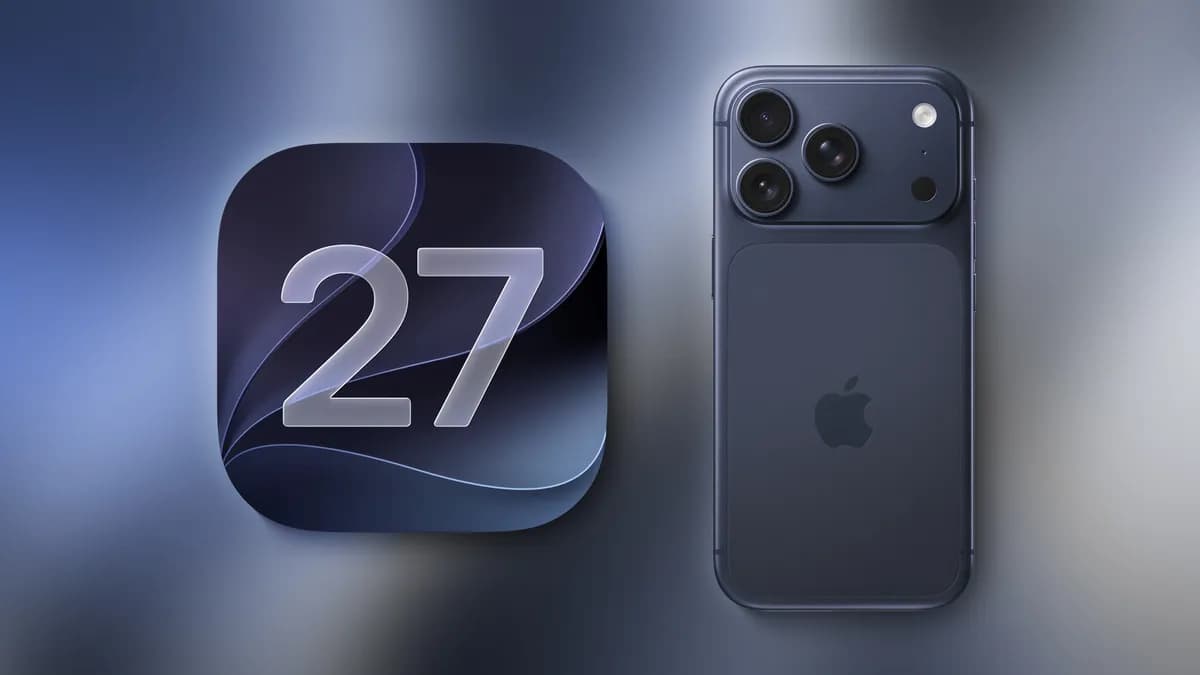
iOS 27.1 is architected around the iPhone Duo. Apple specifically designed this release to support the new form factor — folding display transitions, hinge-aware multitasking behaviors, and app layout adaptations that have no equivalent on any existing iPhone. Labeling these capabilities as a named point release rather than a minor update signals the scope of the work involved.
iOS 27.2 serves a different purpose. Apple publicly committed to adding five additional Siri AI languages in October, and 27.2 is the delivery mechanism. That public promise ties Apple's credibility to this release window in a way that is relatively uncommon for a software update. The practical expectation is a release in the second half of the month, after the iPhone Duo has gone on sale and iOS 27.1 is established.
The two-update structure illustrates how Apple increasingly segments software delivery: hardware-bound capabilities go into releases dedicated to that hardware, while platform-wide additions follow on their own timeline. It is a pattern that became visible in earlier iOS generations and has grown more pronounced as Apple's device range has expanded.
Mac Studio Gets a 512GB RAM Configuration in Late October
Apple shipped an updated Mac Studio featuring M5 Max and M5 Ultra chips last week. That model is already available for purchase. What arrives in late October is a specific tier sitting above the current lineup: the M5 Ultra with 512GB of unified memory, a configuration Apple confirmed is "available in late October" at the time of the original Mac Studio announcement.
Apple's own language is the relevant source here — this is a committed release window, not a rumor. The M5 Ultra architecture supports memory configurations substantially beyond what earlier Apple Silicon generations allowed, and 512GB represents the top of what that chip can address as it ships today.
The market for a 512GB unified memory workstation is narrow but well-defined. Machine learning engineers who train large models locally, post-production facilities running multiple simultaneous high-resolution video streams, and scientific computing workloads that would otherwise require dedicated GPU clusters all represent plausible professional buyers. At this configuration, the Mac Studio competes against dedicated workstation hardware that typically requires different operating systems and costs proportionally more.
Expect the late-October release to arrive roughly four to six weeks after the standard M5 Mac Studio went on sale — a gap that reflects the additional validation time required for the highest-capacity memory configuration.
Rumored Hardware: iPad mini 8, HomePod mini, and Apple TV 4K
Beyond the confirmed launches, MacRumors reported that up to six additional Apple products could surface in October. The three named most specifically are an iPad mini 8, an updated HomePod mini, and a new Apple TV 4K.
The iPad mini 8 is expected to feature an OLED display, which would be the first OLED panel in the mini line's history. The iPad mini 7 shipped with a Liquid Retina LCD; moving to OLED would bring the compact iPad in line with display technology already present in the iPad Pro. Specifications beyond the expected display upgrade are not confirmed from official sources.
The HomePod mini and Apple TV 4K rumors align with both products' observed update cadence — roughly two years between generations in recent history. Apple typically introduces smart home and streaming hardware via press release rather than a staged media event. If these products arrive in October, a low-ceremony announcement is the expected format.
Taken together, the rumored hardware would extend an already dense month into one covering six product lines simultaneously. Apple's supply chain and retail teams would be managing allocation across legacy products and new models at the same time the iPhone Duo is drawing peak consumer attention.
What Apple's October Blitz Means for Consumers
For anyone tracking Apple October 2026 products, the practical challenge is sequencing purchase decisions across a compressed timeline. The iPhone Duo pre-order date of October 16 at 5 a.m. Pacific Time is the first hard decision point. High-demand Apple hardware routinely sees extended delivery estimates within hours of pre-orders opening, so anyone evaluating the foldable needs to be ready that morning.
The Mac Studio 512GB configuration in late October creates a separate window for professional buyers. The standard M5 Ultra Mac Studio is available now; the question is whether the top memory tier is necessary, and that answer depends entirely on workload requirements.
iOS 27.2 is relevant to every compatible iPhone user regardless of hardware. Five additional Siri AI languages arriving mid-month extends Apple Intelligence to a larger global audience without requiring any hardware purchase. That makes 27.2 one of the more broadly consequential releases in this packed month despite arriving without a product announcement attached.
For buyers considering a HomePod mini, iPad mini, or Apple TV 4K, the calculus is familiar: purchasing a current model just before a refresh carries risk. Given how specific and consistent the October rumors have been for these three products, waiting a few weeks before committing is a straightforward position for anyone not in urgent need.
The full range of confirmed and rumored Apple hardware this October spans from entry-level streaming devices up to a professional workstation configuration. That breadth signals a product cycle alignment Apple has not quite matched in a single month before — and it makes October 2026 a genuinely consequential stretch on the company's hardware roadmap.