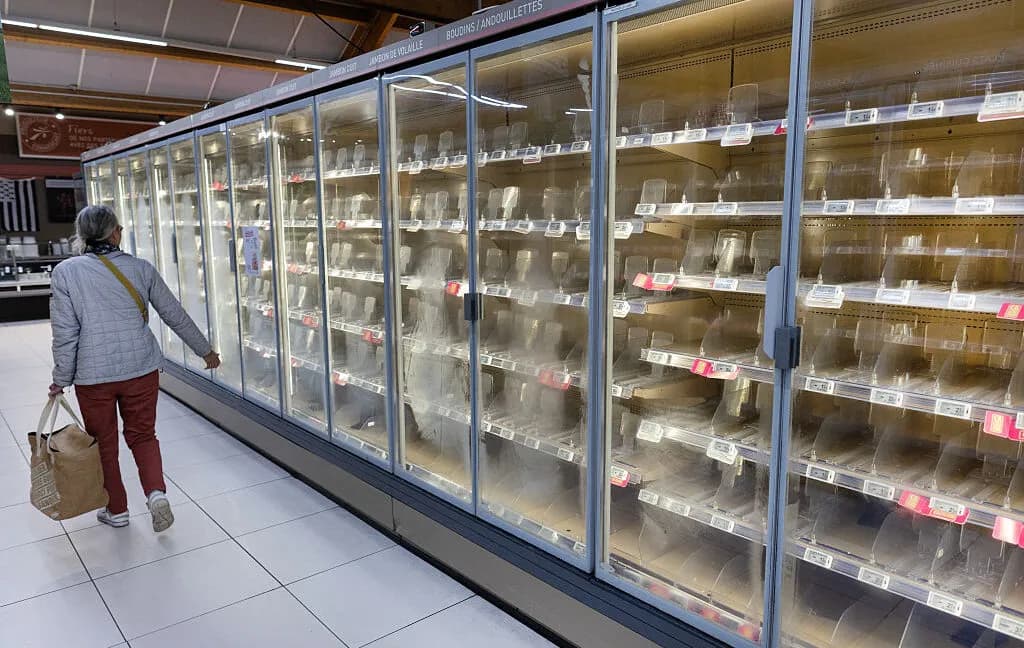
A coordinated cyberattack on internet-connected refrigeration controllers disrupted cooling systems at an estimated 700 supermarkets across France, forcing temperatures as high as 50°C (122°F), spoiling massive quantities of perishable food, and triggering electrical fires. The attack succeeded not through sophisticated zero-day exploits but through vulnerabilities that security researchers had already publicly documented — and that vendors had already flagged through formal advisories.
What Happened in the French Supermarket Refrigeration Hack?
Earlier this week, French authorities confirmed that an unknown group of attackers remotely compromised the refrigeration management systems of roughly 700 supermarkets throughout the country. The targets were not the refrigerators themselves but the networked controllers that technicians use to administer entire fleets of refrigerators and freezers across a store from a single remote interface. Once inside those systems, the attackers triggered the defrost cycles and held them active long enough to push internal temperatures to approximately 50°C (122°F) — well past any threshold at which food remains safe or electrical components remain stable.
The scale of the disruption was significant. Store-wide refrigeration infrastructure failed simultaneously across hundreds of locations. By the time operators identified the breach and began working to restore normal function, the damage was already done: perishables ruined, and in a subset of cases, the thermal stress on electrical components had escalated to actual fires.
The French supermarket refrigeration hack is not primarily a story about the sophistication of the attackers. It is a story about the systematic neglect of industrial control system security in retail environments — a pattern that security professionals have warned about, in writing, for years.
Which Refrigeration Controllers Were Compromised and by Whom?

The controllers at the center of this incident were manufactured by three vendors: Danfoss, a Danish company with a long history in commercial refrigeration controls; Dixell, a specialist in temperature and refrigeration controllers; and Copeland, a US-based company that is Dixell's parent. All three product lines are widely deployed in commercial refrigeration across Europe and beyond, which is precisely what made them attractive targets.
Read next Laika's Wildwood: Stop-Motion Fantasy at TIFF 2026French authorities have not publicly named the attackers or attributed the incident to a specific threat actor. What is clear from the attack pattern — simultaneous compromise across geographically dispersed sites, uniform exploitation of remote administration interfaces, and deliberate activation of defrost mechanisms — is that the operation was coordinated rather than opportunistic.
Multiple security advisories and published research reports had, before this incident, documented critical vulnerabilities in all three of these controller models. The nature of those vulnerabilities is damning in its simplicity: the flaws allowed remote attackers to log into the devices with the same system rights as a legitimate administrator. No privilege escalation required. No complex chaining of exploits. An attacker who found an exposed device on the internet could authenticate with full control.
That these advisories existed and the devices remained exposed and unpatched across 700 retail locations is the central failure the French supermarket refrigeration hack exposes.
Why Did Basic Cybersecurity Fail to Stop the Attackers?

The answer lies in a structural problem that is well understood in industrial control system security but rarely prioritized in retail operations: operational technology (OT) devices are treated as appliances, not as networked computers requiring ongoing security maintenance.
When a technician installs a refrigeration controller with remote administration enabled, the immediate operational benefit is obvious — the ability to monitor and adjust temperatures without a truck roll, to diagnose faults from a central office, to respond to alarms at 2 a.m. without dispatching staff. The security cost of that convenience is less visible and less immediate. So the device gets installed, connected to the internet, and largely forgotten from a security standpoint.
Firmware patching cycles for OT devices in retail are notoriously slow. Unlike enterprise IT environments, where patch management is a core security function, industrial refrigeration controllers are often treated as set-and-forget infrastructure. Vendors may issue firmware updates addressing critical vulnerabilities — as appears to have happened with the Danfoss, Dixell, and Copeland devices involved here — but those updates require operators to identify affected units, schedule downtime, and execute the update process across potentially hundreds of devices per store. The operational friction is real, and in the absence of a regulatory mandate or a visible incident, it rarely gets prioritized.
Credential hygiene compounds the problem. Internet-connected OT devices frequently ship with default credentials or are configured with weak passwords that never change. If the vulnerabilities in these controllers allowed full administrative access, as the advisories indicate, then even a competent attacker with no inside knowledge could systematically scan for exposed devices and authenticate against them.
Network segmentation — isolating OT devices from the public internet behind firewalls and VPNs, accessible only through controlled access points — would have broken the attack chain entirely. It is a fundamental principle of industrial control system security. It was apparently not in place across hundreds of French retail locations.
This is not unique to France, and it is not unique to refrigeration. The same pattern plays out across water treatment facilities, manufacturing plants, building management systems, and energy infrastructure worldwide. Retail refrigeration is simply a visible, consumer-facing example of a much broader problem with internet-exposed OT and ICS devices.
The Real-World Damage: Spoiled Food, Electrical Fires, and Financial Loss
The operational consequences of the French supermarket refrigeration hack were immediate and concrete. When defrost cycles run uncontrolled and internal temperatures climb to 50°C (122°F), the result is not gradual spoilage — it is rapid, total loss of refrigerated and frozen inventory. Dairy products, meat, fish, prepared foods, vaccines if any were stored in pharmaceutical-grade units — anything that depends on a cold chain is destroyed within hours at those temperatures.
Across 700 supermarkets, the volume of spoiled perishables represents a substantial financial and logistical event. Supply chains do not carry infinite buffer stock, and the simultaneous failure of inventory across that many locations creates downstream pressure on distribution networks as well.
The fire incidents add a further dimension of severity. Refrigeration systems are complex electromechanical assemblies. When compressors and other components are subjected to sustained thermal stress outside their operating parameters — the kind that results from defrost cycles held open far beyond their normal duration — electrical failures become possible. That fires occurred in some locations suggests the attack ran long enough in those instances to push components to failure. Fire damage to a store is categorically different from spoiled inventory: it affects the physical structure, creates safety risks for staff, and extends the recovery timeline from days to potentially weeks or months.
French authorities are investigating the incident, and the financial accounting of losses across the affected retailers has not been fully disclosed in available reporting. What is clear is that the combination of inventory loss, store closures, fire damage response, and remediation costs across hundreds of locations places the total impact in the millions, at minimum.
How Can Retailers Secure Internet-Connected Industrial Refrigeration Systems?
The mitigations that would have prevented this incident are not novel or technically demanding. They are well-established practices that the security community has documented extensively for industrial control environments.
Network segmentation is the highest-priority control. OT devices — refrigeration controllers, HVAC systems, building management infrastructure — should never be directly reachable from the public internet. Place them on isolated network segments. Require all remote access to traverse a VPN with strong authentication. This single measure would have blocked the attack vector used here.
Firmware patching must become a scheduled operational discipline. When Danfoss, Dixell, and Copeland issued security advisories for these controllers, that was the moment to audit deployed units and apply updates. Retailers should maintain an inventory of all networked OT devices, subscribe to vendor security bulletins, and treat firmware updates for critical infrastructure components with the same urgency applied to enterprise endpoint patching.
Disable remote access when it is not actively in use. The convenience of persistent remote administration comes with persistent exposure. If remote access to refrigeration controllers is only needed for monthly maintenance windows or fault investigation, it should be disabled by default and enabled only through a controlled process.
Replace or enforce default and weak credentials immediately. Any device accessible from the network with default factory credentials is effectively open to the internet. Credential audits for OT devices should be standard practice during installation and at regular intervals thereafter.
Monitor for anomalous commands. A controller receiving instructions to activate a defrost cycle outside normal scheduling parameters is an anomaly. Behavioral monitoring tools designed for OT environments can flag this kind of deviation and trigger an alert before damage accumulates. Many retail operators have no such monitoring in place.
The French supermarket refrigeration hack will not be the last incident of its kind. Internet-exposed OT devices with unpatched firmware and default credentials represent an enormous attack surface across every sector of the economy. Attackers know this. The security community has documented it in exhaustive detail. The question after an incident like this is never whether warnings existed — they did, in the form of published advisories against the exact devices compromised. The question is whether operators will act on the next round of advisories before the next attack, or after.
Source: Ars Technica - All content