A single, unverified Geekbench 7 entry posted today has given the Apple silicon community its first measurable look at the M6 chip — and the numbers suggest the company's move to a 2nm manufacturing process is delivering exactly the generational lift Apple has been promising. The M6 recorded a single-core CPU score of 4,071 and a multi-core CPU score of 22,783. For context, the average M5 chip scores 3,641 and 17,948, respectively.
M6 Chip Benchmark Results: What the Numbers Say
The 4,071 figure represents roughly a 12% improvement in single-core performance over the M5's 3,641. The multi-core delta is the more dramatic one: at 22,783 versus 17,948, that's an increase of approximately 27%. Those percentages matter because single-core gains have been compressing across the industry, while multi-core scaling depends heavily on how efficiently a chip distributes work across performance and efficiency cores.
To put the 12% single-threaded gain in practical terms, a task that took 10 minutes on an M5-based machine would finish in roughly 8 minutes 48 seconds on the M6, assuming the workload scales linearly with clock and IPC improvements. The 27% multi-core uplift is where users doing video export, code compilation, or 3D rendering will feel the difference most acutely. A 20-minute multi-threaded export on M5 could plausibly drop to around 14 minutes 45 seconds — a meaningful productivity shift for anyone working under deadline.
Apple's own positioning is worth cross-referencing here. The company claimed the M6 chip has the world's fastest single-threaded CPU performance, and the leaked 4,071 score supports that assertion at the top of the Geekbench 7 database — at least for now. The M5 Max, which serves as the previous generation's highest-end mobile configuration, sits at 3,731. Qualcomm's Snapdragon X2 Elite Extreme, the flagship Windows-on-ARM silicon in this database, recorded 3,396. Both fall short of the M6's single-core result.
There's an important structural caveat in these comparisons. The M6 score comes from a Mac mini, while the M5 averages are drawn from the 14-inch MacBook Pro. Thermal envelopes differ between a desktop and a laptop, and sustained versus peak performance can diverge. Still, Apple has consistently tuned its chips so that the same generation performs similarly across form factors in short benchmark bursts, which makes the comparison a reasonable first-order approximation.
The 2nm Process Node: Why It Matters for M6

Two nanometers is the headline manufacturing story. Shrinking from the previous node to 2nm allows Apple's foundry partner to pack more transistors into the same die area while reducing the power required to switch each one. The practical consequences are threefold: higher performance at the same wattage, the same performance at lower wattage, or — most likely — some optimization curve between the two.
Read next iOS 27 Release Time & New Features: Full GuideApple has historically used node transitions to improve both raw throughput and efficiency in the same release. The M6 appears to follow that pattern. A 12% jump in single-core throughput would be respectable on its own, but combined with a 27% multi-core gain, it indicates Apple is not simply pushing clocks higher. Architectural changes in how the chip schedules and feeds its cores are almost certainly contributing, since multi-core scaling often outpaces single-core when a vendor improves uncore fabric, memory bandwidth, or per-core efficiency in parallel.
That 27% figure also lines up with Apple's official claim of up to 1.2× faster multi-threaded performance. A 1.2× improvement equals 20%; the leaked benchmark shows 27%, which exceeds the marketing figure. Vendors typically publish conservative multipliers, so a result above the advertised threshold is plausible rather than suspicious — but it is also the kind of variance that a single run cannot fully validate.
M6 vs the Competition: Apple Silicon vs Qualcomm
The intra-Apple comparison only tells part of the story. The more revealing data point is the cross-platform one: Qualcomm's Snapdragon X2 Elite Extreme at 3,396 single-core trails the M6's 4,071 by approximately 20%. That's a yawning gap in a segment where Qualcomm has spent the last several years positioning itself as the credible alternative to Apple silicon in thin-and-light laptops.
For Windows users considering an ARM-based machine, the competitive calculus just got harder. Qualcomm's platform has made genuine strides in battery life and integrated AI acceleration, but single-threaded responsiveness remains the metric that governs how snappy everyday tasks feel — app launches, window management, web rendering. A 20% deficit there is not trivial.
The M5 Max result, 3,731, adds another wrinkle. Apple's own previous-generation top-tier mobile chip is outpaced in single-core by its new base-model desktop chip. That is a striking inversion of the usual hierarchy, where "Max" variants dominate benchmark tables. It suggests the 2nm node plus the M6's architectural revisions have moved the baseline so far that last generation's premium tier is now mid-table.
Mac Mini with M6: Apple's First 2nm Device
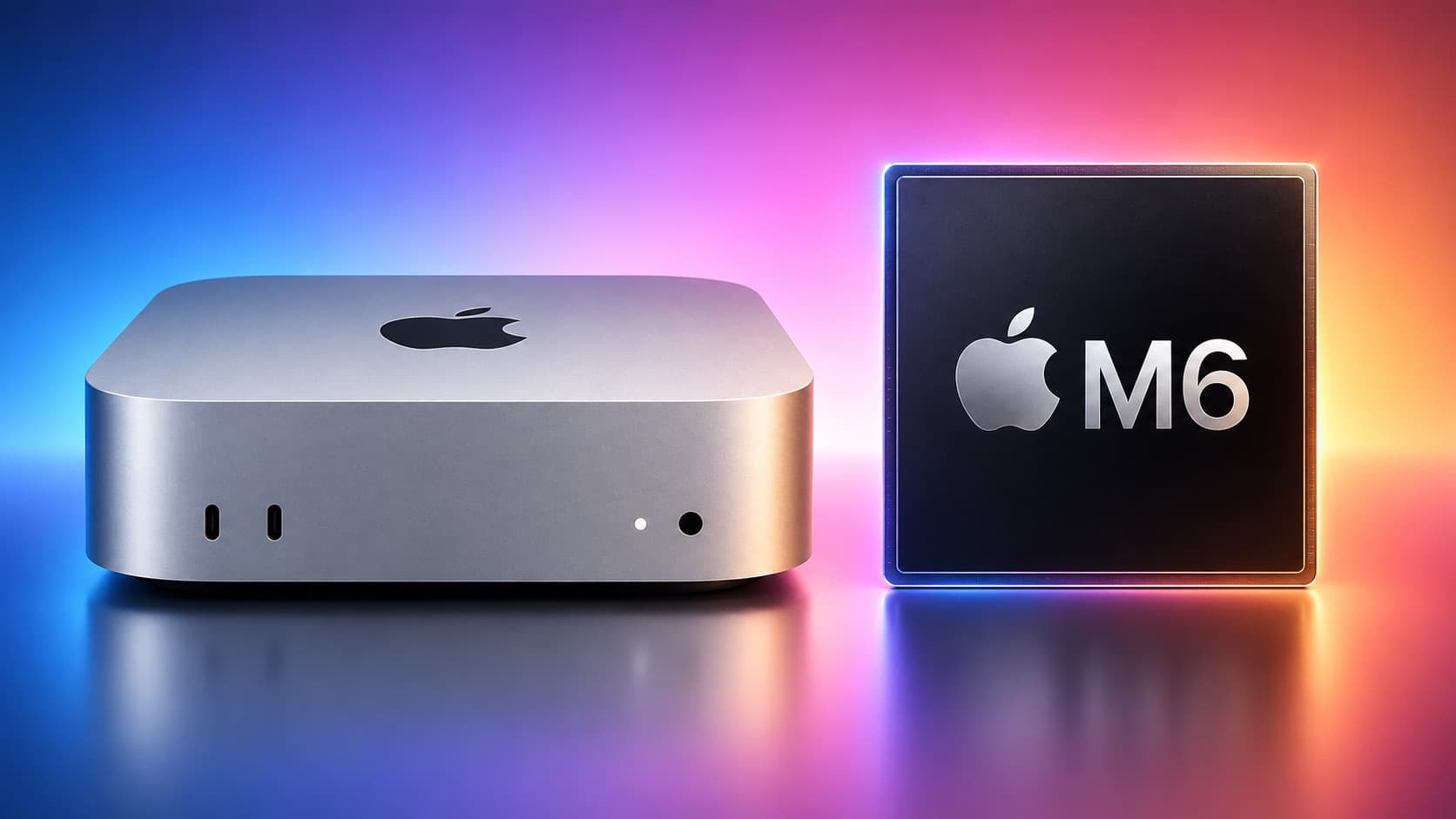
The Mac mini will be the first device to ship with the M6, making it the debut vehicle for Apple's 2nm generation. That choice is consistent with how Apple has handled past transitions — the Mac mini has frequently served as an accessible entry point for new silicon, offering desktop thermal headroom without the price of a MacBook Pro or the constraints of a fanless MacBook Air.
For buyers, the mini's desktop chassis means the M6 can sustain higher power draw for longer than it could in a laptop. If the leaked 4,071 single-core score was achieved in a Mac mini, it may represent something close to the chip's steady-state ceiling rather than a burst-only peak. That would make the 27% multi-core advantage more repeatable under sustained load, which matters for anyone running long compiles or render jobs.
The timing is notable: the benchmark surfaced just as the Mac mini's M6-equipped configuration arrives next week. Pre-release Geekbench entries typically appear within days to weeks of a product launch, uploaded by supply chain contacts, reviewers under embargo, or employees running validation units through public databases.
How Accurate Is a Single Geekbench Leak?
One benchmark row is a data point, not a verdict. Geekbench entries can be affected by background processes, thermal state, power profile settings, and in some cases deliberate cherry-picking by whoever ran the test. The database does not verify whether a machine was plugged in, whether other applications were consuming CPU cycles, or whether the run was repeated and the best result uploaded.
History offers a mixed record. Pre-release Apple silicon leaks have often landed close to final retail performance — the broad strokes tend to be right. But individual entries have also overstated gains, particularly when a single unusually favorable run gets amplified before independent reviewers publish averaged results across multiple runs and controlled conditions.
The right posture is to treat 4,071 and 22,783 as directional. They are consistent with Apple's advertised multi-threaded improvement and with the company's single-threaded claim, which raises confidence. But the specific percentages — 12% and 27% — should be expected to move slightly once multiple units are tested under standardized conditions. A result within a few percentage points of these figures would confirm the leak's general accuracy.
What M6 Means for the Future of Apple Silicon
If the M6's 2nm debut holds up, the implications cascade across Apple's entire lineup. The M6 Pro, M6 Max, and eventually M6 Ultra will inherit the same node and architectural foundation, scaled up with more cores and wider memory interfaces. A base M6 that already beats last generation's M5 Max in single-core suggests the higher tiers could set new records across the Geekbench 7 database.
The broader signal is about cadence. Apple has now demonstrated that it can move to a new process node, deliver double-digit single-core gains and roughly 1.2× multi-threaded improvement, and still put the chip in a mainstream desktop first. Competitors relying on the same foundry ecosystem will face the same node economics — but Apple's vertical integration lets it time the transition to its own product calendar rather than a partner's roadmap.
For now, the M6's leaked numbers describe a chip that is faster, more efficient, and shipping imminently. Confirmation arrives with independent testing next week.