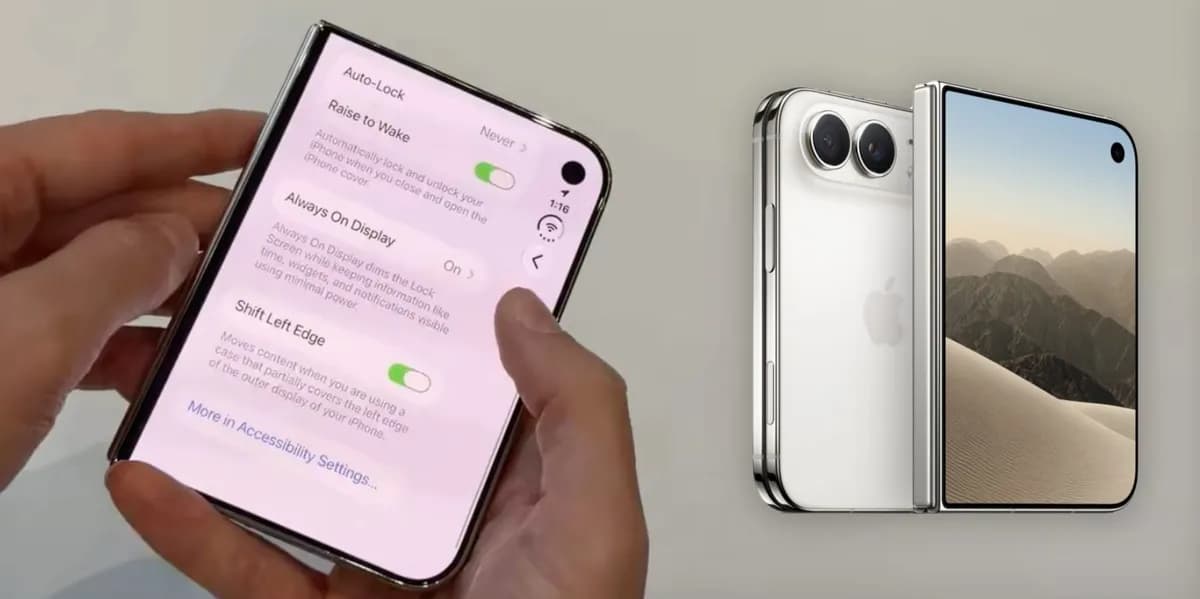
Apple rarely grants extended access to its hardware engineering leadership. When Tom Marieb, Apple's Vice President of Hardware Engineering, sat down with TechRadar to discuss the iPhone Duo in detail, the conversation offered a rare window into how the company approaches the most mechanically complex smartphone it has ever shipped. Marieb addressed the hinge architecture, the display crease, and the durability expectations Apple built into the device — subjects that have defined how every foldable phone is judged since Samsung introduced the original Galaxy Fold in 2019.
Apple VP Tom Marieb Explains iPhone Duo's Engineering Choices
Tom Marieb is not a name that Apple has historically put in front of cameras. His willingness to discuss iPhone Duo engineering specifics with TechRadar signals how seriously Apple wants to shape the public narrative around a product category where hardware credibility is the primary purchase barrier.
Foldable phones carry a credibility deficit that no amount of marketing can dissolve. Consumers remember early failures — creases that deepened into ridges, hinges that accumulated debris, and screens that delaminated after months of regular use. Marieb's interview was effectively Apple's technical rebuttal to that history. He spoke to durability, the hinge mechanism, and the visible crease in the display — three topics that represent the sharpest points of skepticism in the foldable market.
What makes the conversation notable is not just what Marieb said, but that Apple chose to have it at all. The company has historically declined to comment on engineering specifics until a product is already in consumer hands. Engaging proactively with technical questions before mass-market reviews arrive suggests Apple is confident in the hardware — and understands that the iPhone Duo hinge design will be the first thing every reviewer tests.
Inside the iPhone Duo Hinge: Design and Durability
The hinge is the mechanical heart of any foldable. Everything else — display longevity, crease depth, gap management, ingress protection — flows from how well the hinge is engineered.
Read next iPhone Duo's Hidden Fake Bezel Setting ExplainedIndustry practice currently benchmarks hinge durability at 200,000 open-and-close cycles, the rating Samsung publicly uses for its Galaxy Z Fold series. At the average usage pattern of roughly 100 folds per day, that figure translates to approximately five and a half years of operation. From a materials science standpoint, achieving that lifespan requires precise alloy selection, tight dimensional tolerances, and surface treatments that resist wear at contact points where metal moves against metal under repeated load.
Marieb addressed the hinge architecture directly in his conversation with TechRadar, describing the engineering decisions Apple made to handle the mechanical stress that accumulates across tens of thousands of cycles. He spoke to durability as a primary design objective — not a secondary consideration — which reflects an understanding that hinge failure is the single most consequential warranty scenario for a foldable device.
From a mechanical engineering perspective, tolerance stacking is the hidden challenge. Each component in a multi-part hinge introduces a dimensional variance. Stack enough variances and the assembly exhibits slop, binding, or uneven load distribution — all of which accelerate wear. Precision machining and strict supplier qualification are the primary tools for controlling tolerance accumulation. Marieb's framing of iPhone Duo's hinge as a deliberate engineering focus, rather than an adapted off-the-shelf mechanism, aligns with what materials engineers would identify as the necessary approach for a first-generation hinge that has to last.
Addressing the Display Crease on iPhone Duo
No foldable phone has shipped without a crease. The question is never whether it exists, but whether it crosses the threshold of visibility and tactile distraction during normal use.
DisplayMate, which conducts the most rigorous independent OLED measurements in the industry, has documented crease visibility across multiple foldable generations. The critical variable is not the physical depth of the fold but the angle at which reflected light catches the crease boundary — a function of the panel's surface treatment and the radius of curvature the hinge enforces at the fold line. Display analyst Ross Young of DSCC has noted that thinner panel constructions with tighter bend radii tend to reduce crease depth over time, though the tradeoff is increased stress on the organic layers of the OLED stack during the folding cycle itself.
Marieb acknowledged the crease in his TechRadar interview — a straightforward acknowledgment that Apple chose not to obscure. He discussed how Apple approached the crease as an engineering parameter to be minimized and managed rather than a defect to be denied. That distinction matters. Every credible foldable manufacturer has spent years insisting their crease is nearly imperceptible, while reviewers with bright lamps and camera sensors have told a different story. Marieb's candor about the crease's existence, paired with a description of the engineering work done to reduce it, reads as a more honest framing.
The display's behavior under different lighting conditions is where crease management becomes perceptible to real users. Under diffuse indoor lighting, a well-engineered fold line is largely invisible. Under direct sunlight or a point light source held at an oblique angle, even shallow creases become visible as a bright line across the panel. Apple's surface treatment choices and hinge radius will ultimately determine how iPhone Duo performs in those high-contrast conditions.
Durability Standards and Real-World Use Cases
Marieb spoke to durability in terms of real-world scenarios — not just laboratory cycling tests. This framing is significant because lab ratings and lived experience diverge in meaningful ways.
A 200,000-cycle benchmark tests a single failure mode: mechanical fatigue from repeated folding under controlled conditions. Real use introduces variables that lab tests do not replicate at scale: particulate ingress from pockets and bags, thermal cycling from outdoor to air-conditioned environments, asymmetric loads from how different users open and close the device, and the occasional drop that transfers lateral stress to the hinge structure.
Apple's track record with water resistance ratings — the company has consistently delivered IP-rated iPhones that perform well in real consumer conditions, not just IP test tanks — suggests the engineering culture prioritizes real-world durability alongside specification compliance. Marieb's discussion of durability in the TechRadar interview appeared to reflect that same orientation: he addressed the device in terms of how it holds up across normal daily use patterns, not exclusively in terms of rated cycle counts.
What This Means for Buyers Considering iPhone Duo
For consumers weighing an iPhone Duo purchase, Marieb's interview provides something more useful than a specification sheet: engineering intent.
Understanding that Apple designed the iPhone Duo hinge design around longevity as a primary objective — rather than thinness or a particular form factor constraint — helps set expectations. A hinge that prioritizes durability may add fractions of a millimeter to device thickness compared to an architecture optimized purely for profile. Apple has historically made that tradeoff in favor of structural reliability, as evidenced by its chassis construction decisions across the iPhone lineup.
The crease acknowledgment is similarly useful for setting expectations. Buyers who have handled previous-generation foldables from Samsung, Google, or OnePlus will arrive with an existing reference point. Marieb's description of Apple's approach suggests the crease on iPhone Duo is meaningfully managed, though anyone expecting a completely crease-free display on a folding OLED panel should revisit the underlying physics of how organic light-emitting layers behave under repeated mechanical stress.
The strongest signal from the interview is that Apple is confident enough in the hardware to discuss its limitations transparently. That confidence, expressed through a senior engineering leader rather than a marketing communication, carries more weight than any product page claim.
Key Takeaways from Apple's Hardware Engineering Transparency
Apple's decision to have Tom Marieb speak publicly about iPhone Duo's hardware engineering — before the device has been through a full review cycle — is itself a statement. The company is not waiting for the hinge durability tests and crease visibility comparisons to define the conversation.
Several things stand out from what Marieb discussed with TechRadar. The hinge received engineering attention that positions it as a primary design objective rather than an adopted solution. The crease was addressed directly and honestly. Durability was framed in terms of real-world use, not just laboratory benchmarks.
For Apple observers who follow hardware development closely, the transparency is notable. For display analysts and materials engineers, the specifics Marieb provided offer a useful baseline against which teardowns and third-party durability testing can be measured. For buyers, the interview offers what Apple rarely provides on a launch schedule: an unambiguous statement that the company knows where the hard engineering problems are, has worked on them, and is willing to explain the decisions made.
Whether iPhone Duo's hinge holds up across the 200,000-cycle benchmark — and beyond — will be answered over years of consumer use and independent testing. What is already clear is that Apple entered the foldable market with a sober view of what the engineering actually requires.
Source: 9to5Mac