Apple VP Tom Marieb Challenges the Public to Judge iPhone Duo's Crease Over Time
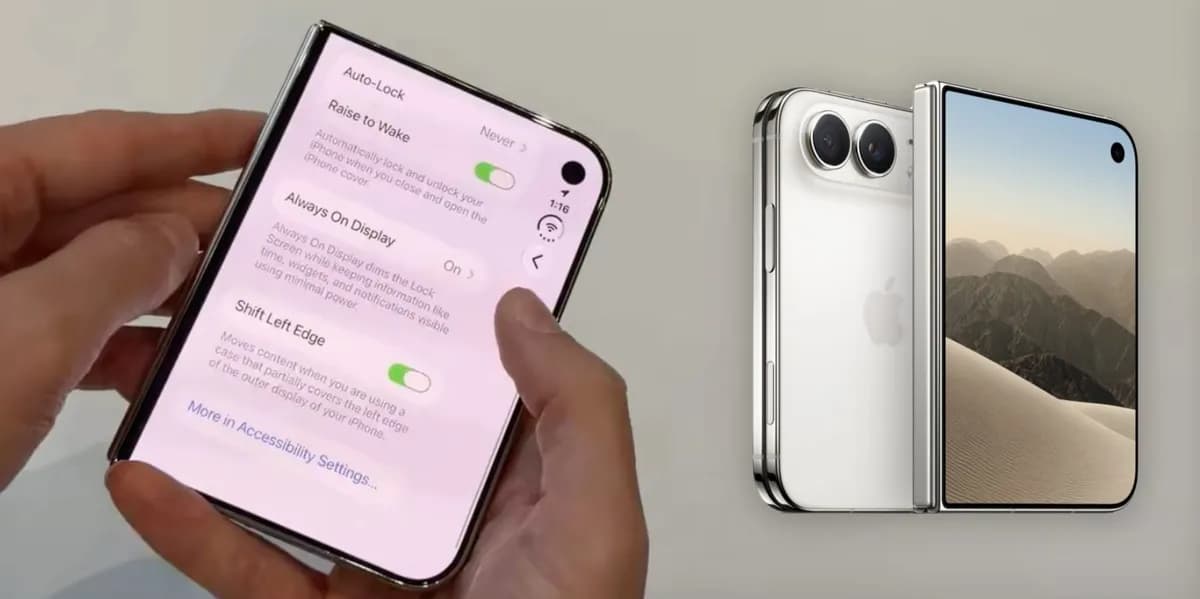
Apple hardware engineering VP Tom Marieb made an unusually direct accountability pledge in a TechRadar interview: watch whether the iPhone Duo crease fades into near-invisibility over months of real-world use, or becomes an embarrassing liability the way it has on competing foldables. "Hold us accountable to that, please," Marieb said — an invitation that no Samsung or Google executive has issued quite so openly about their own foldable displays.
That posture is striking for a company that typically handles product shortcomings with carefully managed PR language. Marieb is, in effect, inviting a longitudinal public test. The foldable market has already run that test on Samsung, Google, and Motorola — frequently with unflattering results. Whether Apple's engineering and display choices hold up differently is now an open, self-declared bet.
Why Apple Chose a Matte Nano-Texture Display for the iPhone Duo

The iPhone Duo crease management strategy starts at the display surface itself. Apple selected a matte nano-texture finish — the same optical treatment found on the Pro Display XDR and certain MacBook Pro models — and Marieb's reasoning reveals this wasn't purely an aesthetic call.
Read next iPhone Duo's Hidden Fake Bezel Setting ExplainedThe materials science is worth understanding. A glossy display is specular: it reflects incoming light in a concentrated, directional beam. Any surface topology variation — a ridge, a bump, a fold line — creates a localized disruption in that beam, which the human eye detects readily. A matte surface, by contrast, scatters incoming light across a broad angular range via microscopic surface irregularities etched at nanometer scale. That diffuse scattering masks topology differences far more effectively than software compensation or display calibration can.
Marieb put it plainly: glossy displays make it "very easy to pick up topology differences" due to their specularity. The matte choice is "not only beautiful in terms of preventing glare, but it's also more forgiving of [hinge] changes over time." The critical phrase is "changes over time." Marieb is not claiming the iPhone Duo crease is absent at launch — he's arguing that the display's optical properties will keep it less visible as hinge mechanics naturally evolve across thousands of fold cycles, which is precisely when crease visibility tends to deteriorate on rival devices.
No current foldable from Samsung, Google, or Motorola ships with a comparable matte nano-texture treatment. That is a genuine differentiator, grounded in optical physics rather than marketing language.
The Engineering Behind iPhone Duo's Hinge
Marieb described the hinge as something he was "especially proud of," and given how directly hinge mechanics influence long-term crease behavior, that pride has engineering substance behind it.
Foldable hinges fail crease tests in two primary ways. They either permit too much panel movement under load — allowing the fold zone to widen progressively — or their torque profiles distribute uneven pressure across the display layers, accelerating delamination. Apple reportedly devoted significant development time to tuning the torque profile: the resistance curve a user feels when opening and closing the device. The goal was a hinge that felt solid and deliberate in both directions.
Torque profile engineering affects more than tactile feel. A well-calibrated hinge controls how the flexible OLED substrate bends at the fold point, governing the mechanical stress experienced by the polarizer, adhesive layers, and plastic OLED panel with each cycle. Durability testing by channels like JerryRigEverything has consistently shown that foldables which fail after thousands of cycles typically exhibit hinge play or lateral misalignment before any visible display failure appears. Apple's emphasis on hinge rigidity reflects direct awareness of that failure sequence — the crease worsens when the hinge loosens, not independently of it.
How iPhone Duo's Crease Approach Compares to Other Foldables
The iPhone Duo crease discussion doesn't happen in isolation. Samsung's Galaxy Z Fold series — now seven generations deep — has carried a persistent crease narrative since 2019. Long-term owner reviews of the Z Fold 5 and Z Fold 6 consistently report that while the crease remains manageable during normal use, it becomes more apparent under direct overhead lighting and measurably more visible after 12 to 18 months of daily use. That pattern has been documented across long-term review coverage from The Verge, CNET, and sustained community feedback on Reddit's r/GalaxyFold.
Google's Pixel Fold arrived with more aggressive hinge engineering, producing a flatter fold zone than Samsung's early designs. Yet DisplayMate's testing of flexible OLED panels has noted that fold-zone reflectance and local brightness uniformity degrade relative to the flat panel region regardless of manufacturer. The crease, in varying degrees, appears to be a structural property of current flexible OLED architecture — not a fixable defect but a manageable tradeoff.
Motorola's Razr lineup places the crease at screen midpoint in a clamshell configuration, where content layout conventions partially obscure it. Teardown analyses still reveal similar adhesive-layer stress patterns at the fold zone. The physics of bending a laminated display stack don't change because the form factor is different.
Apple's matte nano-texture approach is the first display-level optical intervention in the foldable segment aimed specifically at crease perception. Whether it outperforms the competition at the 18-month mark is the test Marieb explicitly signed Apple up for.
What 'Hold Us Accountable' Really Means for Apple's Foldable Strategy
When a VP-level executive says "hold us accountable" in a published interview, the statement carries strategic weight beyond product promotion. Apple enters the foldable market years after Samsung established category norms, which means matching the competition is insufficient — Apple needs to win on the metrics that matter most to buyers who have already experienced crease disappointment on rival devices.
Consumer sentiment data from J.D. Power's annual smartphone satisfaction research consistently ranks display quality among the top-three drivers of overall satisfaction scores. For foldables specifically, crease visibility is the single most-cited dissatisfaction factor in user reviews across major retail platforms. Apple has access to that data. Marieb's accountability framing signals that the company views the iPhone Duo crease not as an inevitable limitation to manage narratively, but as an engineering problem that Apple's display and hinge choices can measurably improve upon — and on which its foldable reputation will be directly judged.
There is a pricing dimension that sharpens this. The iPhone Duo carries a premium over Apple's flat flagship iPhones. At that price point, visible crease degradation within a standard two-to-three-year ownership cycle isn't just an aesthetic complaint — it becomes a straightforward value-proposition failure that no amount of post-launch messaging can reverse.
Takeaways: Should Consumers Trust Apple's Crease Claims?
Skepticism is warranted, but so is measured credence. Marieb's claims rest on verifiable optical physics: matte surfaces scatter light more diffusely than glossy surfaces, and diffuse scattering genuinely reduces the eye's sensitivity to surface topology. That's not a PR construction — it describes how light interacts with textured surfaces at the nanoscale.
The iPhone Duo crease will exist. Flexible OLEDs bend, and the fold zone will accumulate mechanical history over time. The real question is whether the matte nano-texture display renders that crease invisible enough, for long enough, to justify Marieb's public pledge. IFixit teardown analyses will reveal the hinge and adhesive architecture within days of launch. JerryRigEverything durability testing will stress the fold zone across thousands of cycles. Owner reviews at the 12-month mark will provide the empirical answer that Marieb has invited.
Apple has done something the foldable industry rarely does: it set a specific, observable, public standard for one of its most scrutinized new product attributes. That accountability is either a sign of genuine engineering confidence or the most carefully worded bet in recent consumer technology. The next 18 months will settle which.