The Arctic Climate Crisis: An Overview
The Arctic has warmed nearly four times faster than the global average since 1979, according to peer-reviewed analyses of the satellite era, with Arctic Monitoring and Assessment Programme (AMAP) scientists describing the region as a frontline indicator of planetary change. That acceleration is the defining feature of Arctic climate change.
The mechanism is known as Arctic amplification. Bright snow and sea ice reflect sunlight back to space. When they melt, darker ocean water and land absorb more solar energy, which drives further warming. This feedback does not act alone. Warmer air, shifting cloud cover, ocean heat transport from the Atlantic and Pacific, and changes in atmospheric circulation all contribute.
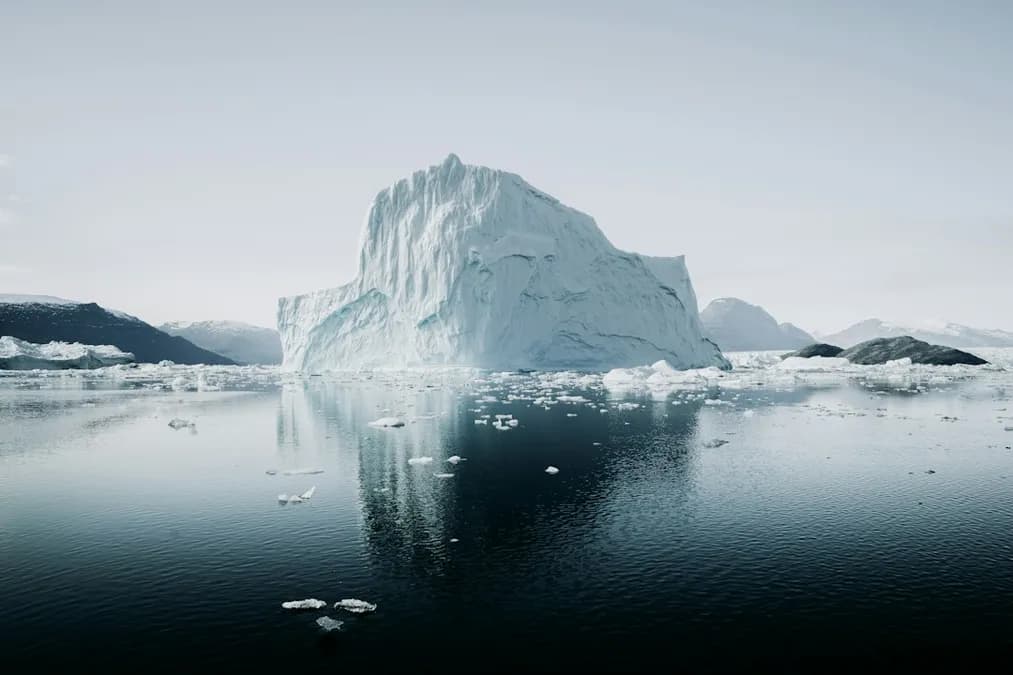
NSIDC sea ice records show the physical result clearly: the Arctic is losing ice cover across seasons, especially in late summer. NASA and NOAA satellite observations, which provide continuous monitoring since 1979, confirm a long-term decline in September sea ice minimum extent. The trend is not a smooth line; some years rebound. But the direction is unmistakable.
The consequences extend beyond polar geography. The Arctic helps regulate Earth’s heat balance, stores vast amounts of carbon in frozen ground, supports Indigenous communities, and influences marine ecosystems from plankton to whales. When this system changes quickly, the effects travel.
Arctic Sea Ice: Decline and Consequences
In September 2012, Arctic sea ice reached the lowest minimum in the satellite record, falling to about 3.39 million square kilometers, roughly half the late-20th-century average. That single year was extreme, but it was not isolated.
Read next How Climate Change Works: A Clear ExplainerNASA’s climate indicators report that September Arctic sea ice extent is declining by about 12.2% per decade relative to the 1981-2010 average. NOAA Arctic Report Card analyses have placed the September decline near 13% per decade in earlier reporting periods. Since 1979, the Arctic has lost not only ice area but also thickness and age. NASA has reported that more than 70% of Arctic sea ice is now seasonal, meaning it forms in winter and melts the following summer instead of surviving for multiple years.
Older, thicker ice matters. It is more resilient to storms and warm summers. Multiyear ice once acted as the Arctic Ocean’s durable lid; now much of the basin is covered by thinner ice that breaks up more easily and melts faster.
The effects are practical. Coastal Alaska communities such as Shishmaref and Kivalina have faced worsening erosion as sea ice retreats earlier, leaving shorelines exposed to autumn storms. For hunters in parts of northern Canada and Greenland, thinner ice makes travel more dangerous and changes access to seals, walrus, and other subsistence resources.
Sea ice loss also alters ecosystems. Ice algae grow on the underside of sea ice and help fuel spring food webs. When ice retreats earlier, the timing and location of productivity shift. That can affect zooplankton, fish, seabirds, seals, and whales. A less icy Arctic also invites more shipping, tourism, and resource activity, raising risks from noise, pollution, invasive species, and accidents in remote waters where emergency response is difficult.
Permafrost Thaw and Carbon Release
Arctic permafrost stores roughly 1,500 gigatons of organic carbon, according to the IPCC Sixth Assessment Report. That is nearly twice the carbon currently in Earth’s atmosphere.
Permafrost is ground that remains frozen for at least two consecutive years. In many Arctic landscapes, it has held plant and animal remains in cold storage for millennia. As temperatures rise, microbes begin decomposing thawed organic matter, releasing carbon dioxide in oxygen-rich conditions and methane in waterlogged environments. Methane is less abundant than carbon dioxide but far more powerful at trapping heat over the short term.
This does not mean all permafrost carbon will suddenly enter the atmosphere. The process is uneven, local, and spread over decades to centuries. But it is a major climate feedback. The IPCC assesses permafrost carbon release as an additional warming factor that is not fully offset by Arctic plant growth.
Real-world signs are already visible. In parts of Alaska, Siberia, and northern Canada, thawing ground damages roads, runways, pipelines, and buildings. The Trans-Alaska Pipeline system was engineered with permafrost in mind, including elevated sections that allow cold air to circulate beneath the structure. As the ground warms, maintaining northern infrastructure becomes more expensive and technically demanding.
Thermokarst landscapes offer another example. When ice-rich permafrost thaws, the land can collapse, forming ponds, slumps, and uneven terrain. In Siberia and Alaska, these abrupt thaw features can expose deeper carbon-rich soils faster than gradual surface warming would.
Ecosystems and Wildlife Under Threat
In the southern Beaufort Sea, polar bear numbers declined by roughly 40% between 2001 and 2010, a loss linked by U.S. Geological Survey researchers to reduced sea ice access and lower cub survival. Polar bears are not the only species under pressure, but they show how tightly Arctic wildlife is tied to frozen habitat.
Sea ice is a hunting platform for polar bears and a resting and breeding environment for seals. Walrus use ice as a base between feeding trips; when ice retreats beyond shallow continental shelves, they may gather in large numbers on land, increasing risks of stampedes and calf mortality. Ivory gulls, ringed seals, and narwhals also depend on ice-associated systems.
On land, warming changes vegetation. Satellite observations show “greening” in some tundra regions as shrubs expand, while other areas experience “browning” from drought, pests, extreme heat, or winter damage. This patchwork matters for caribou and reindeer herds, which depend on access to lichens and seasonal forage. Rain-on-snow events can create hard ice layers over grazing areas, making food inaccessible.
The Bering Sea offers a sharp case study. During recent warm years, reduced sea ice contributed to major ecosystem disruption, including changes in fish distribution and seabird die-offs. Communities that rely on marine resources felt those shifts directly.
Climate scientists associated with AMAP have emphasized that Arctic impacts are cumulative. Warming interacts with contaminants, commercial development, ocean acidification, wildfire, and changing snow conditions. A species may survive one stressor. Several at once can push systems toward rapid reorganization.
Global Ripple Effects of Arctic Change
Greenland lost about 4,700 gigatons of ice between 2002 and 2021, according to NASA satellite gravimetry estimates, adding roughly 13 millimeters to global sea level. That is one Arctic-linked change every coastal city can measure.
The Arctic’s global influence works through several pathways. First is sea level rise. Melting sea ice itself does not raise sea level much because it already floats, but melting land ice from Greenland, Arctic glaciers, and ice caps does. The Greenland Ice Sheet contains enough ice to raise global sea level by about 7 meters if it melted completely over many centuries or longer. Near-term losses are smaller, but already consequential for storm surge, tidal flooding, and coastal planning.
Second is the climate feedback from albedo loss. As reflective ice gives way to darker water and land, the Arctic absorbs more heat. That extra heat can influence regional weather patterns and ocean circulation.
Third is permafrost carbon. Even modest releases add to the emissions burden that governments must reduce elsewhere. Permafrost thaw is not a reason to give up; it is a reason to cut human emissions faster so feedbacks remain smaller.
Scientists continue to study possible links between Arctic warming and mid-latitude weather extremes, including disruptions to the jet stream. The evidence is complex. Some studies suggest that reduced temperature contrast between the Arctic and lower latitudes can favor slower or wavier circulation patterns in certain seasons. Other research finds the signal difficult to separate from natural variability. The measured approach is this: Arctic change can affect broader climate dynamics, but not every cold snap, heat wave, or storm can be traced directly to sea ice loss.
What Can Be Done to Protect the Arctic?
The International Energy Agency has found that global energy-related carbon dioxide emissions remain above 37 billion metric tons per year, which means Arctic outcomes still depend heavily on energy choices made far from the polar region.
The first solution is rapid greenhouse gas reduction. Arctic climate change is driven primarily by human-caused warming from carbon dioxide, methane, and other heat-trapping gases. Cutting fossil fuel emissions from power, transport, buildings, and industry is the most direct way to slow future Arctic loss. Methane reductions are especially valuable in the near term because methane has a strong warming effect over decades.
The second priority is black carbon control. Soot from diesel engines, shipping, flaring, and fires can darken snow and ice, increasing heat absorption. Cleaner fuels, particulate filters, limits on heavy fuel oil in Arctic shipping, and better wildfire management can reduce this pressure.
Third, Arctic governance must keep pace with access. As sea ice retreats, shipping and industrial activity are likely to increase. Stronger safety rules, spill response capacity, protected marine areas, and Indigenous co-management can reduce harm. The International Maritime Organization’s Polar Code is a starting framework, but enforcement and regional planning remain critical.
Fourth, adaptation funding needs to reach Arctic communities. Relocating or defending infrastructure, monitoring ice safety, protecting drinking water, and maintaining food security require long-term investment. Indigenous knowledge should not be treated as an afterthought; it is essential observational science built from generations of living with Arctic conditions.
Finally, monitoring must continue. The credibility of Arctic science comes from sustained records: NSIDC sea ice extent data, NASA and NOAA satellite measurements, field stations, ocean buoys, permafrost boreholes, and community-based observations. AMAP assessments show why this matters. The Arctic is changing quickly, but careful measurement separates evidence from speculation.
The Arctic is not lost. Nor is it unchanged. The evidence points to a narrower window for limiting damage, protecting communities, and preserving parts of a cold-region system that has helped stabilize the planet for thousands of years.
Related coverage