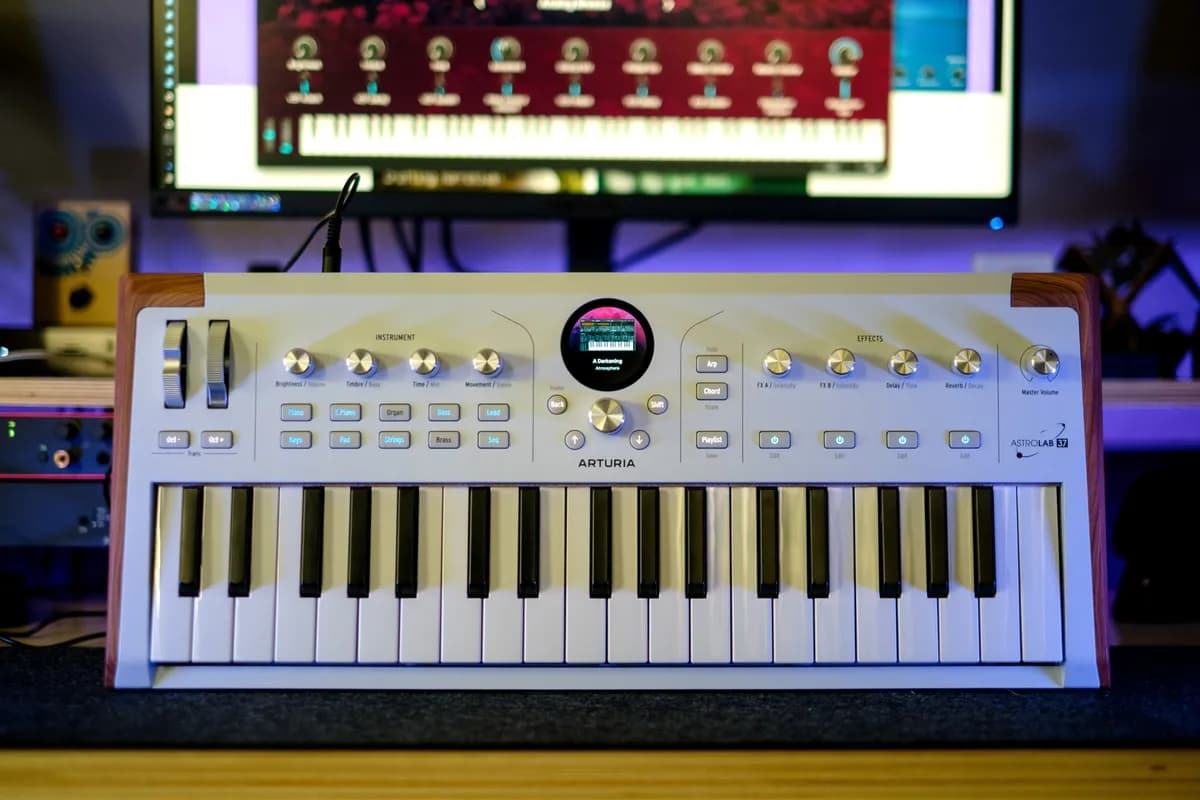
Arturia has released a firmware update for its AstroLab stage keyboard series that transforms the instruments from what The Verge characterized as "glorified preset browsers" into tools capable of genuine sound design. The update unlocks deep parameter editing across the AnalogLab library — a collection spanning vintage synth emulations, sampled pianos, and original instrument plugins — giving working musicians meaningful control they previously lacked.
What does Arturia's AstroLab firmware update actually add?
The firmware update adds proper sound design tools to the AstroLab hardware, breaking open the synthesis engine that was always running beneath the surface but never fully accessible to the player. Before this release, the ceiling on what you could do to any patch was defined by four macro controls and a set of onboard effects parameters. That was it.
Now, the architecture Arturia built into the AnalogLab software — the oscillators, filters, envelopes, and modulation paths that make each emulation convincing in the first place — can be addressed directly from the hardware. The practical implication is significant. A Minimoog-style patch you previously could nudge in one of four pre-assigned directions can now be pulled apart and rebuilt from its core components, without leaving the keyboard or opening a laptop.
This is not a minor quality-of-life patch. It is a fundamental shift in what the instrument does and who it is for.
Why were the AstroLab keyboards called glorified preset browsers?

The "glorified preset browser" label is a pointed but fair critique of what the AstroLab offered before this update. The keyboards shipped loaded with thousands of sounds from the AnalogLab library, and they played and felt excellent — but interacting with those sounds was constrained in a specific, frustrating way.
Read next Laika's Wildwood: Stop-Motion Fantasy at TIFF 2026Each patch exposed exactly four macro controls. Those macros were set by whoever designed the preset. You got brightness, or warmth, or movement — whatever the sound designer decided to surface. What you did not get was access to the underlying synthesis parameters that actually produced those characteristics. The filter cutoff was behind glass. The oscillator mix was behind glass. The envelope attack was behind glass, unless a macro happened to point at it.
Four knobs is a meaningful limitation when you consider the depth of what AnalogLab actually models. A Juno-style patch might have a chorus depth, a filter frequency, a resonance setting, and an LFO rate all competing for those four slots. One of them wins. The rest stay locked. For musicians who just want to call up a vintage string sound and play, that trade-off was acceptable. For anyone who wanted to sculpt sound — to make something that did not already exist in the library — the AstroLab was, in effect, a very expensive and very good preset machine.
That characterization stings a little because the hardware itself was never the problem. The keys are good. The form factor works for the stage. The library is enormous. The issue was software architecture, and firmware can fix software architecture.
What is the Arturia AstroLab series?
The AstroLab keyboards are Arturia's attempt to put the full power of their AnalogLab software suite into a piece of hardware built for live performance. AnalogLab is a well-regarded collection of virtual instruments that encompasses three main categories: emulations of classic vintage synthesizers, sampled acoustic and electric pianos, and a set of original instrument plugins that Arturia has developed independently.
The vintage synth emulations are the headline attraction for most players. Arturia has spent years building software recreations of instruments like the Minimoog, the Yamaha DX7, the Roland Jupiter-8, and many others — doing the painstaking acoustic and circuit-modeling work to make software versions that professionals find usable. Getting those emulations off a laptop and onto dedicated hardware, in a package that can survive a tour, was a genuine engineering achievement.
The sampled pianos round out the collection for players who need acoustic textures alongside synthetic ones. The original plugins add sounds that are not tied to any specific vintage machine, giving composers access to Arturia's own creative voice rather than purely historical recreations.
Taken together, the library is vast. That scale is part of what made the preset browser limitation feel especially acute: the AstroLab contained a serious instrument collection, and then handed you four knobs with which to explore it.
How does deeper sound design change AstroLab's appeal for live performers?
Live performance puts different demands on a keyboard than studio work does, and the Arturia AstroLab firmware update addresses both contexts simultaneously, though perhaps more profoundly for the stage.
On stage, the ability to do sound design in real time is not just a creative option — it is sometimes a practical necessity. Set lists change. Songs get dropped or added. A keyboard player who can reshape a patch quickly to serve an unexpected request is more valuable than one who can only navigate a preset list. More subtly, live arrangements often require that a sound occupy a different frequency space than it does on a recording. A pad that sits perfectly in a studio mix might swamp a live band. Being able to roll off low-end, thin out a filter, or reduce the release time on the fly is a workflow asset.
Before this firmware update, an AstroLab player who needed that kind of adjustment had three options: find a different preset that was already shaped the way they needed, use a macro in the hope it addressed the right parameter, or carry a laptop as a companion device to access the full AnalogLab software. None of those options is ideal. The first depends on luck. The second is limited by design. The third defeats a large portion of the AstroLab's appeal as a standalone instrument.
With deeper parameter access, those workarounds shrink. Players can make targeted, specific adjustments to the sounds they already know and trust, rather than hunting for substitutes. That kind of confidence — knowing exactly what the instrument will do when you turn a knob — is foundational to comfortable live performance.
AstroLab Compared to Other Stage Keyboards
Stage keyboards occupy a specific market position that rewards instruments capable of covering multiple sonic territories convincingly. A player who carries a single board needs it to produce usable acoustic pianos, vintage electric pianos, classic synth leads, lush pads, and whatever else the setlist demands. The AstroLab series was already competitive on that breadth metric. The AnalogLab library is comprehensive enough that gaps in coverage are rare.
Where the AstroLab differed from competitors before this update was in editability. Instruments like the Nord Stage series have long offered players direct access to synthesis parameters alongside their preset libraries. Roland's RD and Fantom lines similarly allow per-instrument editing within their onboard engines. For musicians accustomed to those workflows, the AstroLab's macro-only approach was a concession — you were accepting a trade of control for convenience, and not everyone found that trade worthwhile.
The firmware update narrows that gap. The AstroLab's core strengths — the quality of the AnalogLab emulations, the playability of the hardware, the depth of the library — remain intact. What it adds is parity with the editing expectations that experienced players bring from working with other serious instruments.
Whether this positions the AstroLab as the clear choice for stage work depends on factors beyond parameter access alone: build quality, key feel, connectivity, and price all enter the calculation. But the sound design limitation was a genuine objection that thoughtful buyers raised. Arturia has answered it. The keyboards are no longer preset browsers that happen to feel good to play. They are now, properly, sound design instruments that happen to be built for the stage.
Related coverage
Source: The Verge