Apple's first foldable iPhone ships with a camera suite that cannot be replicated on a slab phone. That is the central pitch behind the iPhone Duo camera features announced this week: a set of tools built specifically around the device's dual-display, half-folded form factor rather than simply porting over the Camera app from the iPhone 17 lineup. According to MacRumors, Apple is introducing Smart Take, Kid Cue, Duo Preview, and Duo FaceTime as exclusives tied to the foldable's hinge and second screen. Each one targets a familiar frustration, and together they sketch out how Apple intends to justify a new product category.
iPhone Duo Camera Features Exclusive to the Foldable Design
IDC has tracked foldable phone shipments growing from roughly 19 million units globally in 2023 toward forecasts that crest above 40 million annually by the late 2020s — a steep curve, but still a rounding error against the billion-plus smartphones sold each year. Counterpoint Research has repeatedly noted that the single biggest brake on foldable adoption is not price alone but the "why" problem: consumers struggle to name a task that a foldable does meaningfully better than the phone already in their pocket. Apple's answer, at least for the camera, is the half-folded stance.
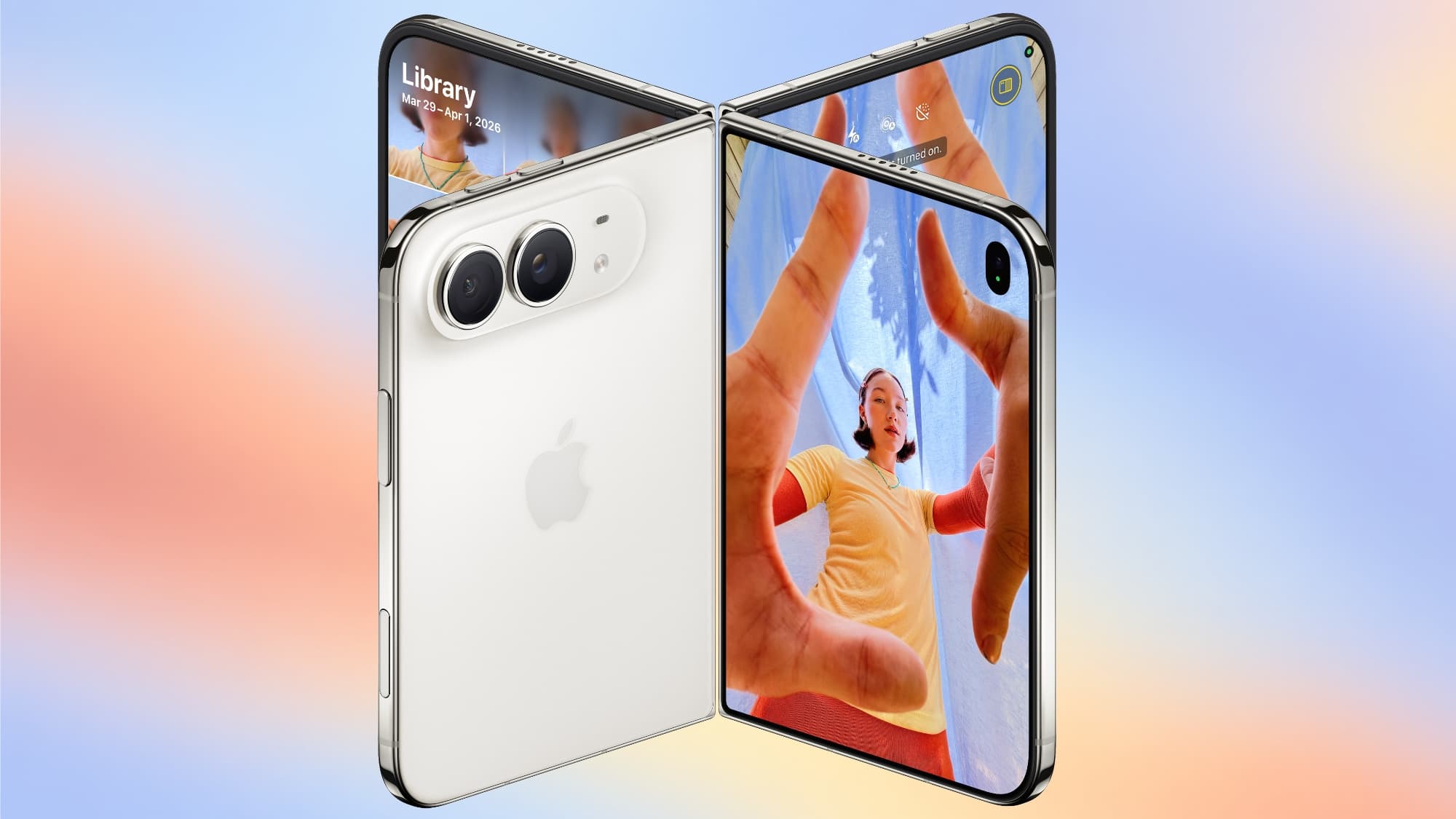
That posture matters because of physics. When the Duo is bent partway and set down, the outer display faces the subject while the inner display faces the photographer. No tripod, no leaning the phone against a coffee cup, no propping it on a backpack. The device becomes its own stand, and both screens become active surfaces. Every exclusive feature Apple announced flows from that single mechanical reality — which is why none of them will arrive on a non-folding iPhone through a software update.
Smart Take: AI-Powered Group Shots Without a Timer
Anyone who has organized a group photo knows the ritual: someone counts down from three, sprints into frame, and arrives slightly blurry and mid-stride. Or the group nominates a reluctant stranger to hold the phone, and the resulting composition is crooked. Apple's own marketing for years has leaned on group shots — the "Shot on iPhone" campaign has featured crowd scenes, family reunions, and wedding parties — yet the software never solved the self-exclusion problem. The timer helps, but a timer cannot know whether a toddler has turned away or whether the person jogging into frame has actually stopped moving.
Read next iOS 27 Release Time & New Features: Full GuideSmart Take attacks that gap directly. Per MacRumors, the feature uses AI to determine when everyone — including the iPhone owner — is ready for a group shot, so no one has to use a timer or stay out of the picture to capture the image. The workflow is straightforward: prop the Duo in a half-folded orientation, step into the frame, and wait. The phone decides when to fire.
Placing Smart Take in context requires looking at Apple's computational photography trajectory. Action mode, introduced with the iPhone 13, used sensor data and machine learning to stabilize shaky handheld video. Photonic Engine, which arrived with the iPhone 14, fused multiple exposures at the pixel level to rescue low-light detail. Both features answered a question of the form "can the pipeline fix what the hardware captured?" Smart Take asks something different and arguably harder: can the pipeline make a decision about human behavior in real time? Scene detection has been standard in phone cameras for a decade, but readiness detection — judging whether a subject is posed, facing forward, and stationary — is a behavioral inference, not a scene classification. Apple has not published accuracy figures, and buyers should treat the feature as an assist rather than a guarantee. Still, the design intent is clear: remove the timer from the equation entirely.
Kid Cue and Duo Preview: Solving Real Photography Pain Points

Parents take more photos of young children than any other demographic group, and the failure rate is punishing. A 2022 survey of camera-app behavior found that among parents of children under five, the average portrait session required four or more attempts to get one usable frame. The reason is simple: children under a certain age do not reliably respond to "look here." They respond to movement, sound, and characters they recognize.
Kid Cue addresses that with a specific, almost charming solution. MacRumors reports that the feature shows little Peanuts animations to children so they look at the camera when you're taking a photo. The mechanic exploits the foldable's geometry: the outer display, which faces the subject, becomes a tiny animated stage. A child watching Snoopy bounce across the screen is a child looking directly at the lens. This is not a general-purpose feature — it is a targeted intervention for a well-documented use case, and it is the kind of thing that only works when the subject-facing screen exists in the first place.
Duo Preview solves a different chronic problem: the subject who cannot see what the photographer sees. Anyone who has taken a portrait and been asked "let me see that" knows the loop — shoot, hand over the phone, hear feedback, reshoot. It is inefficient and, in professional or semi-professional contexts, awkward. With Duo Preview, the Camera app shows a live preview of the shot on both displays, so the subject you're taking a photo of can make adjustments. Hair, posture, expression, framing — all correctable in real time without passing the device back and forth. Photographers who have worked with tethered shooting on DSLRs and mirrorless cameras will recognize the concept immediately; Apple is essentially bringing a studio workflow to a handheld.
Taken together, Kid Cue and Duo Preview illustrate an editorial philosophy: rather than chasing spec-sheet wins, Apple is targeting the moments where photography actually fails for ordinary people.
Duo FaceTime: Shared Video Calls on a Single Device
Video calls have a crowding problem. Position three people in front of a phone on a table and the person on the outside edge is half out of frame. Nearby friends can participate in a FaceTime call using the outer display while the iPhone owner uses the inner display, according to MacRumors — so nobody has to huddle around the iPhone or pass it around to get on video. The outer screen becomes a second participant station.
One clarification matters here. Duo FaceTime is not the same as Dual Capture, which records video with both the front and rear cameras simultaneously. Dual Capture is a capture feature; Duo FaceTime is a display-sharing feature. The distinction is easy to blur in coverage, and Apple's naming does not help. Duo FaceTime specifically uses the outer display to allow another person to join in on a call — nothing more, nothing less.
The practical scenarios write themselves. A grandparent visiting for the weekend sits beside the phone owner without being squeezed into a corner of the frame. A couple on a couch takes a call from a friend abroad and both appear. A small conference room eliminates the ritual of sliding a phone across the table. None of these are dramatic breakthroughs in isolation. Collected, they represent the kind of ergonomic relief that defines whether a new form factor feels useful or ornamental.
What These Features Mean for iPhone Duo Buyers
Foldable buyers in 2026 are making a $1,700-plus bet on a category that, by Counterpoint's estimates, still represents low single-digit percentages of global smartphone sales. That bet needs justification beyond novelty. The exclusive iPhone Duo camera features Apple announced provide it in a narrow but concrete way: each one requires the hinge, and none can be delivered to a traditional iPhone by update.
There is a legitimate caveat. Features like Smart Take depend on AI judgment that Apple has not quantified, and buyers should calibrate expectations accordingly. Duo Preview and Duo FaceTime, by contrast, are mechanical guarantees — the screens are there, and they will do what Apple says. For anyone who shoots group photos, photographs children, or takes a lot of video calls in shared spaces, the Duo's camera suite is not a curiosity. It is the first coherent argument that a folding iPhone does something a flat one cannot.
Frequently Asked Questions About iPhone Duo Camera Capabilities
Can any of these iPhone Duo camera features run on a regular iPhone?
No. Smart Take, Kid Cue, Duo Preview, and Duo FaceTime all depend on the Duo's second display and its ability to hold a half-folded position. There is no software path to replicate them on a single-screen device.
Is Smart Take a replacement for the camera timer?
Functionally, yes, for group shots. The timer still exists for other uses, but Smart Take removes the need to set one by detecting when everyone in the frame is ready and firing automatically.
What is the difference between Duo FaceTime and Dual Capture?
Duo FaceTime uses the outer display so a second person can join a video call on the same device. Dual Capture is a camera recording mode that captures front and rear video simultaneously. They are separate features with separate purposes.
Does Kid Cue work for adults?
Apple describes it as a tool that displays Peanuts animations to children. It is positioned as a child-focused feature, though nothing prevents an adult subject from benefiting from having the outer display facing them.
Will these features expand in future iPhone Duo generations?
Apple has not said. Based on the pattern established with Action mode and Photonic Engine — both of which were refined across multiple hardware cycles — further development of the foldable-specific camera toolset is a reasonable expectation, but no roadmap has been confirmed.