Why the 2026 Bahrain Grand Prix Was Held in Malaysia
The 2026 Bahrain Grand Prix was not held in Bahrain. That sentence carries weight it would never have carried a decade ago. An ongoing armed conflict between Iran and Bahrain rendered the Bahrain International Circuit — the desert venue that served as the F1 season opener for much of the past two decades — operationally inaccessible for an international sporting event. Formula 1 management faced a binary choice: cancel the round or find a replacement host. They relocated.
The Sepang International Circuit in Malaysia stepped in, hosting the 2026 Bahrain Grand Prix Malaysia. It is not the first time geopolitics have forced F1's hand. In 2011, popular uprising across the Arab world led Formula 1 to cancel the Bahrain Grand Prix outright — the sport's first cancellation for explicitly political reasons in the modern era. That round was simply dropped from the calendar. In 2026, with a 24-race schedule and commercial broadcast contracts requiring a full complement of rounds, absorption was not an option. Relocation was.
The 2026 Bahrain Grand Prix Malaysia substitution is the most significant emergency calendar change since that 2011 cancellation. It arrived with complications no contingency plan had modeled: an equatorial downpour, a delayed start, and — adding a distinctly modern layer to a chaotic afternoon — a software fault that required a patch before racing could begin.
Sepang International Circuit: A Tilke Track in the Tropics
Sepang is one of the defining circuits of a specific era. Designed by Herman Tilke and opened in 1999, it belongs to a generation of venues that expanded F1's commercial footprint across Asia and the Middle East. Tilke circuits share recognizable characteristics: wide runoff areas, technical infield sections, and long straights engineered to encourage overtaking. Sepang stretches across approximately 5.5 kilometers, with two of those straights feeding into a demanding stadium complex.
Read next Laika's Wildwood: Stop-Motion Fantasy at TIFF 2026What separates Sepang from its European counterparts is climate, not concrete. Malaysia sits just north of the equator, and ambient race-day temperatures routinely exceed 35°C with humidity levels between 70 and 90 percent. The resulting aerobic demand on drivers has no equivalent at a circuit like Silverstone or Monza. Tire degradation accelerates sharply under sustained heat, brake cooling becomes an engineering priority, and driver core temperature management directly affects late-race pace.
The Malaysian Grand Prix ran on the F1 calendar from 1999 through 2017 before rising hosting costs and declining attendance caused its removal. Engineers and strategists from that era consistently ranked it among the most physically punishing rounds of the year. Returning under the 2026 Bahrain Grand Prix Malaysia designation confirmed that the infrastructure was maintained and the circuit remained FIA-grade — even if the circumstances that brought the race back were far from routine.
Heavy Rain Forces a Delay — and a Software Update
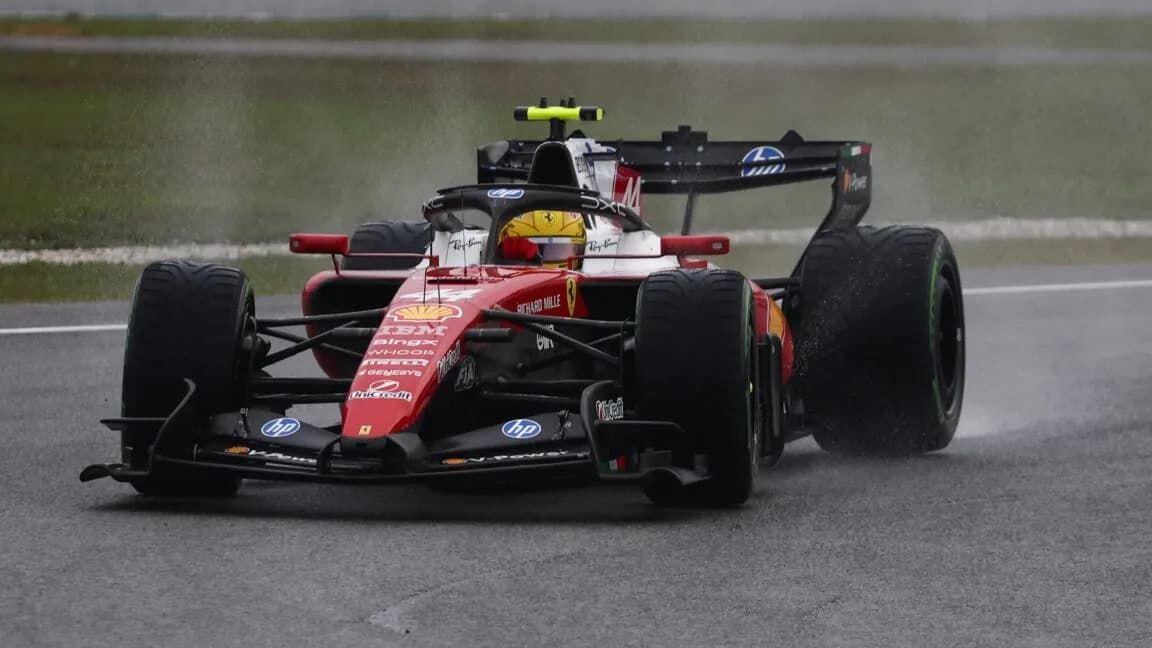
Tropical weather does not consult race schedules. Approximately 30 minutes before the start, heavy rain moved over the circuit. Not a passing shower — sustained, high-intensity equatorial rainfall of the kind that saturates tarmac in minutes and reduces sightlines to nearly nothing.
Race officials delayed the start. FIA regulations permit postponement when conditions make a safe start impossible, and water accumulating on the Sepang surface well exceeded the threshold at which a standing start could be safely conducted. Teams revised their tire strategies in real time, recalculating the transition window from wet to intermediate to slick compounds on an uncertain timetable.
Then came the software problem. A patch was required before the race could be officially started. Which system required updating — timing infrastructure, FIA control hardware, DRS activation systems — was not confirmed in granular detail. The patch was applied. The race eventually ran. But the episode underscored a reality that often goes undiscussed: a modern Formula 1 grand prix runs on a significant layer of digital infrastructure. Marshaling systems, real-time telemetry encoding, timing servers, and race control software all have to function simultaneously. At Sepang in 2026, one component did not. The remedy was a software update rather than a mechanical repair, which is itself a marker of how deeply integrated computing systems have become with the operational backbone of the sport.
F1 Wet Weather Tires Explained: Full Wets vs. Intermediates
Pirelli supplies two distinct compounds for wet-weather racing, and choosing between them is rarely straightforward.
The full wet tire features deep circumferential grooves that evacuate water from the contact patch at approximately 65 liters per second per tire at race speeds. This prevents aquaplaning, but at a steep cost. Full wets generate enormous spray plumes — walls of mist that make following another car at racing distances essentially impossible. The lap time delta versus a dry compound is measured in several seconds per lap, not tenths. In practice, the full wet operates as a safety car tire. If conditions require it, the track is too dangerous for wheel-to-wheel racing anyway.
The intermediate sits in a narrower, more strategically complex window. Its grooves are shallower, designed for damp surfaces where standing water is not the primary concern. In those conditions, intermediate-shod cars can race competitively. The compound works within a defined temperature range. As the track dries, that range tightens: friction rises, rubber temperatures spike, and degradation accelerates. Strategists watching the 2026 Bahrain Grand Prix Malaysia had to judge the precise moment when the surface had dried enough to warrant a switch to slicks — a call worth potentially 10 to 15 seconds over a stint if executed correctly.
The transition from full wet to intermediate to slick is among the highest-leverage decisions in a wet race. At a tropical circuit drying unevenly under clearing cloud cover, the margin for error shrinks further.
The Broader Implications: Geopolitics Reshaping the F1 Calendar
The 2026 Bahrain Grand Prix Malaysia represents a stress test for F1's model of calendar construction. The sport has expanded aggressively since the mid-2000s, adding rounds across the Middle East, Southeast Asia, and the Americas. That expansion depends on the assumption of stable host environments. The 2026 season demonstrated that assumption does not always hold.
In 2011, cancellation was acceptable because the calendar was shorter and commercial stakes were lower. By 2026, the financial architecture built around broadcast rights, race-weekend hospitality, and team sponsorship is dense enough that losing a round entirely carries significant contractual consequences. Malaysia's availability — as a former race host with intact facilities and FIA homologation — provided exactly the kind of contingency infrastructure the sport lacked a decade ago.
The FIA and Formula 1 management will now have concrete operational data on emergency relocation: lead times required, logistics costs, broadcast adaptation, and the software compatibility issues that apparently arose at Sepang. That data is useful. Future calendar design may explicitly designate backup venues for geopolitically exposed rounds.
Key Takeaways from the 2026 Bahrain GP at Sepang
The 2026 Bahrain Grand Prix Malaysia will be remembered for its context as much as its competition. A war displaced a grand prix across two continents. Equatorial rain delayed the start by the better part of an hour. A software patch stood between the race and no race at all.
None of these are minor footnotes. Together they reveal the layered fragility of the most logistically complex annual sporting event in the world. Sepang tested tire strategy, digital infrastructure, regulatory adaptability, and the physical resilience of drivers simultaneously.
Bahrain's absence from its own grand prix reflects forces entirely outside motorsport's reach. What Formula 1 showed in Malaysia is that the sport can adapt when it has to — imperfectly, under pressure, and occasionally one software update at a time.
Source: Ars Technica - All content