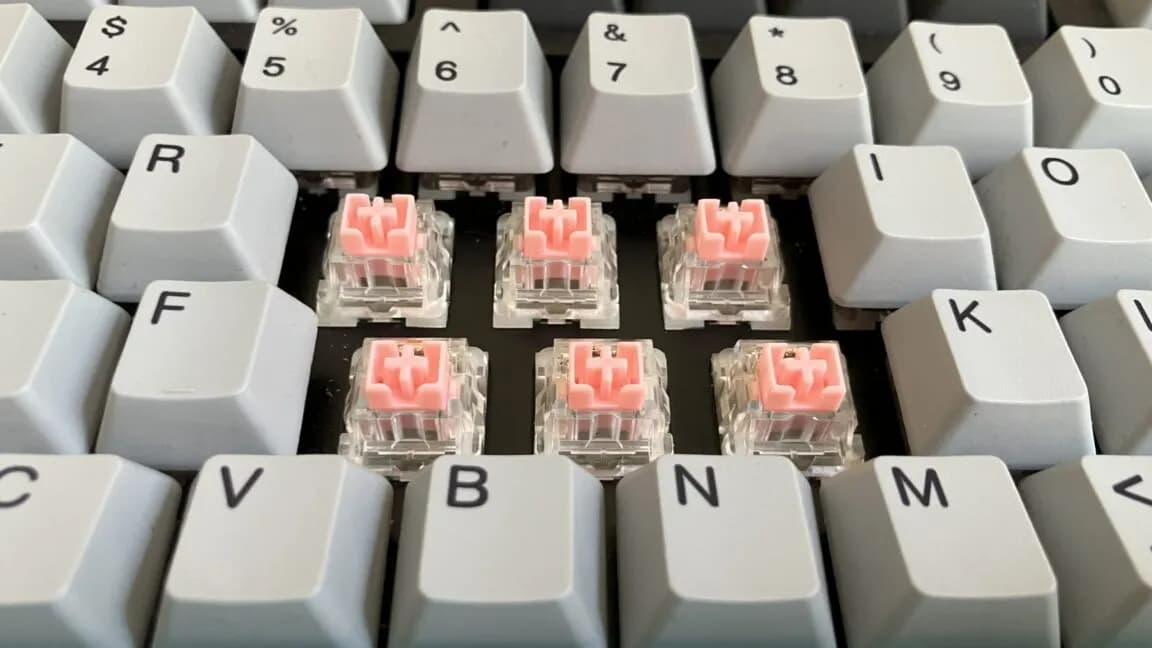
What Makes a Mechanical Switch 'Mechanical'?
A standard Cherry MX-style switch contains two metal contacts. Press a keycap far enough down, and those contacts touch, completing an electrical circuit that registers a keypress. That physical connection — metal meeting metal — is the defining characteristic of what the keyboard industry calls a "mechanical" switch. It has governed keyboard design for decades.
The irony is that this simple, reliable mechanism is also its biggest liability. Metal contacts wear. Over millions of actuations, the conductive surfaces oxidize, develop micro-pitting, and eventually produce inconsistent electrical resistance. Manufacturers rate their switches at 50 to 100 million keystrokes, but that figure represents mean time before failure, not a cliff edge. Contact bounce — where a single physical press registers as multiple electrical signals — requires debounce firmware that introduces measurable input delay. The logic goes: clean up the signal, but accept a slight cost in latency.
This is the engineering problem that optical, Hall-effect keyboard switches, and magnetic variants were all built to solve. Over roughly the past six years, keyboards using these contactless technologies have moved from niche curiosity to mainstream premium product category, consistently commanding higher prices than traditional mechanicals. Whether those premiums are justified depends entirely on what you actually do with a keyboard.
Hall-Effect Switches: Magnetism Replaces Metal Contacts

The Hall effect was first described by physicist Edwin Hall in 1879, but its application to keyboards is a very recent development in consumer electronics. Every Hall-effect keyboard switch contains a small permanent magnet mounted to the switch stem and a Hall-effect sensor positioned below it on the PCB. As the stem travels downward during a keypress, the magnet moves closer to the sensor, altering the magnetic field the sensor experiences. That field change generates a measurable voltage change — no physical contact required.
Read next Laika's Wildwood: Stop-Motion Fantasy at TIFF 2026The practical consequence is significant: there is nothing to wear out. No metal contacts, no oxidation, no bounce artifacts. The actuation point becomes a software threshold rather than a fixed physical position, meaning manufacturers and even end users can adjust exactly how far a key must travel before it registers a press. Most Hall-effect keyboards ship with software that lets users dial actuation depth anywhere from roughly 0.1mm to 4.0mm on the same switch.
This adjustability has made Hall-effect keyboard switches particularly attractive to competitive gamers, for a specific reason. A shallow actuation setting — say, 0.2mm — means a key registers almost the moment your finger makes meaningful contact with it, effectively eliminating the mechanical travel delay inherent in traditional switches. Reviewers at outlets such as Switch & Click and Rtings have documented polling-rate and actuation behavior in these systems, noting that the combination of rapid hardware registration and eliminated debounce delay can produce measurable input-to-output latency advantages under controlled bench conditions.
Whether those sub-millisecond differences translate to perceptible improvement in actual gameplay is a more contested question — one addressed in a later section.
Optical Switches: Light as the Trigger Signal

Optical switches pursue the same contactless goal through entirely different physics. Inside each switch, an infrared LED shines a beam of light toward a photodetector on the opposite side of the switch housing. At rest, the switch stem sits above this beam. When you press the key far enough, a small shutter or prism element on the stem either breaks or redirects the beam, changing the signal the photodetector receives. The firmware interprets that change as a keypress.
Like Hall-effect designs, optical switches carry no metal contacts and therefore produce no contact bounce. This allows keyboard firmware to skip or minimize the debounce algorithm entirely, which on traditional mechanicals typically adds between 5 and 25 milliseconds of intentional delay to ensure signal integrity. Removing that delay is one of the cleaner, more defensible advantages of contactless switch designs — the math is straightforward and the improvement is measurable.
Optical switches do have constraints. Because the signal relies on a fixed physical beam position, the actuation point on most optical designs cannot be adjusted by the user after manufacturing. The shutter hits the beam at whatever position the tooling was set to. Some manufacturers have developed analog optical variants that modulate light intensity rather than simply interrupting the beam, recovering some of the positional flexibility that Hall-effect sensors provide natively — though these remain less common in the current market.
Optical designs also carry an inherent sensitivity to contamination. Dust, debris, or moisture inside the switch housing can scatter infrared light and cause false signals or missed registrations, which is worth considering in environments where keyboards take significant abuse.
TMR and Emerging Contactless Technologies
Tunnel magnetoresistance, or TMR, represents the newest frontier in contactless switch design. Where Hall-effect sensors measure the voltage induced by a moving magnetic field, TMR sensors exploit a quantum mechanical phenomenon: electrons tunneling through an extremely thin insulating barrier between two magnetic layers. The electrical resistance of that tunnel junction changes dramatically depending on the relative orientation of the magnetic fields on either side. The result is a sensor that can detect incredibly small changes in magnetic field with a signal-to-noise ratio substantially higher than classical Hall-effect sensors.
In practice, TMR switches promise even finer actuation precision and potentially more consistent behavior across temperature ranges, since quantum tunneling is less sensitive to thermal drift than the semiconductor behavior Hall sensors rely on. As of late 2026, TMR remains a premium and relatively scarce technology in consumer keyboards, present in a small number of high-end products aimed squarely at competitive gamers willing to pay for specification headroom they may never fully exploit.
Other contactless approaches exist at smaller commercial scale, including capacitive designs popular in the Topre switch family, where a change in electrical capacitance between a rubber dome and PCB pad registers a keypress. Capacitive switches predate optical and Hall-effect designs by decades but were historically expensive to manufacture. None of these technologies occupy the same growing mainstream footprint as optical and Hall-effect variants, which now appear across a broad range of keyboards from budget gaming boards to enthusiast-tier products.
Real-World Performance: Do Contactless Switches Actually Matter?
The honest answer is: probably not for most people, and meaningfully for a specific few. For office productivity use, document writing, coding, or any task where fingers spend milliseconds on keys rather than microseconds, the difference between a traditional mechanical switch and a contactless one is imperceptible. The mechanical switch is already fast enough. The bottleneck is human cognition and reaction time, not switch physics.
For competitive gaming — particularly in genres where the margin between winning and losing registers in tens of milliseconds, like first-person shooters or fighting games — the picture is more nuanced. Hardware engineers and competitive players generally agree that the elimination of debounce delay is real and measurable. Where disagreement emerges is whether a 10 to 20 millisecond improvement in theoretical input latency translates to observable performance improvement given that human reaction times rarely dip below 150 milliseconds under optimal conditions. The gaming community remains split: professional players often cite the psychological confidence of knowing their hardware is not the bottleneck, even if the millisecond gap is theoretically beneath perception.
Rapid trigger features — where Hall-effect keyboards re-register a key on partial reset rather than requiring full travel return — have drawn more consistent enthusiasm from competitive players. These require Hall-effect or similar analog position sensing and cannot be replicated on optical or traditional mechanical designs. For games requiring rapid repeated keystrokes or quick direction reversals, this feature is functionally distinct rather than merely marginally better.
Choosing the Right Switch Type for Your Needs
Traditional mechanical switches remain the pragmatic choice for most buyers. They are widely available, heavily reviewed, thoroughly understood, and offered at nearly every price point. Their failure modes are known. Enthusiast communities have catalogued their acoustic and tactile profiles in exhaustive detail. If you want a quality typing experience without paying a premium for theoretical gaming advantages, a well-regarded traditional mechanical switch delivers.
Hall-effect keyboard switches are the strongest argument for the contactless premium. The combination of adjustable actuation, no wear-related degradation, and rapid trigger support represents genuine functional differentiation — not marketing abstraction. If you play competitively or simply want hardware that behaves identically in year one and year five, the price difference over a traditional mechanical is defensible.
Optical switches occupy a middle position. They deliver contactless reliability and reduced input latency without the user-adjustable actuation of Hall-effect designs. For gamers who want a fast, durable switch without the software complexity, they are a reasonable choice. TMR remains an enthusiast edge case for now — technically impressive, practically indistinguishable from high-quality Hall-effect designs for all but the most demanding users.
The six-year rise of contactless switches has given buyers more genuinely differentiated options than at any prior point in keyboard history. Understanding what each technology actually changes — and what it does not — is the only reliable path through the specification noise.
Source: Ars Technica - All content