What Is Hydropower and How Does It Work?
A single cubic meter of water weighs about one metric ton, and when that water drops through a turbine inside a dam, its gravitational energy can be converted into electricity in seconds. That simple physics has made hydropower one of the oldest and most productive forms of renewable electricity on the planet.
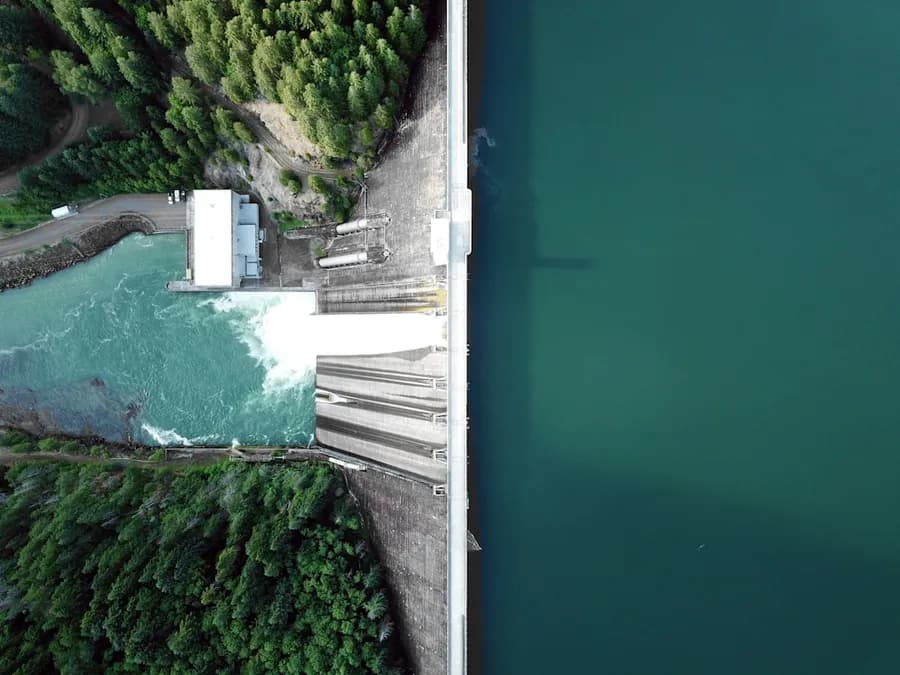
Hydropower energy is generated by moving water. In the most familiar form, a dam stores water in a reservoir and releases it through large pipes called penstocks. As water flows downhill, it spins turbine blades connected to a generator. The generator converts mechanical rotation into electricity, which is then sent to the grid.
Not all hydropower plants rely on large reservoirs. There are three main types:
Reservoir hydropower stores water behind a dam and releases it when electricity is needed. This gives grid operators control, making reservoir plants valuable during peak demand.
Run-of-river hydropower channels part of a river’s natural flow through turbines, often with little or no large storage reservoir. Its output depends more directly on seasonal river conditions.
Pumped storage hydropower acts like a giant water battery. During periods of low electricity demand or high wind and solar output, electricity is used to pump water uphill into an upper reservoir. When demand rises, the water flows back down through turbines to generate power. According to the International Energy Agency, pumped storage accounts for the vast majority of global electricity storage capacity by energy volume.
The technology is mature, but it is not simple. Modern hydropower projects require hydrology, civil engineering, ecology, sediment management, fish passage design, grid planning, and community consent. A dam can operate for 50 to 100 years, sometimes longer, so decisions made at the planning stage can shape river systems and regional economies for generations.
Hydropower’s appeal comes from three traits rarely found together: it is renewable, dispatchable, and capable of large-scale output. Solar panels generate only when sunlight is available. Wind turbines depend on wind conditions. Hydropower, where water storage exists, can often be ramped up or down quickly. That flexibility is increasingly valuable as power systems add more variable renewable energy.
But hydropower is not one technology with one climate profile. A high-head plant in a cold mountain region, a lowland tropical reservoir, a run-of-river project, and a pumped storage facility can have very different environmental footprints. The best projects can provide low-carbon electricity, flood management, irrigation support, and grid stability. Poorly planned projects can fragment rivers, displace communities, alter fisheries, and emit methane from flooded organic matter.
That range of outcomes is why hydropower energy sits at the center of a more complicated climate debate than wind or solar. It can be a powerful tool for decarbonization. It can also create real ecological and social costs if treated as automatically clean.
Hydropower's Role in the Global Energy Mix
Hydropower supplied about 16% of global electricity in 2020, according to the International Energy Agency’s Hydropower Special Market Report published in 2021. That made it the world’s largest source of renewable electricity at the time, ahead of wind and solar combined.
Read next How Climate Change Works: A Clear ExplainerIts role varies widely by country. In Norway, hydropower typically provides the overwhelming majority of electricity generation. Brazil, Canada, Colombia, Ethiopia, Paraguay, and parts of China also rely heavily on river systems for power. In Paraguay, the Itaipu Dam, shared with Brazil, has long been central to national electricity supply. In Canada, hydropower underpins low-carbon grids in provinces such as Quebec, British Columbia, and Manitoba.
China is the world’s largest hydropower producer. The Three Gorges Dam on the Yangtze River has an installed capacity of 22.5 gigawatts, making it one of the largest power stations ever built. Its annual generation varies with river conditions, but in strong water years it can produce electricity on the scale of a large national power fleet.
Globally, hydropower’s installed capacity exceeds 1,300 gigawatts, including conventional hydropower and pumped storage. Yet growth has slowed in many mature markets. The easiest large dam sites in North America and Europe were developed decades ago, while new projects face higher environmental scrutiny, stronger Indigenous rights claims, financing challenges, and climate-related hydrology risks.
The IEA has warned that hydropower growth is not on track with pathways needed for net-zero emissions by mid-century. Its 2021 report found that global hydropower capacity additions were expected to slow during the 2020s compared with the previous decade, even as clean power demand was rising. That creates a tension: the world needs more firm low-carbon power, but the era of building large dams with limited scrutiny is over.
Hydropower also plays a hidden role in grid reliability. Because many plants can adjust output quickly, hydro can help balance sudden changes in demand or renewable generation. In electricity markets with high solar penetration, daytime solar output may surge and then fall sharply in the evening. Hydropower can fill part of that gap if water is available and operating rules allow it.
Pumped storage is especially valuable. Lithium-ion batteries are growing rapidly and are excellent for short-duration balancing, often over one to four hours. Pumped storage can often discharge for longer periods, depending on reservoir size. That makes it useful for overnight balancing, multi-hour peaks, and emergency reserves. The Bath County Pumped Storage Station in Virginia, one of the largest in the world, has a capacity of about 3 gigawatts and has operated for decades as a major grid asset.
Hydropower’s global footprint is therefore larger than its generation share alone suggests. It supplies electricity, stores energy, supports grid stability, and anchors national power systems. But its future role will depend on whether countries can modernize existing assets, add capacity at lower-impact sites, and manage river basins under a warming climate.
How Hydropower Impacts Climate Change Mitigation
The Intergovernmental Panel on Climate Change’s Sixth Assessment Report lists median lifecycle greenhouse gas emissions for hydropower at about 24 grams of carbon dioxide equivalent per kilowatt-hour, compared with roughly 820 grams for coal. That gap explains why hydropower energy has been a major contributor to avoided emissions in power systems.
Lifecycle emissions include construction, operations, maintenance, and reservoir-related greenhouse gases. For most hydropower projects, emissions are far below those of fossil fuel power plants. A coal plant emits carbon dioxide every time fuel is burned. A hydropower facility does not burn fuel during generation.
The climate value can be enormous. When hydropower replaces coal or oil-fired generation, emissions reductions can be substantial. A 1,000-megawatt hydropower facility operating at a 50% capacity factor can generate about 4.4 terawatt-hours per year. If that electricity displaces coal at 820 grams CO2eq per kilowatt-hour, the avoided emissions could approach 3.6 million metric tons of CO2eq annually, before accounting for hydropower’s own lifecycle emissions.
That math is one reason countries with abundant hydropower often have cleaner electricity grids. Norway’s power sector is among the lowest-carbon in the industrialized world largely because of hydropower. Quebec’s grid, dominated by hydro, has helped attract industries seeking low-carbon electricity, from aluminum production to data centers.
Hydropower can also support climate mitigation indirectly. Wind and solar are now among the cheapest sources of new electricity in many regions, but their output fluctuates. Flexible hydropower can reduce the need for gas-fired peaker plants, especially when reservoirs are managed to complement variable renewables. In a net-zero system, flexibility is not a side issue. It is a core requirement.
Yet the emissions profile of hydropower is not uniform. Reservoirs can emit methane, a potent greenhouse gas, when flooded vegetation and organic material decompose under low-oxygen conditions. This risk is higher in warm tropical reservoirs, especially shallow ones with large flooded areas relative to electricity output. Methane can be released from reservoir surfaces, downstream flows, and turbine degassing.
The Balbina Dam in Brazil is often cited as a cautionary example. Built in the Amazon and completed in the late 1980s, it flooded a very large forested area while producing relatively modest electricity. Studies have found that its greenhouse gas emissions per unit of electricity can be high compared with better-sited hydropower projects. Balbina does not represent all hydropower. It represents what can happen when project design, geography, and ecological cost are poorly matched.
By contrast, high-output hydropower projects with smaller flooded areas and colder reservoirs tend to have much lower emissions intensity. Upgrades to existing dams can be especially climate-efficient because they add generation without creating a new reservoir. Replacing old turbines, improving controls, reducing hydraulic losses, and adding generation to existing non-powered dams can increase clean electricity with less new land disturbance.
The U.S. Department of Energy has identified thousands of existing dams in the United States that do not generate electricity. Not all are suitable for conversion, and many should be removed for ecological reasons. But some existing infrastructure may offer low-impact opportunities.
For climate mitigation, the key question is not whether hydropower is clean or dirty in the abstract. The question is whether a specific project, in a specific river basin, with specific operating rules, reduces emissions while meeting credible environmental and social safeguards. Good hydro can support decarbonization. Bad hydro can damage ecosystems and weaken public trust in clean energy policy.
Environmental Benefits and Challenges of Hydropower
A hydropower reservoir can store water for dry seasons, reduce flood peaks, and provide electricity without burning fossil fuels; it can also block fish migration, trap sediment, and transform a living river into a managed water staircase. Both realities are true.
The environmental benefits begin with air quality. Hydropower plants do not emit sulfur dioxide, nitrogen oxides, particulate matter, or mercury during generation. In regions where hydro replaces coal, oil, or diesel generation, public health benefits can be meaningful. Diesel displacement is especially relevant for remote communities and islanded grids, where fuel costs are high and air pollution is local.
Hydropower reservoirs can also provide water services beyond electricity. Multipurpose dams may support irrigation, municipal water supply, flood control, navigation, and drought storage. In parts of Africa and Asia, governments often view hydropower as both an energy project and a development project.
The challenges are equally concrete. Dams fragment rivers. The World Wildlife Fund and other conservation organizations have warned that river fragmentation is one of the major pressures on freshwater biodiversity. Migratory fish such as salmon, sturgeon, eel, and many tropical species depend on connected river systems. Fish ladders and bypass systems can help in some cases, but they rarely restore full ecological function across all species.
Sediment is another problem. Rivers carry sand, silt, gravel, and nutrients downstream. Dams trap much of that material in reservoirs. Over time, sediment buildup can reduce storage capacity and turbine performance. Downstream, sediment-starved rivers may erode channels, shrink deltas, and weaken coastal protection. The Mekong River basin illustrates the stakes. Hydropower development on the mainstream and tributaries has raised concerns about sediment flows, fisheries, and food security for millions of people in Cambodia, Laos, Thailand, and Vietnam.
Reservoirs also change water temperature and oxygen levels. Cold, oxygen-poor water released from deep reservoirs can alter downstream habitat. Rapid changes in hydropower releases, known as hydropeaking, can strand fish, disrupt spawning, and destabilize riverbanks. Environmental flow rules are designed to reduce these impacts by requiring releases that mimic aspects of natural river flow.
The social footprint can be severe. Large dams have displaced tens of millions of people globally over the past century, according to estimates often cited in development literature. Displacement can mean loss of homes, farms, sacred sites, fisheries, and community networks. Compensation programs have frequently fallen short, particularly for Indigenous peoples and rural communities with customary land rights.
The International Hydropower Association has tried to codify stronger performance expectations through the Hydropower Sustainability Standard and related assessment tools. These benchmarks cover governance, biodiversity, Indigenous peoples, labor conditions, resettlement, water quality, erosion, sedimentation, climate mitigation, and climate resilience. Projects are assessed against performance levels rather than treated as sustainable by default.
That shift matters. A credible hydropower project now has to show more than megawatts. It has to demonstrate basin-level planning, transparent consultation, free, prior and informed consent where Indigenous rights are involved, biodiversity safeguards, grievance mechanisms, and long-term monitoring.
There are examples of better practice. In Europe and North America, some aging dams have been removed where their ecological harm outweighed their energy or water value. The removal of dams on the Elwha River in Washington state restored access to salmon habitat and became a landmark case in river restoration. The Klamath River dam removals, spanning California and Oregon, have been among the largest river restoration efforts in the United States.
Dam removal is not the opposite of climate action. In some cases, it is part of better hydropower governance: keep, upgrade, and operate the dams that provide high public value; retire those that impose high ecological costs for little benefit. The future of hydropower depends on that discrimination.
Hydropower and Climate Resilience: Risks from Changing Weather
In 2022, severe drought in Europe reduced river flows, strained electricity systems, and cut hydropower output in several countries just as energy markets were already under pressure from Russia’s invasion of Ukraine. The event exposed a central climate risk: hydropower depends on water, and warming is changing water.
Climate scientists have long warned that global warming intensifies the water cycle. Warmer air holds more moisture, increasing the likelihood of heavier precipitation in some regions, while higher evaporation and altered circulation patterns can deepen drought in others. Snowpack is shrinking in many mountain systems. Glaciers are retreating. Rainfall timing is shifting.
For hydropower, these changes are operationally significant. A plant designed around 20th-century river flows may face a 21st-century regime with earlier snowmelt, longer dry seasons, more intense floods, and greater year-to-year volatility. That makes historic hydrology a weaker guide for future planning.
The western United States offers a clear example. The Colorado River Basin has experienced a prolonged megadrought, intensified by warming temperatures. Lake Mead and Lake Powell, the two largest reservoirs in the United States, fell to historically low levels in the early 2020s. Hydropower generation at Hoover Dam and Glen Canyon Dam declined as reservoir levels dropped. At very low elevations, turbines can become less efficient or even unable to operate.
Brazil has faced similar risks. In 2021, drought reduced reservoir levels and hydropower output, forcing greater reliance on thermal power and contributing to higher electricity costs. Because Brazil’s grid has historically depended heavily on hydro, drought becomes both an energy security issue and a climate issue if fossil generation rises to fill the gap.
China has also seen hydropower vulnerability. In 2022, extreme heat and drought in Sichuan province reduced hydropower generation while electricity demand for cooling surged. Factories faced power restrictions. The episode showed how climate extremes can hit both supply and demand at once.
Expert perspectives from climate scientists increasingly point in the same direction: hydropower can be low-carbon, but it is not climate-proof. Researchers working on climate impacts and water resources emphasize that warming changes the probability distribution of droughts and floods, not just average rainfall. A basin may still receive similar annual precipitation but in fewer, more intense events, with longer dry spells between them. That pattern is difficult for both ecosystems and reservoir management.
The IPCC’s Sixth Assessment Report finds high confidence that climate change has intensified the global water cycle and that many regions will experience increases in hydrological extremes as warming continues. For hydropower planners, that means climate resilience must be built into project design, licensing, and operations.
Resilience measures include stress-testing projects under multiple warming scenarios, updating flood design standards, improving seasonal forecasting, coordinating reservoirs across river basins, and preserving ecological flows even during drought. In some regions, smaller and more distributed hydropower may reduce risk. In others, no new hydro project may be justified if future water reliability is poor.
There is also a governance challenge. During drought, reservoir water may be needed for electricity, irrigation, drinking water, navigation, fisheries, and ecosystem protection. Those demands can conflict. Hydropower licenses and water rights systems must define priorities before crisis conditions arrive.
Climate change does not eliminate hydropower’s value. It changes the terms of investment. The strongest projects will be those designed for variable hydrology, integrated with wind and solar, and governed transparently across competing water needs.
Innovations in Sustainable Hydropower Technology
More than half of many countries’ hydropower capacity comes from plants built decades ago, which means some of the fastest gains can come from modernization rather than new dams. Better turbines, digital controls, and smarter operations can increase output while reducing environmental harm.
Turbine upgrades are a practical starting point. Modern runners can improve efficiency across a wider range of flows. Fish-friendly turbine designs aim to reduce blade strike, pressure changes, and shear stress for downstream migrating fish. The U.S. Department of Energy has supported research into turbines that improve fish passage survival while maintaining generation.
Digitalization is changing operations. Sensors, automated controls, satellite data, and machine learning can improve inflow forecasting, sediment management, maintenance scheduling, and coordination with solar and wind. Better forecasting allows operators to decide when to store water, when to generate, and when to preserve reserves for drought periods.
Environmental flow technology is also advancing. Instead of fixed minimum releases, some projects now use more dynamic flow regimes designed to support spawning, migration, sediment movement, and floodplain connectivity. These rules are harder to manage than simple release schedules, but they better reflect how rivers work.
Sediment management is another critical frontier. Techniques include sediment bypass tunnels, sluicing, flushing, dredging, and reservoir drawdown strategies. Japan and Switzerland have used sediment bypass systems in some mountainous basins to route sediment around dams during high-flow events. These systems can extend reservoir life and reduce downstream sediment starvation.
Floating solar on hydropower reservoirs is gaining attention. Solar panels installed on reservoir surfaces can use existing grid connections and reduce evaporation in some settings. Pairing solar with hydropower can also smooth output: solar generates during daylight hours, while hydropower can shift generation to evening peaks. China, India, Brazil, and several Southeast Asian countries have explored or deployed floating solar on reservoirs.
Pumped storage is being redesigned for a renewable-heavy grid. Traditional pumped storage often uses large reservoirs and significant land areas. Newer concepts include closed-loop pumped storage, where reservoirs are not built on a major river system. Closed-loop designs can reduce impacts on fish migration and river flows, though they still require careful land, water, and community assessment.
Existing infrastructure may offer lower-conflict opportunities. Adding generation to irrigation canals, water supply systems, wastewater outfalls, and non-powered dams can produce electricity without building major new river barriers. These projects are usually smaller, but they can be useful locally and avoid some of the largest ecological costs.
There is also innovation in project assessment. The International Hydropower Association’s sustainability benchmarks and the Hydropower Sustainability Standard give governments, developers, lenders, and civil society a common framework for evaluating performance. These tools do not remove conflict, but they raise the bar for evidence. A project claiming sustainability should be able to show how it manages biodiversity, sediment, Indigenous rights, labor standards, greenhouse gas emissions, and climate resilience.
Finance is beginning to reflect these standards. Development banks and private lenders increasingly require stronger environmental and social safeguards before funding hydropower. Poorly governed projects face reputational, legal, and financial risk. Well-governed modernization projects, by contrast, may attract climate finance because they can add low-carbon flexibility without the footprint of a new megadam.
The most promising innovation may be a planning shift: from project-by-project dam building to basin-scale decision-making. A river basin is a connected system. Building one dam can alter the value and impact of every dam downstream. Basin planning can identify which rivers should remain free-flowing, which existing dams should be upgraded, where pumped storage might work with lower ecological cost, and how climate risk should shape long-term water allocation.
Sustainable hydropower is less about a single breakthrough machine than about disciplined choices. The technology exists. The harder task is using it only where the total public value is strong.
The Future of Hydropower in a Net-Zero World
The IEA’s net-zero analysis shows that clean electricity must expand rapidly this decade, and hydropower remains the largest established source of renewable power. Yet its future will be defined less by building ever-larger dams and more by upgrading existing assets, adding storage, protecting rivers, and planning for climate volatility.
Hydropower energy can serve three major roles in a net-zero power system.
First, it can provide low-carbon generation. Many countries still burn coal, oil, and gas for electricity. Where hydropower projects meet strong environmental and social standards, they can reduce fossil fuel dependence.
Second, it can provide flexibility. As solar and wind grow, grids need resources that can respond quickly. Reservoir hydropower and pumped storage can ramp output, store energy, and provide ancillary services such as frequency control.
Third, it can support water security if governed carefully. Multipurpose reservoirs may help manage floods and droughts, but only if climate risk, ecosystem health, and community rights are built into operating rules.
The strongest growth opportunities are likely to fall into several categories: modernization of aging plants, pumped storage for long-duration flexibility, power generation at existing non-powered dams, canal and water-system hydropower, and carefully selected new projects in regions with strong governance and clear development needs.
Africa illustrates both the promise and the difficulty. The continent has vast undeveloped hydropower potential and major electricity access needs. Ethiopia’s Grand Ethiopian Renaissance Dam, built on the Blue Nile, has become one of Africa’s most consequential energy projects, with an installed capacity planned above 5 gigawatts. It also shows how hydropower can become geopolitically sensitive when downstream countries depend on the same river. The dispute among Ethiopia, Sudan, and Egypt underscores the need for basin diplomacy, data sharing, and cooperative drought management.
In South Asia, Himalayan hydropower offers large potential but faces risks from earthquakes, landslides, glacial lake outburst floods, and changing snow and glacier dynamics. In February 2021, a flood disaster in Uttarakhand, India, damaged hydropower infrastructure and killed many workers and residents. Scientists have linked such mountain hazards to complex interactions among geology, weather extremes, and cryosphere change. Future projects in high mountain regions will need far more rigorous risk assessment.
In Europe and the United States, the future may be less about new large dams and more about relicensing, refurbishment, dam safety, river restoration, and pumped storage. Many dams are aging. Some are valuable clean energy assets. Others no longer serve their original purpose. Public policy will need to sort them carefully.
The International Hydropower Association has argued that hydropower development aligned with sustainability standards can support the Paris Agreement and the United Nations Sustainable Development Goals. That is plausible, but only if standards are enforced in practice. Certification cannot be a marketing exercise. Communities need real participation. Biodiversity impacts need measurable mitigation. Climate resilience needs scenario-based design. Reservoir emissions need transparent accounting.
Hydropower’s future will also depend on competition. Solar, wind, batteries, geothermal, advanced nuclear, demand response, and transmission expansion are all moving quickly. In many markets, new solar and wind are cheaper and faster to build than large hydro. That does not make hydropower obsolete. It means hydro must compete on its strongest attributes: long asset life, grid flexibility, storage, inertia, and firm capacity.
The climate case for hydropower is strongest when it avoids three mistakes. The first is assuming all hydro is automatically sustainable. The second is rejecting all hydro because some projects have caused serious harm. The third is planning based on yesterday’s water.
A net-zero world will need abundant clean electricity and resilient water systems. Hydropower can help provide both, but only under stricter rules than those that shaped much of the 20th century. The next era should prioritize high-value upgrades, low-impact storage, basin-scale planning, Indigenous and community rights, and climate-tested operations.
Hydropower is not a relic. Nor is it a universal answer. It is a powerful, site-specific tool. Used well, it can reduce emissions, stabilize renewable grids, and support water management. Used poorly, it can damage rivers and communities for generations. The difference lies in evidence, governance, and the willingness to treat every river as more than a source of megawatts.
Related coverage