Inside Apple's Creative Process: How Notebooks Inspired the iPhone Duo
The object that reportedly sat on Apple's design studio reference shelves while the iPhone Duo took shape wasn't a rival foldable device or a CAD rendering — it was a pocket notebook. That detail, surfaced in a candid interview with GQ published in September 2026, reframes how one of the most technically complex consumer electronics products in recent memory came to be: not through pure engineering ambition, but through an attempt to replicate the casual, familiar confidence of reaching for a small bound book.
The iPhone Duo design, at its core, is Apple's answer to a question the foldable smartphone category has struggled to resolve since Samsung launched the original Galaxy Fold in 2019: how do you give people more screen without making the device feel like a burden to carry? Apple's design team chose to answer it by looking not at the competition, but at an object optimized for portability across centuries.
The relationship between physical notebooks and portable computing is not incidental. Notebook computers took their name from the same idea. In the Duo's case, however, the reference goes deeper than metaphor — it became a design specification.
Meet the Designers: Ternus, Anderson, and Lemay on the iPhone Duo
Three of Apple's most senior figures sat for the GQ conversation: CEO John Ternus, Vice President of Industrial Design Molly Anderson, and Vice President of Human Interface Design Steve Lemay. The seniority of that lineup is itself a signal. Apple rarely assembles its top design leadership for a single press engagement unless the product in question represents something the company considers genuinely consequential.
Read next iPhone Duo's Hidden Fake Bezel Setting ExplainedTernus leads Apple at the product-strategy level, having guided some of its most technically demanding hardware cycles before ascending to the chief executive role. Anderson oversees the physical character of every Apple product — the materials, the geometry, and the tactile qualities that users experience before a screen ever illuminates. Lemay owns the software layer: how information is organized, animated, and made navigable across Apple's operating systems. That three disciplines this distinct converged on a single interview reflects the fundamental nature of the challenge. iPhone Duo design could not be resolved by hardware engineering or software design independently. Both had to speak the same language from the earliest conceptual sketches.
Anderson's explanation to GQ is worth quoting directly. "Everyone knows what a notebook feels like in the pocket and what it feels like to carry around," she said. "So that was a big part of the inspiration: 'How do you get to something that gives you space but also feels compact?'" It is a deceptively simple framing for an extraordinarily difficult mechanical and geometric problem.
Engineering the Hinge: Variable Torque and the Feel of Opening
Hinges are the mechanical component that have most visibly separated successful foldable phones from failed ones. Early entrants from several manufacturers suffered from mechanisms that felt fragile, created visible creases in the display, or failed to hold a chosen angle with confidence. Apple's approach, as Anderson described it, centers on a custom variable torque profile — a hinge that does not apply uniform resistance across its range of motion.
In Apple's implementation, the mechanism is tuned to feel easy to open in the initial stage of the gesture, reducing the effort required when first separating the two halves, before biasing the device toward a stable resting position as it approaches fully open. The result is an opening motion that feels considered rather than mechanical — closer to cracking open a well-made hardback than actuating a consumer electronics clasp.
This matters more than it might appear. Counterpoint Research has consistently identified hinge feel and display crease among the physical attributes most likely to determine whether foldable device owners recommend the product to others. A hinge that opens with appropriate ease but holds reliably is not a minor refinement; it is a primary driver of the form factor earning sustained daily use. Apple has held patents relating to variable-resistance hinge mechanisms for several years, suggesting the company studied this specific problem long before the Duo reached production scale.
A-Series Paper Proportions and the Science of the Dual Display
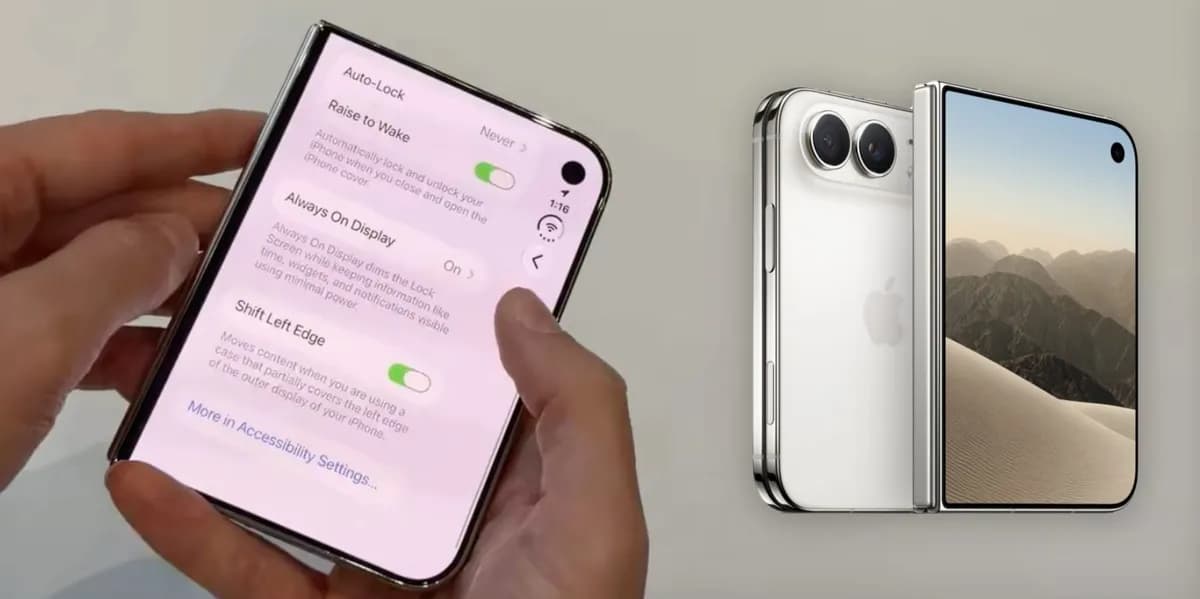
One of the more technically specific disclosures in the GQ interview concerns the geometric system Apple used to determine the iPhone Duo's dimensions. Anderson confirmed that the device's proportions derive from the international ISO 216 A-series paper standard — the same mathematical framework that defines the A4 sheets used in offices across most of the world.
The A-series system rests on a single elegant property: a rectangle whose sides observe a 1:√2 ratio can be folded exactly in half to produce two smaller rectangles with the identical proportions. A sheet of A4 folded once becomes two sheets of A5. A3 folded once yields A4. The shape is self-similar at every scale in the series.
Applied to a foldable phone, this means the iPhone Duo's open display and its closed footprint share the same aspect ratio. A user handling the device in its closed state sees the same proportional geometry as when it is fully unfolded. There are no awkward intermediate shapes — no squarish closed profile bearing no visual relationship to the elongated open display. The geometry is continuous throughout the device's range of use.
The practical benefit extends beyond aesthetics. Self-similar proportions make it substantially easier for developers to design layouts that translate coherently between folded and unfolded states. Screen real estate doubles, but the shape language does not change. That consistency reduces cognitive load for both the developer designing the interface and the user navigating it.
Human Interface Principles: Moving Between Two Screens
Steve Lemay's contributions to the GQ interview address the experience of moving between the Duo's two displays — a challenge with no direct precedent in Apple's product history. The iPhone has always been a single-screen device. The iPad introduced a larger canvas, but one that does not fold. The Duo requires a genuinely new mental model.
Lemay's approach treats the transition between displays not as a mode switch but as a spatial expansion. Rather than designing software to interpret folded and unfolded states as two separate contexts demanding two distinct orientations, the human interface team built around the idea that the open display is simply more of the same space — a natural continuation of what the user was already doing.
This principle carries significant implications for how applications behave. Rather than requiring developers to produce separate layouts for each display state, Apple's framework appears designed to let content reflow and expand organically, much as a document in a word processor reflows when its window is resized. The user's place is preserved; the content simply gains room.
IDC's ongoing research into foldable smartphone adoption has repeatedly flagged software optimization — or the absence of it — as the most frequently cited friction point among users considering whether to stay with the form factor on their next upgrade cycle. A hardware design as carefully considered as the Duo's ultimately lives or dies on whether the software matches its ambitions.
What Apple's Design Reveal Signals About Future iPhone Innovation
Apple's decision to explain the iPhone Duo design in this level of detail, through a GQ interview featuring three senior executives, departs from the company's characteristic reticence. Apple rarely articulates design rationale publicly, and almost never does so while a product is newly launched rather than years after the fact.
The transparency serves a purpose. The foldable smartphone segment remains a relatively small fraction of global smartphone shipments, though Counterpoint Research and IDC both track it as among the fastest-growing premium device categories. By grounding the Duo's design in legible, verifiable systems — the ISO 216 paper standard, the variable torque hinge profile, the principle of proportional self-similarity — Apple is making an argument not only about this product but about its design methodology as a competitive differentiator.
The notebook analogy Anderson describes is, on reflection, an unusually direct window into how Apple's process begins. Not with a display diagonal target or a specification table, but with a question about how an object feels in a hand and in a pocket. That starting point, and the A-series geometry it produced, suggests future iPhone development will continue to measure itself against objects people already trust — and that the Duo is a template, not a terminus.
Those original notebook sketches, now revealed as the conceptual anchor for one of the most anticipated product launches in Apple's recent history, point toward a design culture still more concerned with human scale than with the outer limits of what manufacturing can produce.