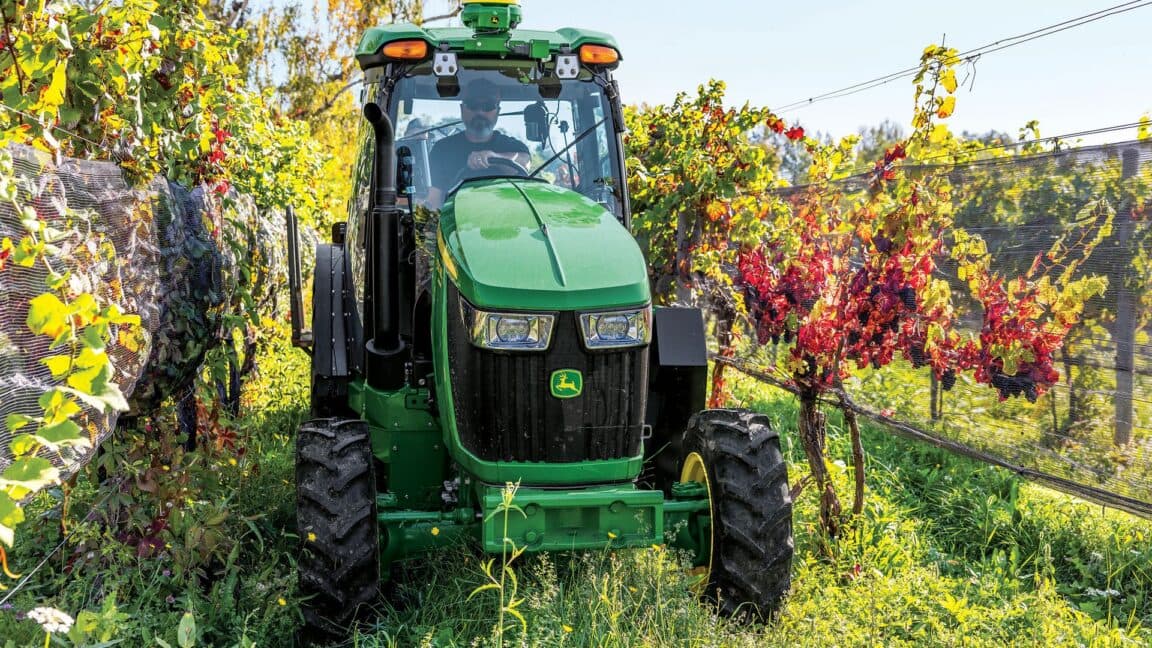
There is something wrong with the tractor. A red notification flares on a laptop screen, flagging a disconnected water-in-fuel sensor on a John Deere 5130ML sitting on the grass outside the company's Santa Clara, California offices. The person at the keyboard is not a farmer. Is not a mechanic. Is a journalist, typing a question into diagnostic software that immediately surfaces instructions and photographs pulled from the machine's own user manual — matched, automatically, to its serial number.
The technology works. Whether it works for farmers is a different question entirely.
What Is John Deere's Self-Repair Service?
John Deere's self-repair program is the company's formal answer to years of mounting pressure from farmers, right-to-repair advocates, and state legislators who argued that proprietary software locks had effectively stripped equipment owners of the ability to fix what they own. The service gives customers access to diagnostic software, repair documentation, and guided troubleshooting tools — the same category of resources that previously lived exclusively inside authorized dealership networks.
At its core, the system works by connecting a laptop directly to a piece of equipment via cable. Once linked, the software reads the machine's serial number, cross-references it against the relevant documentation, and surfaces repair guidance tailored to that specific unit. For simple fault codes and sensor issues, the workflow is intuitive. A user can query the system conversationally, and it returns step-by-step instructions alongside images drawn from the official manual.
The backstory to this offering is rooted in regulatory and reputational pressure. In January 2023, John Deere signed a memorandum of understanding with the American Farm Bureau Federation, committing to expand access to diagnostic tools, software, and parts documentation for customers and independent repair technicians by 2027. The agreement stopped short of binding legislation but signaled the company recognized the political temperature had changed. By that point, more than two dozen states had introduced right-to-repair bills targeting agricultural equipment specifically, and the Federal Trade Commission had issued a report calling repair restrictions anti-competitive.
A Hands-On Look at the Repair Process
The Santa Clara demonstration was designed to show the system at its most capable. The fault: a disconnected water-in-fuel sensor, a component that monitors diesel integrity in the engine. It is the kind of problem a technician would typically diagnose, document, and charge for at a dealership — a trip that, depending on location and schedule, could take days to arrange.
Read next Top Technology Trends in 2026 You Need to KnowIn the demo environment, the process was faster. After establishing the cable connection between the laptop and the 5130ML, the diagnostic interface identified the active fault code without prompting. Typing a plain-language question into the software brought up structured guidance: which manual section applied, what the sensor does, how to inspect the connection, and photographs illustrating the physical layout of the component.
For someone with mechanical inclination and a clear workspace, the path from notification to repair looks manageable. The manual integration is the standout feature — rather than hunting through a PDF or calling a dealer's service line, relevant documentation surfaces automatically around the specific machine and the specific problem.
But the demo conditions matter. Santa Clara is not a muddy field in central Iowa at 6 a.m. during corn harvest. The laptop was charged. The cable connection was clean. The fault was known in advance. Real farm diagnostics rarely arrive so neatly packaged.
Why Farmers Remain Skeptical
The gap between a controlled demonstration and a working farm is wide, and farmers know it better than anyone.
Several structural concerns feed the skepticism. First, connectivity. The current John Deere self-repair tools require a physical cable link between the laptop and the machine. In remote agricultural settings — where cellular signals are inconsistent and the nearest Wi-Fi might be miles away — even software-based solutions can become logistical puzzles. If future iterations move toward wireless or cloud-dependent diagnostics, rural broadband gaps become a direct barrier to repair access.
Second, parts availability. Diagnostic clarity does not automatically translate into a repair completed. Knowing that a sensor is disconnected is one step; having the replacement part on hand, or being able to source it quickly from an independent supplier rather than an authorized dealer, is another. Right-to-repair advocates, including U.S. PIRG and the Repair Association, have long argued that parts availability and pricing are as consequential as software access — and that without addressing both, diagnostic tools become a partial solution to a systemic problem.
Third, trust accumulated slowly is spent quickly. John Deere's history with its customer base on repair issues is complicated. For years, the company's software locked out third-party technicians and even some farmers from performing basic repairs, requiring expensive dealer visits for problems that older generations of equipment would have taken a wrench to fix. That history does not dissolve because of a memorandum of understanding or a press demo. Farmers who have waited seasons for dealer service appointments, or who have watched critical planting or harvest windows close while a machine sat idle, carry that experience into every conversation about what the company now offers.
Agricultural economists have flagged equipment downtime as a significant and underappreciated cost driver on American farms. Research from university extension services in major grain-producing states has noted that a single day of unplanned downtime during peak harvest can translate to substantial yield losses — losses that compound when weather windows are narrow. When the repair infrastructure depends on dealer availability, parts supply chains, and proprietary software access, that downtime risk multiplies. The self-repair tools are theoretically a partial mitigation. Farmers want evidence they work under real conditions, not Santa Clara ones.
The Broader Right-to-Repair Battle in Agriculture
Agriculture has become one of the most politically active fronts in the right-to-repair movement. Unlike consumer electronics, where repair access is a convenience and environmental issue, farm equipment repair is a livelihood issue. The machines are expensive — large tractors routinely cost more than $500,000 — and the windows for their operation are biologically fixed.
The 2023 John Deere memorandum with the American Farm Bureau Federation was widely described as a voluntary compromise designed to forestall binding legislation. Whether it succeeds in doing so remains to be seen. Colorado passed an agricultural right-to-repair law in 2023, becoming the first state to enact such legislation, and other states have continued to advance bills. The FTC's position, articulated in its 2021 report "Nixing the Fix," remains that repair restrictions harm consumers and competition.
The Repair Association, an advocacy coalition representing repair businesses and consumer groups, has argued that voluntary commitments from manufacturers are insufficient without enforcement mechanisms. The organization has tracked the economic toll of locked repair ecosystems, estimating that restricted access forces consumers and businesses into manufacturer-controlled channels that command premium pricing and longer wait times. For farmers, those premiums and delays are not abstract — they affect whether a crop comes in on time.
Independent repair technicians, a category of worker that once formed the backbone of rural equipment service, have been another casualty of software-locked systems. When proprietary diagnostics are required to complete a repair, technicians without dealer certification cannot do the work. That narrows competition, reduces service options in rural communities already facing business attrition, and concentrates repair revenue inside manufacturer networks.
What This Means for the Future of Farm Equipment Repair
John Deere's self-repair tools are a meaningful step, and they should be assessed as one. The technology demonstrated in Santa Clara is real, functional, and represents a genuine expansion of what equipment owners can attempt without a dealer visit. For straightforward fault codes and sensor issues, the guided documentation approach works.
The harder question is whether the program's scope, implementation, and long-term trajectory match the depth of the problem it is meant to address. Farmers need more than access to a diagnostic interface. They need assurance that parts are available through competitive supply chains, that independent technicians can be certified and equipped, and that the tools remain accessible even as equipment software grows more complex.
John Deere self-repair, in its current form, is best understood as a floor, not a ceiling. The farm bureau memorandum set a 2027 deadline for expanded access commitments. The next few years will determine whether that commitment produces durable infrastructure for independent repair — or whether it functions primarily as a pressure-release valve that delays more substantive regulatory action.
Farmers have seen enough promises about equipment access to know the difference between a press demo and a policy. The tractor in Santa Clara started working again. The trust between a major equipment manufacturer and its customers takes considerably longer to fix.
Source: Ars Technica - All content


