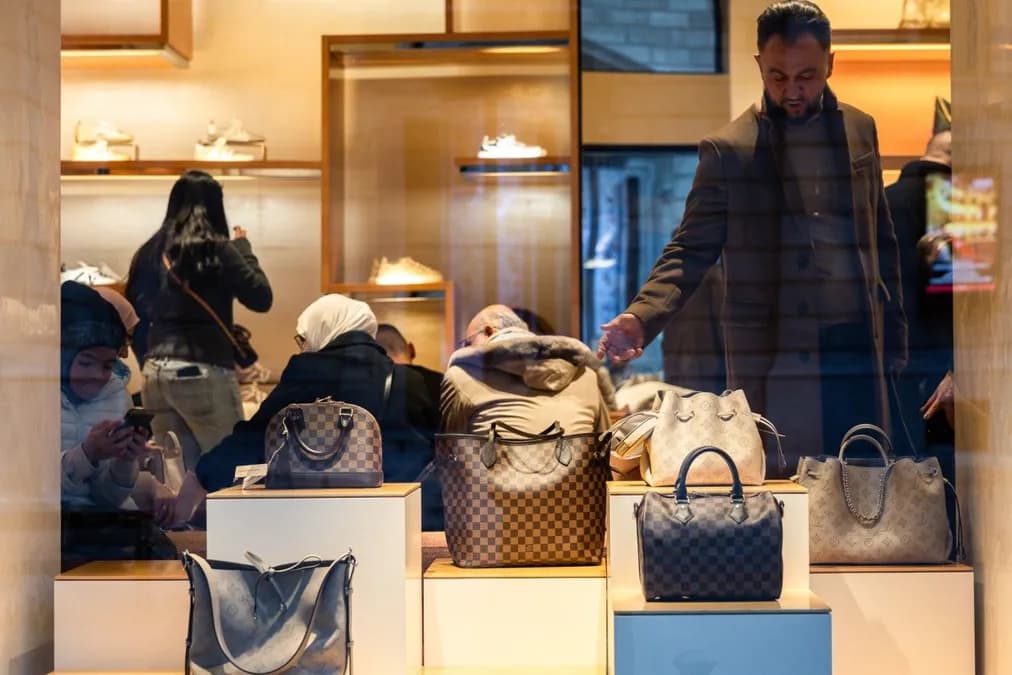
The End of Luxury's Two-Decade Bull Run
For most of the past twenty years, owning LVMH Moët Hennessy Louis Vuitton meant owning a compounder that behaved less like a retailer and more like a toll road on global wealth creation. Between the mid-2000s and the 2021 peak, LVMH's shares routinely commanded forward price-to-earnings multiples in the high-20s to mid-30s, and at the frothiest moments of the post-pandemic luxury boom, north of 40x. The MSCI Europe Textiles, Apparel & Luxury Goods index traded at a persistent premium to the broad European market that at times exceeded 100%. That premium was never an accident. It reflected a set of assumptions investors treated as near-axiomatic: pricing power that outpaced inflation, a Chinese consumer whose appetite seemed bottomless, and margins that expanded almost mechanically as scale grew.
Those assumptions are now being tested in ways the market has not seen since the 2008–2009 crisis. According to reporting from The Wall Street Journal, the trends that made luxury companies such a brilliant investment over the past two decades are fading. That single sentence carries enormous weight for anyone holding LVMH stock valuation models built on the old regime. The question is no longer whether the premium existed — it is whether it can ever be rebuilt, and what investors should do while the market decides.
LVMH Stock Now Trades Like Fast Fashion: What the Numbers Say

The compression is stark when you lay the multiples side by side. During the 2010s, LVMH's EV/EBITDA rarely dipped below 14x and spent much of the decade in the 16x–19x range — a valuation band that implied perpetual mid-to-high single-digit revenue growth with stable or rising margins. Fast-fashion peers like Inditex and H&M, by contrast, historically traded in the 8x–12x EV/EBITDA range, reflecting their exposure to discretionary spending, fashion risk, and thinner pricing power.
Read next Altman: OpenAI IPO 'Ill-Advised' in 2026 | AI ValuationsThe WSJ's framing — that luxury stocks are now "selling at fast-fashion prices" — signals that this gap has narrowed dramatically. When a category leader that once justified a 30x forward P/E drifts toward multiples associated with mass-market apparel, the market is repricing not just near-term earnings but the durability of the entire business model. That is a fundamentally different kind of de-rating than a cyclical drawdown. Cyclical de-ratings reverse when demand returns. Structural de-ratings require the market to rebuild conviction in a growth story it no longer believes.
The symmetry with the 2013–2015 luxury slowdown is instructive but imperfect. During that earlier episode, LVMH's multiple compressed roughly 20–25% before recovering within eighteen months as Chinese demand reaccelerated. The current episode arrives with the sector's premium already eroded and no obvious catalyst to restore it. Investors who bought the 2021 highs are sitting on a valuation reset that has outpaced any earnings decline — the classic signature of multiple compression rather than earnings disappointment.
The Structural Forces Pressuring Luxury Stocks

Three forces are doing the heaviest lifting in this repricing, and none of them is transitory.
The first is Chinese demand. Bain & Company's annual luxury studies have documented that Greater China grew to roughly a fifth of global personal luxury goods sales by the early 2020s, up from under 10% a decade earlier. That concentration made luxury equities a leveraged bet on Chinese consumer confidence — and Chinese consumer confidence has been weak for an extended stretch, weighed down by property-sector stress and cautious household balance sheets. Euromonitor data on discretionary spending categories has echoed the same theme: aspiration-driven purchases are being deferred, not eliminated, and deferred demand does not compound the way recurring demand does.
The second force is aspirational trade-down. The entry-level luxury consumer — the buyer of a €400 wallet or a €900 sneaker — has proven far more cyclical than the ultra-high-net-worth clientele that anchors the top of the pyramid. When that cohort pulls back, volume falls faster than price, and the mix shift hits margins. Companies that spent a decade pushing prices up to capture aspirational demand now face the awkward arithmetic of defending price integrity while volumes soften.
The third is normalization of the post-pandemic surge. The 2021–2022 luxury boom pulled forward years of demand into a compressed window. Reverting to trend growth is not a crisis, but it is incompatible with multiples that priced in permanent acceleration. The WSJ's observation that the two-decade investment case is fading is, in essence, the market admitting that the trend line was always lower than the boom suggested.
What LVMH Investors Should Watch Next
Sell-side positioning has shifted accordingly. As reported in the coverage of this de-rating, analysts covering the sector have been marking down earnings trajectories for luxury names as demand normalizes, with the debate centering less on whether estimates fall and more on how far. The bear argument is straightforward: if Chinese demand stays soft and aspirational buyers remain cautious, current consensus estimates still embed too much optimism, and the multiple has further to compress. The bull counterargument is equally coherent: LVMH's brand portfolio — anchored by Louis Vuitton, Dior, and a stable of category-defining houses — has survived every prior demand cycle, and the ultra-wealthy cohort that drives the majority of profits has shown remarkable resilience across macro regimes.
For investors, the actionable watch items are concrete. First, organic revenue growth in the fashion and leather goods division, which is the earnings engine and the truest read on pricing power. Second, gross margin trajectory — a company that can hold price through a volume downturn preserves the premium narrative; one that discounts destroys it. Third, management commentary on Chinese footfall and conversion, which leads reported revenue by a quarter or two. Fourth, capital allocation: buybacks executed at compressed multiples create more per-share value than buybacks at 35x, and how aggressively management repurchases into weakness is a signal about its own confidence in the long-term model.
Is This a Buying Opportunity or a Value Trap?
The honest answer is that it depends on which premium you think is deserved. If LVMH's sustainable growth is high-single-digit with stable margins, a 20x–25x forward P/E is defensible, and current levels may offer reasonable entry for patient capital. If the structural headwinds in China and aspirational trade-down prove durable, fair value sits closer to the fast-fashion band the market is now assigning, and today's "cheap" multiple is simply the market finally getting it right.
The distinction between opportunity and trap hinges on a single question: was the 20-year premium a reflection of genuine, durable competitive advantage, or was it a momentum-driven anomaly inflated by a once-in-a-generation Chinese wealth boom and a pandemic-era demand surge? The evidence suggests it was some of both. LVMH's brand equity is real and not easily replicated. But the multiple it carried assumed a growth rate that the underlying demand environment may no longer support. That is the definition of a value trap for investors who anchor on historical multiples — and the definition of an opportunity for those who underwrite the business on normalized, not peak, assumptions.
Key Takeaways for Luxury Sector Investors
The WSJ's report marks a genuine inflection, not a headline. Luxury's two-decade premium was built on assumptions — relentless Chinese demand, aspirational expansion, and permanent pricing power — that are now being repriced in real time. For LVMH investors, the practical implications are these: expect multiple compression to dominate returns more than earnings growth for the foreseeable future; watch fashion and leather goods organic growth and gross margin as the two metrics that will confirm or deny the bull case; treat buyback activity at depressed multiples as a genuine signal of management conviction; and resist the instinct to buy simply because a stock that once traded at 35x now trades at 20x. Cheap relative to history is not the same as cheap relative to fundamentals. The next leg of luxury investing will be won by investors who underwrite normalized growth, not by those waiting for the old premium to return.
Source: WSJ.com: Markets