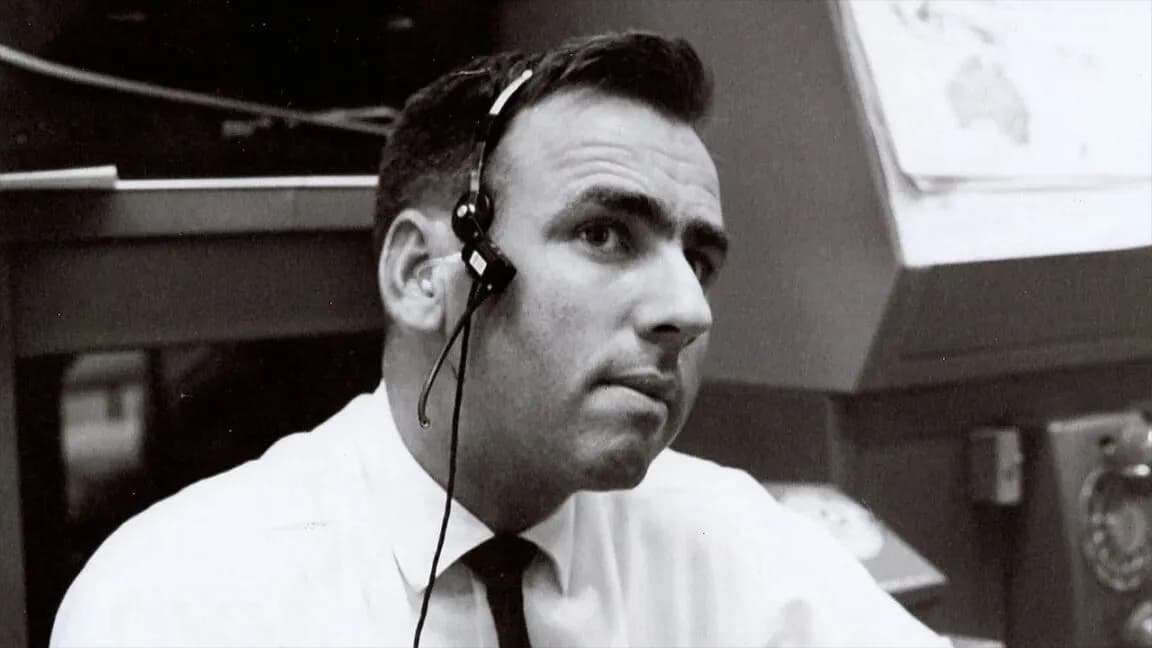
Milt Windler, a NASA flight director who helped lead Mission Control's round-the-clock effort to bring the Apollo 13 astronauts home in 1970, has died at 94, Ars Technica reported on October 3, 2026. A brief family notice said he died on a Thursday, surrounded by his loving family.
Who Was Milt Windler?
Milt Windler was an American spaceflight veteran who rose from recovery work on NASA's early crewed programs to become a flight director in 1968. According to Ars Technica, he worked on recovery operations during the Mercury and Gemini programs before NASA named him to the post.
That path matters. Recovery work meant thinking about the end of a mission, about how crews and spacecraft get home. A flight director carries the same concern through every phase of a flight. Windler's early career was in bringing people back, and his later career is remembered for a mission whose entire goal became exactly that.
A flight director is the person who leads a team of flight controllers in Mission Control and holds overall responsibility for the real-time conduct of a mission during their shift. The specialists at the consoles advise. The flight director weighs the advice and makes the call.
Ars Technica's report describes Windler as one of the leaders of Mission Control during some of the most consequential flights of the Apollo era. It also covers his later work on America's first space station.
How Did Milt Windler Help Save Apollo 13?
Windler was one of four Mission Control leaders who directed the round-the-clock effort to return the Apollo 13 astronauts safely to Earth in 1970, according to Ars Technica. That is the achievement most often tied to his name.
Read next Laika's Wildwood: Stop-Motion Fantasy at TIFF 2026The source is specific about the structure of that effort. Four leaders shared the work, and the work ran continuously. Spaceflight in this period relied on shifts, with each flight director commanding a team of controllers for a stretch before handing off to the next. A crisis that lasted days could not be managed by one person's stamina. It needed a chain of qualified leaders who could take over a problem mid-stream and carry it forward without losing the thread.
This is a point about the job, not an embellishment of Windler's personal role. The reported facts are that he was among the four, and that the team's effort brought the crew back safely. The public record that Ars Technica summarizes does not break down which decisions belonged to which director, and this article does not guess.
What the structure does show is why the work was collective. The Apollo 13 recovery was a sustained operation that relied on the handoff discipline flight directors practiced on every mission, and Windler was one of the people who held that line.
Which NASA Missions Did Milt Windler Lead?
Windler led a shift of flight controllers on Apollo 8, Apollo 10, Apollo 12, Apollo 14 and Apollo 15, and he was one of four Mission Control leaders on Apollo 13, according to Ars Technica. Those flights span several of the program's major firsts and milestones.
The report describes Apollo 8 as the first circumlunar flight and Apollo 10 as the lunar landing dress rehearsal. It identifies Apollo 12, Apollo 14 and Apollo 15 as the second, third and fourth moon landings.
| Mission | Description in Ars Technica's report | Windler's role |
|---|---|---|
| Apollo 8 | First circumlunar flight | Led a shift of flight controllers |
| Apollo 10 | Lunar landing dress rehearsal | Led a shift of flight controllers |
| Apollo 12 | Second moon landing | Led a shift of flight controllers |
| Apollo 13 | Round-the-clock effort to return the crew in 1970 | One of four Mission Control leaders |
| Apollo 14 | Third moon landing | Led a shift of flight controllers |
| Apollo 15 | Fourth moon landing | Led a shift of flight controllers |
Taken together, the list shows range. A circumlunar flight, a rehearsal for landing, three landings and a rescue are different problems. Each demands its own preparation, its own contingency thinking and its own tolerance for uncertainty. A flight director who appears across all of them has shown he could adapt as the program's ambitions changed.
A short timeline from the reported facts
- Mercury and Gemini programs: Windler works on recovery operations.
- 1968: NASA names him a flight director.
- Apollo missions: He leads shifts on Apollo 8 and Apollo 10.
- 1970: He is one of four leaders directing the effort to return the Apollo 13 crew.
- After Apollo 13: He leads shifts on Apollo 12, Apollo 14 and Apollo 15, per the source's list of his missions.
- Skylab: He serves as a flight director for all three crewed missions to the station.
- Thursday before October 3, 2026: He dies at 94, per the family notice cited by Ars Technica.
The source gives the 1968 and 1970 dates explicitly. It does not date the other missions here, so this article does not add dates the report does not supply. The ordering above follows the way the report presents his career, not a confirmed launch calendar.
What Was Milt Windler's Role on Skylab?
Windler served as a flight director for all three crewed missions to Skylab, the United States' first space station, according to Ars Technica. The detail closes out the career arc the report lays out.
Skylab changed what Mission Control was managing. Lunar flights were short, intense journeys with a clear destination. A space station is a place where people live and work. The control team's job shifts from a sprint toward a destination to the steady care of a crew and a vehicle over time.
The source does not describe what Windler did on each Skylab mission, and this article will not invent it. The reported fact is simple and strong. He was a flight director on every one of the three crewed missions, so the same leader who worked the Moon flights helped carry NASA's operational experience into its first orbital outpost.
That continuity is itself informative. Agencies keep programs alive by moving experienced people from one effort to the next, and Windler's record shows that pattern: Mercury and Gemini recovery, then Apollo, then Skylab.
When and How Did Milt Windler Die?
Milt Windler died at 94 on a Thursday, surrounded by his loving family, according to a brief notice posted online and cited by Ars Technica. The report was published on October 3, 2026.
The notice is short, and the public reporting does not include a cause of death. This article does not speculate about one. It also leaves aside private details beyond what the family chose to share.
Two facts are worth stating plainly. First, his age: 94, as reported in October 2026. Second, the setting: with his family around him. Those are the details the notice supports, and they are the ones the record can carry.
Ars Technica, which carried the news, is the source for this report. Readers looking for the family's own wording or for any memorial arrangements should look to the original notice and to the publication's coverage, since neither is detailed in the summary this piece relies on.
Why Does the Legacy of Apollo-Era Flight Directors Still Matter?
Apollo-era flight directors matter because they built the working model of real-time mission leadership that human spaceflight still draws on. Windler's career, as Ars Technica outlines it, touches nearly every major kind of flight the program attempted.
The legacy has three parts, each grounded in the reported record:
- Shift-based command. The Apollo 13 effort was directed by four leaders working around the clock, per Ars Technica. The model proved that a crisis can be sustained by a team of equals who hand off cleanly.
- Breadth of experience. Windler's missions included a circumlunar flight, a landing rehearsal, three landings and a rescue. Few careers cover that much ground.
- Continuity into Skylab. His work on all three crewed Skylab missions links the Moon program to the era of orbital stations.
His death also marks the thinning of a generation. The people who ran those consoles are leaving, and each obituary is a prompt to preserve what they did. The recovery operations he worked on early in his career, the lunar flights and the station missions are all part of a record that will increasingly live in archives and reporting rather than in memory.
What This Means
This section is analysis, not reported fact.
For general readers, Windler's death is a reminder that famous rescues are team achievements. The reported record credits four Mission Control leaders on Apollo 13, not one, and that framing is the accurate one.
For anyone following spaceflight today, the practical lesson is about institutions. Programs that last depend on handoffs, shared procedures and people who carry experience from one mission type to the next. Windler's path from recovery work to Apollo to Skylab illustrates that in a single career.
For researchers and writers, the reporting gaps matter. The public summary leaves out his specific decisions on each mission and any cause of death. Anyone writing about him should stay inside what sources such as Ars Technica, NASA's own records and the family notice actually say.
Source: Ars Technica - All content