What Is the Nacon Revolution 5 Unlimited?
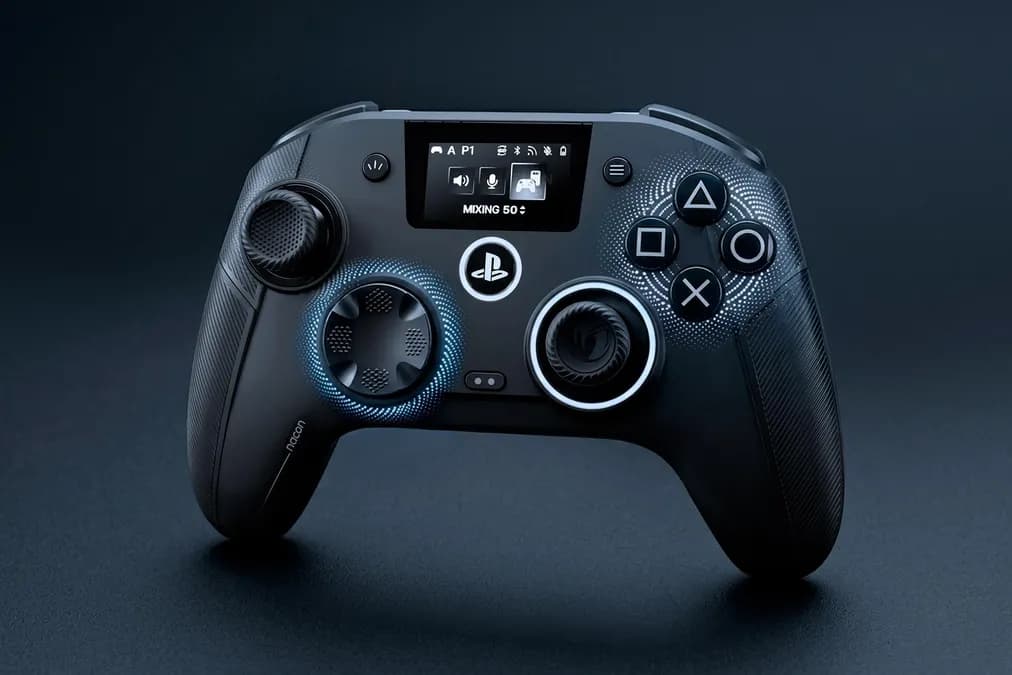
On October 2, 2026, Nacon became the first accessory maker to announce an officially licensed PlayStation 5 controller with a built-in display. The Nacon Revolution 5 Unlimited is a wireless gamepad that carries Sony's licensing badge and replaces the traditional companion-app workflow with an onboard screen for settings and audio control. That combination — official PlayStation approval plus a screen — has not appeared together in a licensed PS5 product before.
The core pitch is consolidation. Instead of pausing a game, opening a phone app, waiting for a Bluetooth handshake, and then tweaking a deadzone slider, players adjust settings directly on the controller. Nacon says the screen handles joystick sensitivity tuning and button remapping. The same display also functions as an audio mixer, a feature the company is positioning as a genuine differentiator rather than a novelty.
The name matters as much as the spec sheet. "Unlimited" suggests Nacon intends this as a flagship entry in its Revolution line, the range that built the company's reputation among console players who want more customization than a first-party DualSense offers. Sony's licensing program is not automatic entry; manufacturers submit hardware for review against Sony's technical and quality standards, and approved products can carry official PlayStation branding. That review process exists so consumers can trust that a third-party pad will pair cleanly, wake the console reliably, and behave predictably across firmware updates. Earning that badge is a meaningful hurdle, and Nacon has cleared it before. Doing so with a screen on board is new.
For PS5 owners who have watched the third-party controller market fill up with pads that look ambitious but stumble on basics — flaky wireless, drifting sticks, broken haptics — the licensing label carries real informational weight. It is not a guarantee of excellence. It is a signal that the product met a defined bar.
The Built-In Screen: A First for Licensed PS5 Controllers
Picture the last time you wanted to raise your right stick sensitivity mid-match. On a standard PS5 setup, that means leaving the game, navigating menus, or reaching for a phone app — a process measured in tens of seconds, not milliseconds. The Revolution 5 Unlimited collapses that into an on-controller interaction. Nacon claims it is the first officially licensed PS5 controller to offer this, and based on the current licensed landscape, that claim holds.
Read next Laika's Wildwood: Stop-Motion Fantasy at TIFF 2026Why does this matter beyond convenience? Because competitive and semi-pro players treat controller settings as fluid variables, not fixed preferences. A player might run low sensitivity for precision aiming in a tactical shooter, then switch to a faster response curve when moving to a different title. The friction of that switch has always been the enemy. Onboard controls remove it.
The screen also addresses a quieter problem: app fatigue. Most premium third-party controllers rely on companion software for remapping macros, adjusting trigger travel, or saving multiple profiles. These apps vary wildly in quality across iOS and Android, and support tends to decay as phones update. Hardware-based configuration sidesteps that lifecycle entirely. As long as the controller works, the settings interface works.
There are open questions the announcement does not answer. Screen size, resolution, battery impact, and whether profiles save to onboard memory or require a connection are all unspecified. Battery is the most consequential unknown. Every lit display draws power, and a wireless controller already balances rumble, haptics, and radio against runtime. How Nacon manages that trade-off will determine whether the screen feels like an upgrade or a tax.
Ergonomics specialists would also flag weight and balance. Adding a display shifts mass toward the center of the pad, which can alter how a controller sits in the hands during long sessions. Pro players are notoriously sensitive to this. A few dozen grams in the wrong place changes grip pressure and fatigue over a four-hour scrim block. Until units are in hands, this remains an unknown.
Audio Mixing From Phone and Console Simultaneously
The audio feature is where the Revolution 5 Unlimited gets genuinely interesting. According to Nacon, the controller can mix audio from multiple sources, so a player wearing headphones can hear game audio from the PS5 and phone audio at the same time. Discord calls, voice chat, music, a podcast, a phone call — all layered on top of console sound through one headset.
This solves a real and stubborn problem. Console players who want to chat on Discord while gaming typically juggle multiple devices: a headset for game audio, earbuds for the call, a phone propped somewhere visible. Mixing both sources through the controller's screen means adjusting the balance between them without unplugging anything. For streamers, that is a workflow improvement. For players coordinating with friends who are not on PlayStation, it removes a genuinely annoying layer of hardware.
Audio control is an underrated axis of competitive performance. Semi-pro players often cite footstep clarity as a decisive factor in shooters, and the ability to duck game audio versus voice chat without leaving the game is a capability that first-party pads do not offer natively. If Nacon's implementation is clean — low latency, no channel bleed, independent volume curves — this single feature could justify the product for a specific slice of the audience.
It also fits a broader pattern in gaming peripherals: manufacturers selling control over the environment, not just the input. Mixing, EQ, and per-source volume are the kinds of features that once required a dedicated audio interface or a PC-based solution. Shrinking that into a gamepad is a meaningful engineering claim, and one that Sony's licensing review presumably scrutinized.
Nacon's Position in the PlayStation Accessories Market
The gaming accessories market is not a rounding error on the industry's balance sheet. Analyst tracking from firms including Newzoo and Circana has repeatedly shown accessories as one of the more resilient segments of gaming spend, outperforming software in some quarters as players extend the life of hardware they already own. A player who spends $500 on a console and $70 on a game will often spend another $100 to $200 on a headset, a spare pad, or a charging dock over the same period. Sony's own licensing program exists precisely because that spend is substantial and worth capturing under controlled quality standards.
The third-party PlayStation controller segment has historically been a mixed bag. Some licensed pads delivered solid value. Others shipped with mushy face buttons, unreliable wireless, or build quality that did not survive a year of play. That history is why the "officially licensed" label does real work in a buyer's decision — and why Nacon's track record matters. The company has spent years building the Revolution brand around back buttons, trigger stops, and weight customization, features that cater to players who treat the DualSense as a starting point rather than a finished tool.
Positioning a screen-equipped flagship at the top of that lineup is a logical move. It creates a clear halo product, differentiates Nacon from competitors who are still iterating on paddles and grips, and gives the licensing program a marquee example of what approved third parties can attempt. If it sells, expect other licensed manufacturers to explore onboard interfaces. If it stumbles, the screen concept may be shelved for a generation.
Who Should Consider the Revolution 5 Unlimited?
Three buyer profiles stand out. The first is the multi-platform communicator: someone who plays on PS5 while staying in a Discord call or monitoring a phone, and who is tired of the two-headset shuffle. The audio mixing feature is aimed directly at them.
The second is the settings tinkerer. Players who maintain separate sensitivity profiles across shooters, fighters, and racing games, and who currently manage that through an app they resent. Onboard adjustment is a genuine quality-of-life upgrade for this group.
The third is the competitive-adjacent player — not esports, but the person who plays ranked modes nightly and cares about stick response and button mapping. For them, the screen is useful but the fundamentals matter more: stick module quality, trigger feel, wireless latency, and durability. A licensed badge helps here, but hands-on reviews will decide it.
Skippers include casual players who never touch sensitivity settings, anyone happy with a stock DualSense, and buyers who prioritize battery life above all else. Until Nacon publishes runtime figures, the screen is a legitimate reason for that last group to wait.
Final Verdict: Is This the Most Feature-Rich Licensed PS5 Controller?
On paper, yes — and the paper is notable. A built-in screen, on-controller remapping, sensitivity tuning, and simultaneous phone-plus-console audio mixing, all under Sony's official licensing umbrella, is a feature set no other licensed PS5 pad currently matches. The Nacon Revolution 5 Unlimited is making a specific bet: that players want control consolidated into the device in their hands rather than spread across apps and phones.
That bet is reasonable. It is not yet proven. Pricing, battery life, screen usability, and long-term durability are all unresolved, and those are the variables that separate a genuinely great controller from a spec sheet that reads well. What Nacon has demonstrated so far is that the licensed PS5 accessory category still has room for real invention. Whether the screen becomes a standard feature or a one-off experiment depends on execution — and on players deciding the trade-offs are worth it.
Source: The Verge