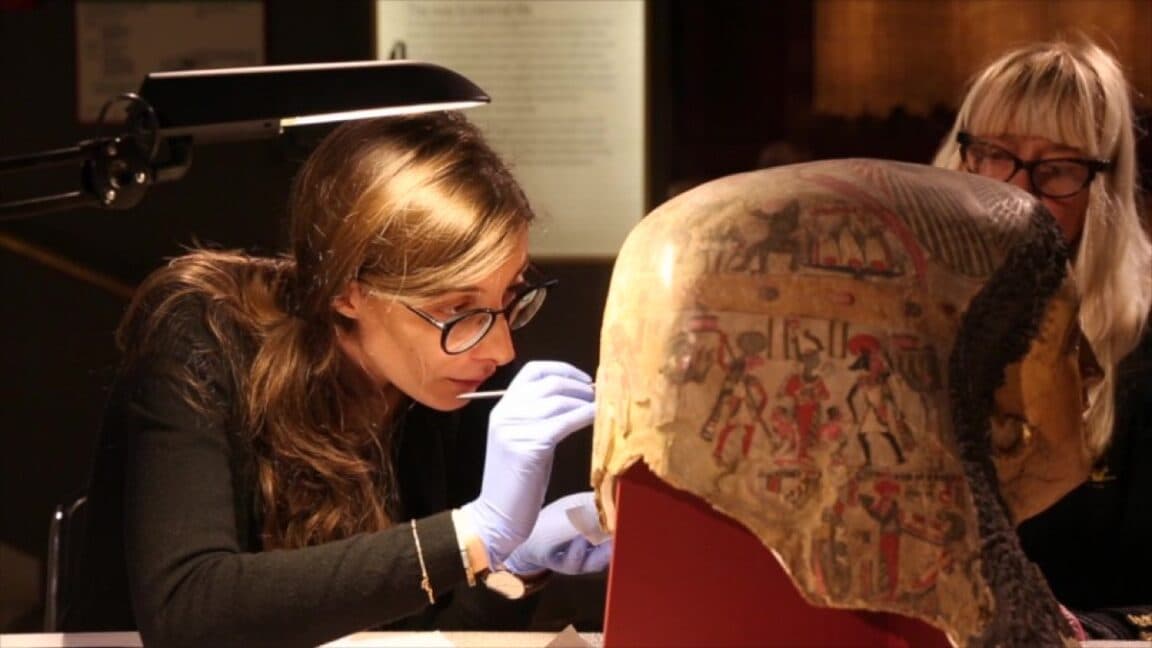
A single sesame seed's worth of protein residue—invisible to the naked eye, embedded in a 3,000-year-old adhesive—can now tell conservation scientists more about Egyptian craft traditions than a full chemical assay could a decade ago. That is the promise delivered by a new study published in Science Advances, in which researchers applied mass spectrometry-based proteomics to a broad set of Egyptian artifacts, identifying the biological origins of the glues and binders that hold them together. The work represents a quiet revolution in how ancient Egyptian proteomics is reshaping archaeology, delivering molecular-level insight without removing a single visible flake of material from irreplaceable objects.
What Is Proteomics and Why Does It Matter for Archaeology
Proteomics is the large-scale study of proteins—the molecular machines that build and operate living tissues. In archaeology, it works like a forensic tool. Proteins degrade over millennia, but fragments survive, and their amino acid sequences carry signatures specific to the organism that produced them: cattle, sheep, birds, eggs, or plants. Mass spectrometry can read those fragments with extraordinary precision, even when the original sample weighs less than a grain of sand.
That precision matters because proteins are cultural fingerprints. A binder made from egg white tells a different story than one made from animal collagen. Each points to a distinct workshop tradition, supply chain, or ritual practice. Until recently, identifying these materials required wet chemistry that consumed samples—an unacceptable trade-off for museum collections where every artifact is finite and often unique.
The Science Advances paper demonstrates how far the field has come. By analyzing proteins rather than pigments or bulk materials, the researchers accessed a layer of information that previous techniques simply could not reach.
The Challenge of Analyzing Ancient Egyptian Artifacts

Egyptian collections worldwide—including those held by institutions such as the Museum of Mediterranean and Near Eastern Antiquities in Stockholm, which provided imagery associated with this research—face a persistent dilemma. Scholars want to understand how objects were made, but the objects themselves are too valuable to sacrifice.
Read next Top Technology Trends in 2026 You Need to KnowTraditional analysis methods carry real costs. Sampling a painted coffin fragment or a gilded mask means removing material that cannot be replaced. Over decades, cumulative sampling can degrade an object's integrity, altering surfaces that conservators are ethically bound to protect. For smaller artifacts—beads, amulets, cosmetic containers—there may be no safe place to sample at all.
Non-destructive and minimally invasive techniques have therefore become the holy grail of conservation science. Techniques such as reflectance spectroscopy and X-ray fluorescence have helped identify pigments without contact, but proteins and organic binders remained stubbornly difficult to characterize. Proteomics closes that gap. Because it can work with trace residues—micrograms or less—it allows analysis with negligible impact on the artifact. The breakthrough is not merely technical. It preserves the object as a primary source while still extracting the scientific data locked inside it.
What Researchers Found in the Adhesives and Glues

The team behind the Science Advances study cast a wide net across Egyptian artifacts, targeting the glues and adhesives used in their construction. Some results were unsurprising. Animal collagens appeared, consistent with the hide and bone glues used across the ancient world. Egg proteins also showed up, confirming what textual and artistic evidence had long suggested about egg-based binders in Egyptian craft.
Then came the unexpected entries: plant proteins, specifically from sesame and from the drumstick tree, also known as moringa. Both are crops with deep roots in northeastern Africa and the Near East. Sesame was cultivated for its oil-rich seeds; moringa was valued for its edible leaves, pods, and seeds. Finding their proteins in adhesive residues suggests these plants played a role in material preparation that historians had not fully documented.
This matters because adhesives are not glamorous. They are the hidden infrastructure of ancient craft. Identifying plant proteins in them expands the known repertoire of Egyptian materials and raises new questions about how workshops sourced, processed, and combined ingredients. The presence of sesame and moringa proteins points toward a more botanically sophisticated toolkit than the collagen-and-egg narrative alone would imply.
Implications for Egyptian Art and Conservation Science
Every new material identified changes how conservators approach treatment. If an adhesive contains plant proteins rather than animal collagen, its response to humidity, solvents, and temperature will differ. Cleaning a surface with a method calibrated for collagen could damage a moringa-based binder. The proteomic data therefore feeds directly into practical conservation decisions—what to use, what to avoid, and how to store objects for the long term.
The interdisciplinary nature of this work is its strength. Chemists operate the mass spectrometers. Egyptologists interpret the cultural context. Conservation scientists translate findings into treatment protocols. No single discipline could produce these results alone, and the Science Advances publication reflects that collaboration.
There is also a scholarly payoff. Binder composition can help authenticate objects, detect forgeries, and trace trade networks. If sesame proteins appear in adhesives from a specific site or period, that pattern becomes a marker—a molecular signature that can link artifacts to workshops, regions, or eras. Over time, such signatures could build into a map of Egyptian material practice as detailed as the visual style that already defines the civilization in the popular imagination.
The Broader Picture: Egyptian Pigments and Painting Techniques
Adhesives do not exist in isolation. They work alongside pigments, and the Egyptian palette is one of the best-documented in the ancient world. Reds came from hematite and realgar. Yellows drew on goethite. These minerals were ground, mixed with binders, and applied in a highly formalized painting style so recognizable that even untrained viewers can identify Egyptian art at a glance.
That formalization is precisely why material analysis is so valuable. Style tells us what artists wanted to depict. Materials tell us how they did it—what they mixed, what they substituted, and what they imported. The pigments have been studied for generations. The binders have not, largely because they are harder to detect and require techniques like proteomics to characterize. By identifying plant proteins alongside the expected animal and egg sources, the new research adds a missing chapter to a story that pigment studies alone could never complete.
It also complicates the picture in productive ways. A painting is a composite: pigment, binder, ground layer, and varnish. Each component can degrade differently, and each carries its own chemical signature. Understanding binders at the protein level gives conservators a more complete model of how these layered objects age—and how to slow that aging.
What This Discovery Means for Future Artifact Research
Sesame and moringa proteins in Egyptian adhesives are a beginning, not an endpoint. The methods demonstrated in the Science Advances paper are scalable. Museum collections hold thousands of objects with organic residues that have never been analyzed because the techniques did not exist or were considered too destructive. Proteomics now offers a path to study them without harm.
Expect several lines of follow-up. Researchers can compare binder composition across sites and dynasties to see whether recipes changed over time. They can examine whether plant-based adhesives correlate with specific artifact types—wood, textile, papyrus, or stone. They can test whether sesame and moringa appear in imported objects, which would signal trade in raw materials rather than finished goods.
For museum professionals, the message is straightforward: the analytical toolkit has expanded, and the ethical barrier to using it has fallen. For everyone else, the lesson is subtler. Ancient Egyptian proteomics reveals that the civilization's genius was not confined to monumental architecture or golden masks. It extended to the workshop bench, where artisans blended collagen, egg, sesame, and moringa into adhesives that have held their creations together for millennia—and that are only now giving up their secrets.
Source: Ars Technica - All content


