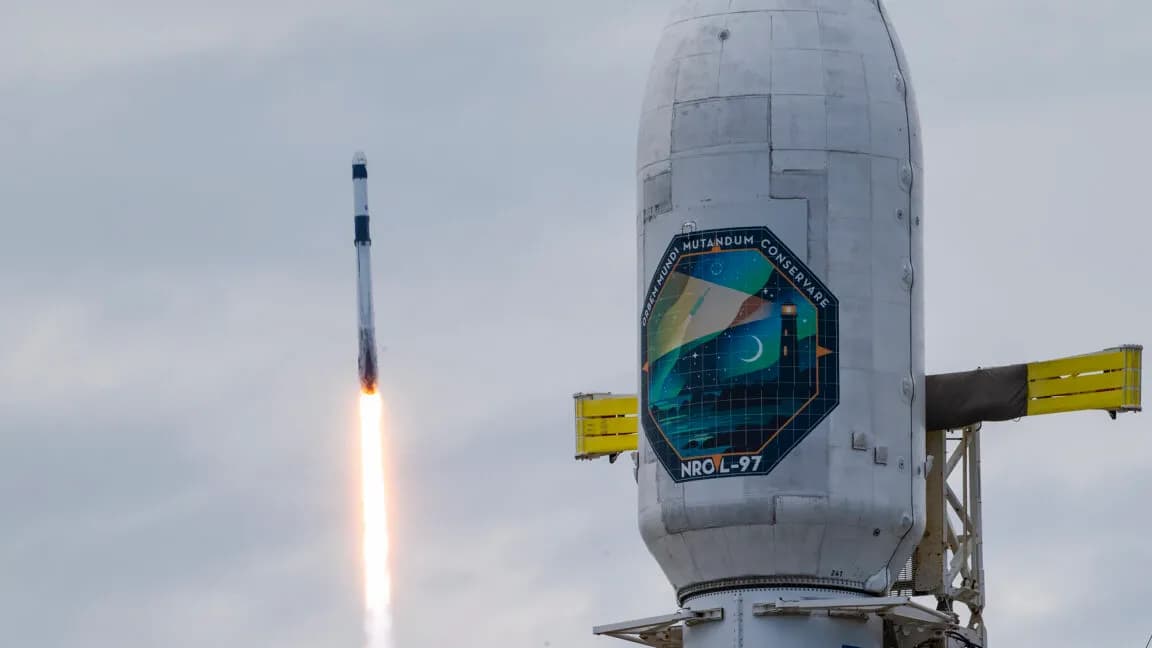
SpaceX Achieves First Orbital Starship Flight After 14 Attempts
Fourteen flights. That is the number that separates Starship's development campaign from the tidy milestones often implied by press releases. Monday morning's launch finally pushed the vehicle into low-Earth orbit, technically and demonstrably, after a test program that had repeatedly reached the edge of orbital velocity without crossing the line. The distinction between "almost orbital" and "orbital" is not a matter of public relations. It is a matter of energy, trajectory, and — as SpaceX itself framed the earlier flights — a deliberate choice to avoid stranding a fully fueled super-heavy vehicle in space without a controlled disposal plan.
That restraint is worth examining. Starship had already flown trajectories that took it roughly 99 percent of the way to orbit on prior attempts, held back by safety considerations rather than propulsion limits. Reaching orbit, then, was less a question of raw capability than of closing the final margin with confidence that the vehicle could be safely managed after engine cutoff. Monday's flight resolved that.
The 14-flight count should be read as an engineering data point, not a delay. SpaceX's own Falcon 9 reached operational reusability through an iterative test campaign that saw multiple failed booster landings before the first successful recovery. Each failure generated aerodynamic, thermal, and structural data that no ground test could replicate at full scale. Starship's path has followed the same logic at a much larger scale: a super-heavy booster and upper stage that together represent a step change in thrust and propellant mass, developed primarily through flight rather than through exhaustive pre-flight qualification. Fourteen flights to orbit is fast by the standards of vehicles this size. NASA's Saturn V, by comparison, reached orbit on its second flight but benefited from decades of prior rocket development and a national mandate that tolerated enormous cost. Starship is attempting something different — a reusable, high-cadence system developed in public, with each flight treated as a test article rather than a one-off.
Starlink V3 Satellites Deployed: What This Means for the Network

The first 26 Starlink V3 satellites rode Monday's flight to orbit. That payload figure is the more consequential detail for the commercial side of SpaceX's business. Starlink is already the largest satellite constellation in low-Earth orbit, with thousands of spacecraft in service, but V3 represents a generational capacity jump. Larger satellites generally mean more capable phased-array antennas, higher power budgets, and greater throughput per spacecraft. Deploying them on a super-heavy rocket is the only practical way to get that mass to orbit at scale.
Read next Laika's Wildwood: Stop-Motion Fantasy at TIFF 2026The arithmetic matters here. A constellation's aggregate capacity is a function of both the number of satellites and the bandwidth each one can deliver. Upgrading from earlier Starlink generations to V3 multiplies the second variable while the first continues to grow. Industry analysts who track the low-Earth-orbit broadband market have consistently projected that capacity, not coverage, will become the binding constraint as demand for satellite internet expands in maritime, aviation, and rural terrestrial markets. The first 26 V3 satellites are a rounding error against the constellation's eventual size, but they validate the deployment pathway: a rocket that can lift a meaningful batch of large satellites in a single flight.
That pathway is the real unlock. Before Monday, SpaceX had a super-heavy rocket that could nearly reach orbit and a next-generation satellite design waiting for a ride. After Monday, both halves of that equation exist simultaneously. Starlink's growth potential, as the company has characterized it, is now constrained less by launch capability than by manufacturing rate and ground infrastructure.
SpaceX Completes a Launch Triple-Header

Starship's orbital debut did not happen in isolation. SpaceX completed a triple-header of launches during the same period, a cadence that has become routine for the company's Falcon line even as Starship enters the mix. The operational significance of a triple-header is easy to overlook. Launch cadence is a systems problem — range scheduling, payload integration, propellant logistics, recovery operations, and ground crew availability all have to align. A company that can execute three launches in short succession is demonstrating industrial maturity, not just engineering capability.
For SpaceX, the cadence also serves a strategic purpose. Falcon 9 remains the workhorse for commercial and government customers, while Starship moves toward operational status. Running both programs concurrently spreads risk. If Starship's orbital campaign slows, Falcon continues to generate revenue and maintain Starlink's deployment schedule. If Starship accelerates, the company gains a vehicle with a payload capacity that no competitor currently matches.
Rocket Lab Secures a Major New Contract
Rocket Lab's contract win is notable for what it says about the small-launch market's maturation. The company's Electron rocket has become one of the most frequently flown small-lift vehicles, with a launch manifest that includes commercial, civil, and defense customers. A large contract award signals that institutional buyers — particularly in the defense and government space sectors — are willing to commit to dedicated small-launch capacity over extended periods rather than procuring launches one at a time.
That shift matters because the small-launch segment has consolidated. Several would-be competitors have struggled to reach consistent flight rates, and the customers who depend on small dedicated launches have gravitated toward providers with demonstrated reliability. Rocket Lab has also pursued a larger vehicle, Neutron, intended to serve the medium-lift market and to compete for constellation deployment work that currently flows to Falcon 9. A significant contract win provides both revenue and credibility as that program advances.
Defense and commercial satellite demand trends support the case. Governments are fielding proliferated architectures — many smaller satellites in low-Earth orbit rather than a few large ones in geostationary orbit — which increases the number of dedicated launches required. Commercial operators building their own constellations need the same cadence. Rocket Lab's position in that market is strengthened by the fact that it operates its own launch site and manufactures its own engines and avionics, giving it more control over schedule than providers dependent on external suppliers.
Implications for the Broader Commercial Space Industry
Two data points from this week frame the competitive landscape. First, Starship reached orbit with 26 next-generation satellites aboard, demonstrating that a super-heavy reusable vehicle can deploy a meaningful payload batch. Second, Rocket Lab secured a large contract, demonstrating that the small-launch market has a durable institutional customer base. These are not competing developments. They describe two ends of a launch market that is segmenting by payload class and mission type.
The middle of that market is where the pressure will be felt. Medium-lift vehicles must justify their cost against a Falcon 9 that flies frequently and a Starship that, once operational, offers far greater capacity per flight. Rocket Lab's Neutron is designed for exactly that squeeze. Whether it succeeds depends on execution and on whether customers value a dedicated medium-lift option enough to pay a premium over rideshare on a larger vehicle.
For satellite operators, the practical effect of Starship's orbital milestone is optionality. A vehicle that can lift large batches of V3 satellites changes the economics of constellation deployment and replenishment. That, in turn, affects how operators design their spacecraft: larger, more capable satellites become viable when launch mass is less constrained. The feedback loop between launch capacity and satellite design has historically driven generational shifts in the industry, from the smallsat revolution enabled by rideshare pricing to the proliferated architectures now favored by defense agencies.
What to Watch Next in the Rocket Report
The next question for SpaceX is cadence. A single orbital flight proves the trajectory; repeated orbital flights prove the system. Watch for how quickly Starship returns to the pad, whether the booster recovery profile advances, and whether V3 satellite deployment becomes a regular manifest item rather than a demonstration. Each of those milestones carries more operational weight than the first orbital insertion itself.
For Rocket Lab, the contract win raises the question of capacity. Can the company increase Electron's flight rate while simultaneously maturing Neutron? The answer will determine whether it remains a small-launch specialist or becomes a broader provider. Both companies are now operating in a market where demonstrated flight history — not promised capability — sets the terms of competition.
Source: Ars Technica - All content