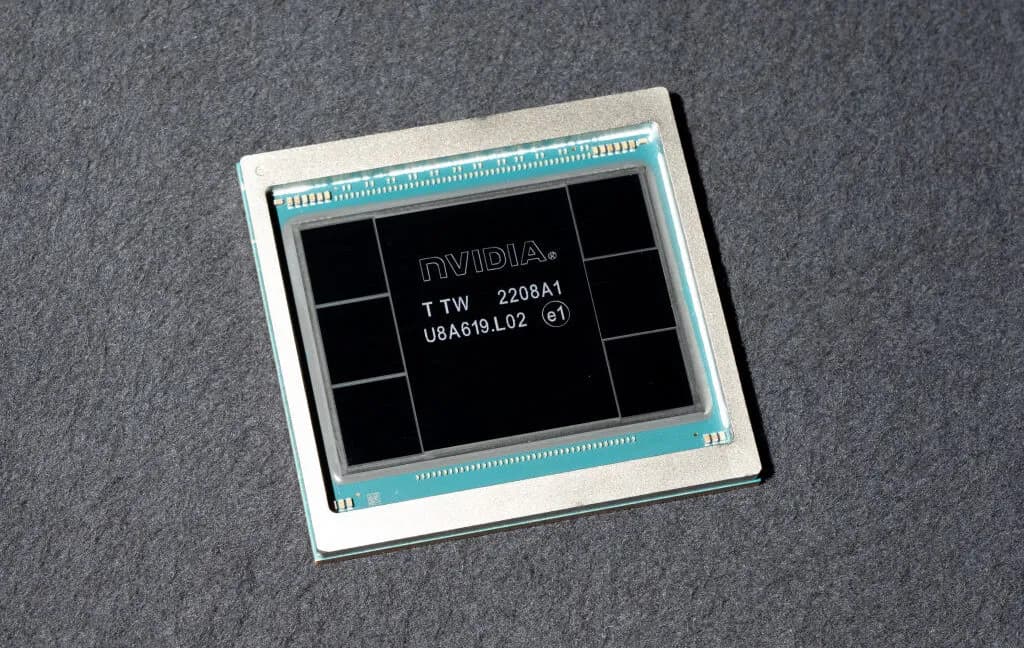
US Arrests Tech CEO Over $300M Nvidia Chip Smuggling Operation
Federal agents arrested 38-year-old Greg Lui on charges that he orchestrated a smuggling pipeline moving more than $300 million worth of export-controlled computer servers into China, the Department of Justice announced Thursday. Lui served as chief executive of Earthmade Computer, a position that prosecutors say he used to coordinate the illicit diversion of hardware built around Nvidia's most tightly regulated data center processors.
According to the FBI's indictment, Lui relied on falsified paperwork to obscure the true destination of the shipments. The servers, which contained high-end Nvidia chips, were routed through intermediary countries before allegedly reaching Chinese buyers. Prosecutors say Lui knew the end destination was China and structured the transactions specifically to defeat U.S. export controls.
The arrest adds another name to a growing roster of defendants charged in connection with semiconductor diversion. It also underscores how the $300 million figure — while substantial on its own — represents only a fraction of the estimated value of controlled chips flowing out of the United States through illicit channels each year.
Earthmade Computer has not issued a public statement on the charges. The DOJ's press release did not indicate whether additional defendants are expected, though the indictment's references to "conspirators" suggest the investigation remains active.
Which Nvidia Chips Were at the Center of the Case
The indictment names two specific processors: Nvidia's A100 and H100 GPUs. Both are data center accelerators designed for large-scale artificial intelligence training and inference. Neither is Nvidia's most advanced product — the company has since released newer architectures — but both remain extraordinarily capable machines for training large language models and running the compute-heavy workloads that define modern AI development.
Read next Laika's Wildwood: Stop-Motion Fantasy at TIFF 2026The A100 launched in 2020 and quickly became the workhorse of the AI boom. The H100, introduced in 2022, delivered a substantial performance jump and became the most sought-after chip in the industry during the generative AI surge. Both are classified under U.S. export control rules as items requiring a license for shipment to China, a restriction that took effect in October 2022 when the Bureau of Industry and Security (BIS) issued sweeping new regulations targeting advanced computing semiconductors.
Those October 2022 rules established performance-density thresholds that captured the A100 and H100 specifically. The regulations also extended controls to related software, technology, and equipment, and imposed restrictions on U.S. persons supporting Chinese advanced chip development. Subsequent updates in 2023 and 2024 tightened the thresholds further and closed loopholes that had allowed some downgraded chips to reach China legally.
The H100 in particular has become a black-market staple. Its combination of high memory bandwidth and transformer-engine acceleration makes it uniquely valuable for training models at scale. A single H100 can cost between $25,000 and $40,000 on the open market, and demand has consistently outstripped supply since its release. That scarcity — combined with China's inability to legally purchase the chip — creates enormous profit incentives for smugglers.
The Role of South Asian Freight Forwarders in the Scheme
Lui allegedly worked with freight-forwarding firms in Malaysia and Singapore to move the servers. These countries occupy a strategically useful position in the semiconductor supply chain: both are major transshipment hubs with established logistics infrastructure, and both host legitimate semiconductor assembly and testing operations. That legitimate activity provides cover for illicit shipments.
The pattern is familiar to export control investigators. A server leaves the United States with paperwork listing a Malaysian or Singaporean consignee. Once it arrives, the shipment is re-documented and forwarded to China. The original U.S. exporter never files a license application because, on paper, the destination is not China.
Freight forwarders are required under U.S. law to exercise due diligence about the end users of controlled items they handle. The indictment alleges that the firms involved either knowingly participated or failed to ask questions they were obligated to ask. Prosecutors have not named the forwarding companies.
Malaysia and Singapore have both cooperated with U.S. export control investigations in recent years. Singaporean authorities have publicly stated their commitment to enforcing multilateral export controls, and Malaysia has tightened its own re-export regulations. But the volume of trade flowing through both countries makes comprehensive screening difficult.
Why the US Restricts Advanced Chips to China
The October 2022 BIS rules represented the most significant expansion of U.S. export controls on semiconductors since the Cold War. The stated rationale: advanced AI chips can be used to develop weapons systems, conduct surveillance at scale, and accelerate military modernization. The Department of Defense and intelligence community have warned that Chinese access to sufficient AI compute could erode U.S. military advantages in areas ranging from autonomous systems to cryptography.
The controls target not just chips but the entire ecosystem. BIS restricted exports of advanced chip manufacturing equipment, software tools for chip design, and even the services of U.S. persons working on Chinese advanced chip development. The Entity List — which prohibits U.S. companies from exporting to listed parties without a license — has been expanded to include major Chinese AI and semiconductor firms.
The Semiconductor Industry Association has publicly supported targeted controls while cautioning against overly broad restrictions that could harm U.S. competitiveness. In a 2023 statement, the SIA noted that export controls "must be carefully calibrated" to protect national security without undermining the industry's ability to innovate. The association has also emphasized the importance of multilateral coordination, arguing that unilateral U.S. restrictions are less effective when allied countries do not impose matching rules.
China has consistently criticized the controls as an attempt to stifle its technological development. Beijing has accelerated domestic chip production efforts in response, though its most advanced domestic GPUs still lag behind Nvidia's offerings by a significant margin.
Broader DOJ Crackdown on Semiconductor Export Violations
The Lui case is not an isolated prosecution. It fits a documented enforcement pattern that has accelerated since 2022.
In 2024, the DOJ charged multiple individuals in connection with diversion schemes involving Nvidia chips. One case involved a Chinese national who allegedly attempted to procure A100 chips for a Chinese military-linked entity. Another involved U.S. persons accused of facilitating shipments to entities on the Entity List.
The FBI and BIS have expanded their joint enforcement efforts. BIS created a dedicated Disruptive Technology Strike Force in 2023, partnering with the DOJ to investigate and prosecute export control violations. The strike force has brought cases involving not just chips but also advanced machine tools, missile technology components, and other controlled items.
Penalties have escalated. Export control violations can carry up to 20 years in prison and fines of up to $1 million per violation under the International Emergency Economic Powers Act. The DOJ has also pursued asset forfeiture in smuggling cases, seeking to recover the proceeds of illicit shipments.
The $300 million figure in the Lui case places it among the larger chip diversion prosecutions to date. But enforcement officials have acknowledged that detected cases represent a fraction of total illicit flows. The challenge is structural: semiconductors are small, high-value, and easy to reship. A single server can contain multiple controlled chips, and the paperwork trail can be broken at any point in the logistics chain.
What This Case Means for US-China Tech Tensions
The arrest lands at a moment of heightened friction between Washington and Beijing over technology. The U.S. has restricted Chinese investment in American tech firms, limited visa issuance for Chinese STEM students in sensitive fields, and expanded controls on outbound investment in Chinese AI and quantum computing.
China has responded with its own restrictions, including export controls on gallium and germanium — materials critical to semiconductor manufacturing. Beijing has also accelerated its push for self-sufficiency in chip production, though progress has been uneven.
The Lui case signals that the U.S. intends to enforce its controls aggressively, even when the alleged violations involve intermediaries in third countries. That approach carries diplomatic risks. Malaysia and Singapore are U.S. partners, and both have expressed discomfort with being characterized as transshipment hubs for illicit trade. Overly aggressive enforcement could strain those relationships.
For Nvidia, the case is another reminder that its most valuable products are at the center of a geopolitical contest. The company has consistently stated that it complies with all export control laws and that its chips are designed for commercial use. But the demand for its hardware in China remains intense, and smugglers will continue to find ways to meet it as long as the price differential between legal and illicit channels remains wide.
The prosecution of Greg Lui will test whether the DOJ's expanded enforcement apparatus can deter that trade — or whether it will simply push it further underground.
Source: Ars Technica - All content