What It's Like to Own a $4,000 Robot Dog
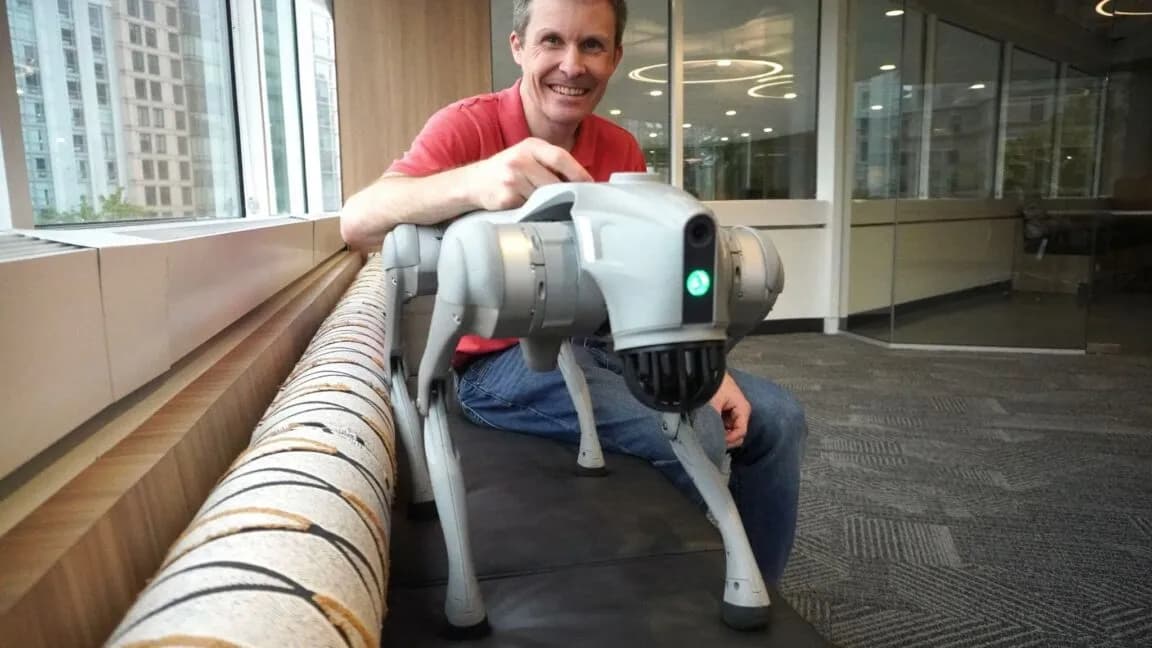
Four thousand dollars. That's what I handed over for a quadruped robot built in China — a machine with four legs, onboard sensors, and no need for walks to the bathroom. The consumer robotics market has compressed dramatically over the past several years. Boston Dynamics, the American firm that essentially defined what a robot dog could look like, was acquired by Hyundai in 2021 for approximately $880 million — a signal of how seriously the industrial world was taking mobile robotics. Chinese manufacturers followed, entering the space with machines that approach similar capabilities at a fraction of the enterprise cost. ABI Research has tracked the service robotics sector as one of the fastest-growing technology categories globally, with quadruped robots increasingly cited as a breakout segment.
Owning one feels nothing like you'd expect. Before the unit arrived, I imagined it as a curiosity I'd demo for friends and store in a corner. The reality is stranger and more instructive than that.
Taking a Robot Dog Into the Real World

One sunny morning in June, I walked to work with the machine pacing alongside me on the sidewalk. Nothing I'd read about quadruped robotics prepared me for what happened next.
Read next Laika's Wildwood: Stop-Motion Fantasy at TIFF 2026The public reaction was immediate. Strangers snapped photographs without asking. Others stopped mid-stride to ask questions — was it mine? Did I build it? Was it recording them for surveillance? I answered the same three questions repeatedly, cheerfully, for the length of my commute. The experience felt less like walking to the office and more like accompanying a minor celebrity through a press gauntlet.
Biological dogs reacted differently. Every dog we passed either maintained a careful distance or barked and growled. None attempted anything resembling friendliness. Animal behaviorists have noted that quadruped robots moving with naturalistic gaits can trigger territorial responses in domestic dogs — the locomotion reads as "animal" even when the sensory details clearly don't. That tension between familiar and alien shapes the entire public experience of walking with a robot dog from China through a normal urban neighborhood.
The attention wasn't always comfortable. It was illuminating, though. You learn a lot about public anxieties around emerging technology when you're the person fielding them in real time.
Performance and Capabilities: What Can It Actually Do?

This is where honest assessment matters most.
Quadruped locomotion has advanced significantly over the past decade. IEEE Transactions on Robotics has published extensively on reinforcement-learning-based gait controllers, which allow modern quadrupeds to self-correct on uneven surfaces in real time. The robot dog from China I purchased uses similar underlying principles. On smooth pavement, it performs confidently and consistently.
Stairs, curbs, and irregular terrain reveal the limits. Hesitation appears at threshold transitions. Recovery from slips is slower than the fluid self-correction that Boston Dynamics has demonstrated repeatedly in public showcases. Onboard processing is capable, but the margin for error narrows sharply outside of controlled environments. This isn't a criticism unique to Chinese-manufactured hardware — it reflects the genuine frontier of consumer-grade quadruped engineering in 2026.
Battery life is a practical constraint worth naming plainly. Extended outdoor sessions require planning around charge cycles. The unit is not something you walk to work every single day without logistical forethought.
What the machine does well: navigating open flat terrain, responding to commands, functioning as an extraordinarily effective conversation starter, and providing hands-on experience with technology that most people will only encounter from a distance for years yet.
Is a $4,000 Consumer Robot Dog Worth the Price?
Bluntly: it depends entirely on what you expect to buy.
If you want a working assistant that performs physical labor autonomously — fetching items, patrolling property, carrying packages — the technology isn't fully there at this price point, regardless of which manufacturer produced it. A robot dog from China at $4,000 is not a productivity tool. Not yet.
If you're a developer, researcher, or seriously curious technologist who wants hands-on experience with real quadruped hardware, the calculus shifts. The machine offers direct access to locomotion systems, sensor integration, and behavioral programming that would otherwise require institutional affiliation to touch. For that audience, $4,000 is arguably reasonable given how recently this technology existed only inside university labs and well-funded robotics companies.
Consumer sentiment in robotics enthusiast communities consistently splits along one fault line: buyers who approached these machines with utility expectations report disappointment; buyers who approached them as exploratory hardware report satisfaction. Knowing which camp you belong to before purchasing is the most useful due diligence you can do.
The novelty value is genuine but finite. The crowds on my June commute proved the machine commands serious attention. That attention fades faster than the machine's novelty does for its owner.
Privacy, Surveillance Concerns, and Public Perception
The surveillance question — "Is it recording me?" — followed me for every block of that walk.
This concern isn't irrational. Modern quadruped robots ship with cameras and depth sensors as standard equipment. The data-collection capabilities are real, even when the immediate intentions of a random pedestrian owner are not remotely sinister. Public anxiety about a robot dog from China carries an additional geopolitical dimension that any honest review must acknowledge. Concerns about data practices associated with Chinese consumer technology companies are documented in FCC proceedings, congressional testimony, and reporting from independent security researchers. Dismissing that anxiety as uninformed would be wrong.
What I told people on my commute was accurate: I wasn't surveilling anyone. But the fact that I had to explain this repeatedly, to skeptical strangers who remained unconvinced, reveals something important about where public trust in robotics currently sits. Walking with this machine is simultaneously a personal experience and an involuntary exercise in public relations for an entire product category. You become a representative whether you want to be or not.
The State of Consumer Quadruped Robots in 2026
The market for a robot dog from China has matured enough to deliver genuine hardware at a price point that individuals — not just enterprises — can reach. That's a meaningful shift.
Boston Dynamics' Spot is priced around $75,000 for enterprise customers. The compression from that figure to $4,000 represents a staggering democratization of the underlying technology, even accounting for the capability gap between the two machines. Robotics analysts tracking consumer adoption curves have observed that categories like drones and personal computers followed similar trajectories — initially dismissed as expensive curiosities, eventually normalized as essential tools.
Quadruped robots are somewhere in the middle of that arc right now. The machine I walked to work in June attracted crowds because it was strange. In five years, it may attract nothing more than a passing glance. The technology will improve. The price will fall further. Public anxiety will either resolve through familiarity or crystallize into formal regulation — probably some of both.
For now, spending $4,000 on a robot dog from China buys something money rarely purchases cleanly: a front-row seat at the exact moment a technology crosses from science fiction to sidewalk companion. What that's worth depends entirely on what you were hoping to buy.
Related coverage
- US-China AI Race: Why Safety Talks May Already Be Failing
- Agility Digit 5 Robot Squats to Stay Safe Near Humans
- iOS 27 Review: Apple's LLM Siri Finally Arrives
Source: Ars Technica - All content