Apple rarely telegraphs its hardware ambitions in press releases. It does so in software. This week, the company pushed a quiet but telling update to TestFlight — its beta distribution platform used by developers worldwide — adding support for landscape orientation and integrating with the newly resizable iPhone Mirroring window introduced in macOS 27 Golden Gate. Taken alone, either change might seem like routine housekeeping. Together, they read as something closer to a infrastructure laying exercise, the kind Apple has performed before every major new form factor it has ever shipped.
What Apple's TestFlight Update Actually Changed
TestFlight serves as the primary distribution mechanism for pre-release iOS, iPadOS, and macOS applications, connecting developers with beta testers at scale. The platform supports millions of active beta testers at any given time, making it a critical artery in Apple's developer ecosystem.
The update in question delivered two distinct functional changes. First, TestFlight now renders properly in landscape orientation — a deceptively mundane change for an app that, until now, operated exclusively in portrait. Second, the update integrates with macOS 27 Golden Gate's updated iPhone Mirroring feature, which now supports a resizable window rather than a fixed-dimension display of the iPhone screen on Mac.
Neither of these changes serves a meaningful purpose for existing iPhones. Standard iPhones do not require landscape-mode operation of a testing app. The App Store developer documentation has long established that landscape support is mandatory only when an app targets hardware that users routinely hold horizontally — or, critically, hardware that unfolds. Resizable iPhone Mirroring windows, meanwhile, suggest that the iPhone's screen geometry is about to become variable in ways that a fixed mirroring rectangle could not accommodate.
These are not cosmetic updates. They are plumbing changes — and the pipes are being laid for a reason.
Why This Update Points to a Foldable iPhone Duo
The connection between TestFlight's landscape support and the foldable iPhone Duo is not speculative in the way that supply-chain tea-leaf reading tends to be. It is grounded in how Apple's developer tools have historically preceded hardware announcements, and in the specific nature of what landscape orientation means for a testing platform.
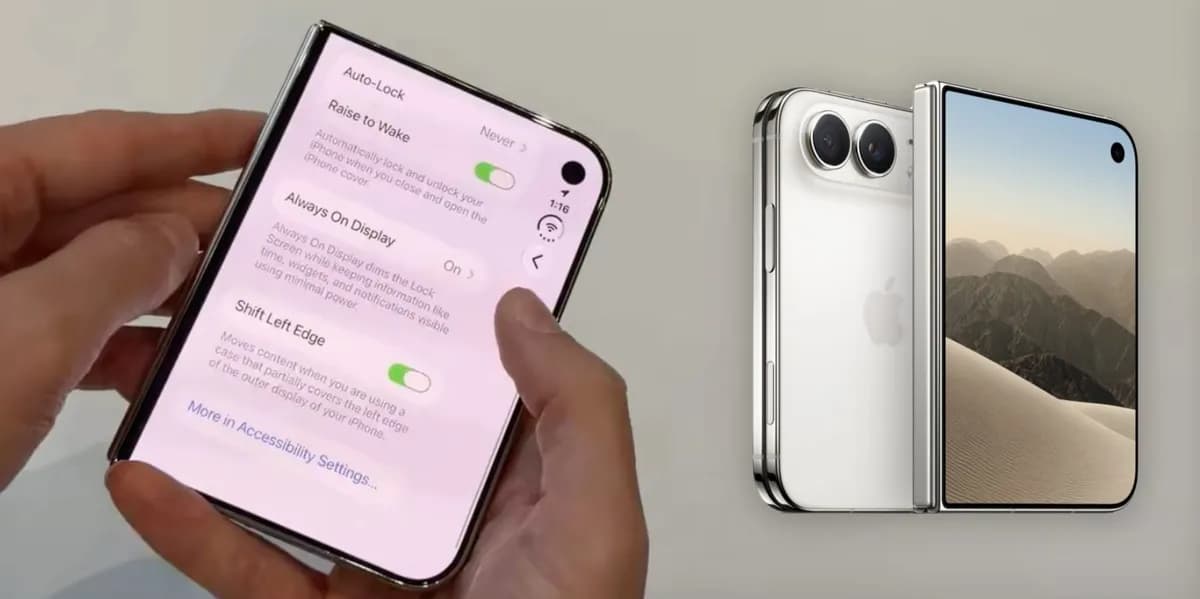
Read next iPhone Duo's Hidden Fake Bezel Setting ExplainedA foldable iPhone, oriented book-style, would sit in landscape orientation when fully open. Developers building apps for such a device would need to test them in that configuration from day one. If Apple wanted developers to be ready at launch — which it invariably does — it would need TestFlight to mirror that experience first. Requiring landscape support in a testing tool is essentially unnecessary overhead unless new hardware demands it.
The resizable iPhone Mirroring window on macOS 27 Golden Gate reinforces this reading. A phone with a fixed 6.1-inch or 6.7-inch display does not need a resizable mirroring window — the aspect ratio is known, the dimensions are set. A foldable device, however, presents a range of possible display states: folded, partially open, fully open. Each state presents a different screen geometry. A resizable mirroring window that can adapt to those dimensions is not a luxury feature for existing hardware; it is a prerequisite for testing a device that changes shape.
The commercial stakes make this timing plausible. Counterpoint Research has tracked the global foldable smartphone market growing at compound annual rates exceeding 50 percent through the mid-2020s, with IDC projecting tens of millions of foldable units shipped annually by the latter half of the decade. Apple's characteristic late entry into a category — arriving after competitors have done the early-adopter education — means the foldable iPhone Duo would be stepping into a market that has already demonstrated consumer appetite, not pioneering into uncertainty.
What We Know About the iPhone Duo So Far
The foldable iPhone Duo has circulated in the rumor ecosystem long enough to accumulate a modest layer of credibility. The "Duo" name itself reflects the device's dual-screen nature — a book-fold design that presents a compact exterior display and a larger interior display when opened fully. This mirrors the form factor popularized by Samsung's Galaxy Z Fold series, though Apple's implementation would predictably diverge in materials, software behavior, and integration depth.
The TestFlight update does not confirm a ship date, a price, or specific hardware dimensions — and it would be overreaching to claim otherwise. What it does confirm is that Apple is actively building the developer infrastructure that a foldable iPhone Duo requires. That infrastructure work typically begins six to twelve months before a product launch, a timeline that aligns with industry speculation placing the device's debut somewhere in 2025 or 2026's product cycle.
The macOS 27 Golden Gate connection adds another layer. Naming a macOS release and shipping a meaningful iPhone Mirroring update within it suggests these two platforms are being co-developed with a specific shared use case in mind — namely, a phone whose screen geometry cannot be assumed constant.
Apple's History of Preparing the Ecosystem Before Hardware Launches
Apple's approach to new hardware categories follows a consistent pattern that analysts and developers have documented across decades of product launches. The company does not ship hardware and then scramble to build the software ecosystem. It builds the ecosystem first, ships the hardware second, and lets third-party developers fill the gaps in between.
WatchKit, the framework enabling developers to build apps for Apple Watch, arrived in November 2014 — months before the Apple Watch itself shipped in April 2015. Developers had a working development and testing environment before the hardware existed in consumer hands. The launch catalog for Apple Watch was therefore populated on day one rather than barren.
The parallel with iPad multitasking is equally instructive. Apple shipped the APIs for Split View and Slide Over multitasking in iOS 9, well in advance of the iPad Pro's debut. Developers who targeted those APIs were ready when the hardware that most benefited from them arrived. Users buying iPad Pro for its large screen and productivity promise found an App Store already prepared for them.
The same logic applies here. TestFlight's landscape support is this generation's WatchKit moment. It is Apple telling developers — without a press release, without a keynote, without a single public statement — that landscape-first app experiences are about to matter in a new way.
WWDC session patterns corroborate this reading. Historically, Apple introduces new API surface at its developer conference roughly six to nine months before the hardware that most relies on those APIs reaches consumers. Sessions covering adaptive layout, multitasking behavior across display states, and interface resizing tend to cluster in the WWDC cycle immediately preceding a new form-factor launch.
What Developers and Users Should Expect Next
For developers, the TestFlight update is an implicit instruction to audit their apps for landscape readiness. Apps that assume portrait orientation as a default — particularly reading apps, productivity tools, camera utilities, and social platforms — will need meaningful adaptation to perform well on a foldable iPhone Duo's interior display. The good news is that the UIKit and SwiftUI frameworks have long supported adaptive layouts; the work is less about rewriting apps from scratch and more about ensuring that existing adaptive logic handles a wider range of aspect ratios gracefully.
The resizable iPhone Mirroring integration on macOS 27 Golden Gate suggests that Mac users who use iPhone Mirroring as part of their workflow — moving files, responding to notifications, monitoring app activity — will see a substantially richer experience once the foldable iPhone Duo ships. A window that resizes to match the phone's current display state is a meaningful quality-of-life improvement, not a novelty.
For users, the practical expectation is that app quality on a foldable iPhone Duo at launch will depend heavily on how seriously the developer community takes these preparatory signals. Apple's ecosystem has historically been responsive to these cues when they are clear. The TestFlight update is as clear as Apple gets without holding a press conference.
Takeaway: Reading the Signals Apple Leaves Behind
Apple is a company that communicates its hardware roadmap through software behavior. It has done this consistently, across Apple Watch, iPad Pro, and every other form factor that required developers to adapt before consumers could fully benefit. The TestFlight update — landscape orientation support and a resizable iPhone Mirroring window in macOS 27 Golden Gate — fits this pattern precisely.
None of this constitutes a formal announcement. Apple has not confirmed the foldable iPhone Duo exists, named a launch date, or discussed specifications. What it has done is build the infrastructure that such a device requires, in a developer tool used by millions of testers, integrated with an operating system update shipping this fall.
The signal is quiet. It is also unmistakable to anyone who has watched Apple prepare for new hardware before. The foldable iPhone Duo may not be shipping tomorrow. Based on the pattern Apple has now established in its own developer tools, it is closer than it has ever been.
Source: 9to5Mac