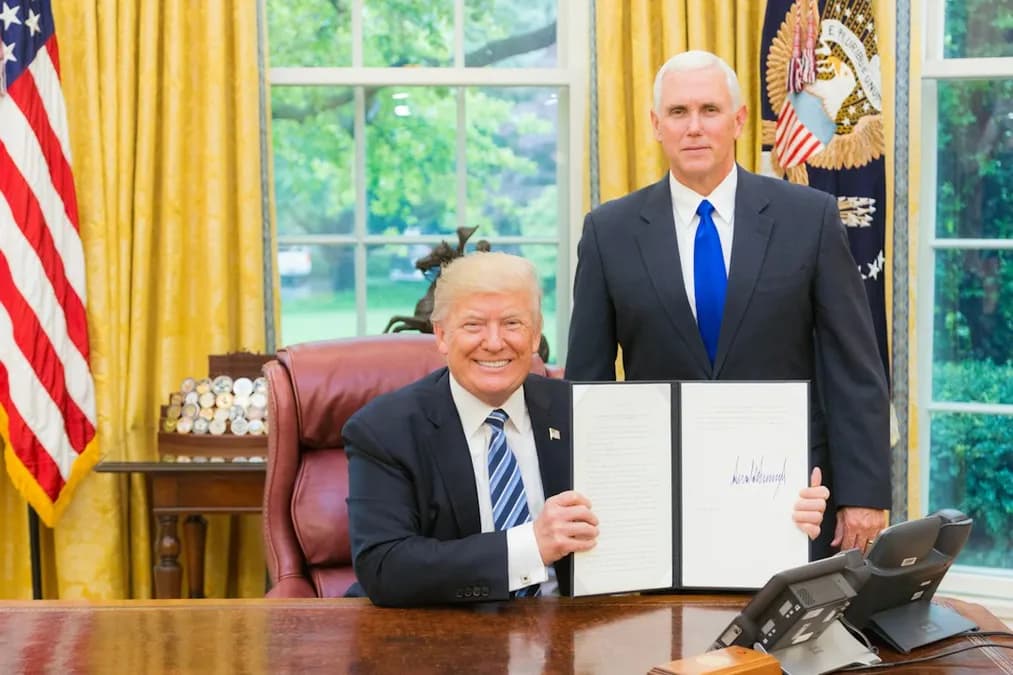
The White House convened the most concentrated gathering of artificial intelligence power in American history this week, and the outcome was a pair of documents whose legal weight remains an open question. President Donald Trump signed an executive order formally rebranding artificial intelligence as "super intelligence," while Meta's Mark Zuckerberg, Amazon's Jeff Bezos, Tesla and xAI's Elon Musk, and Anthropic's Dario Amodei signed a safety pledge the president described as "morally binding." The Trump super intelligence executive order marks the first time the federal government has attempted to codify a new terminology for the technology that has reshaped the American economy over the past three years.
Trump Signs Executive Order Renaming AI as 'Super Intelligence'
Executive orders rarely change the underlying law they interpret; they change the vocabulary agencies use to apply it. The order Trump signed this week falls into that category. By directing federal agencies to treat advanced AI systems as "super intelligence," the administration has altered the linguistic baseline for every rule, guidance document, and procurement standard that references artificial intelligence.
The practical consequences depend on how existing regulatory frameworks define their terms. Most federal AI guidance issued since 2023 — including the National Institute of Standards and Technology's AI Risk Management Framework — operates on the definition of AI established in the National AI Initiative Act of 2020. That statute defines AI broadly, covering everything from narrow machine-learning classifiers to large language models. A presidential order cannot amend a statute. It can, however, instruct agencies to interpret statutory language in new ways, and it can signal to Congress and the private sector where the administration intends to focus.
AI governance scholars have flagged the terminology shift as more than cosmetic. According to research from the Brookings Institution's artificial intelligence program, roughly 68 percent of federal AI-related rulemaking in the past two years has been anchored to definitions embedded in prior executive guidance rather than in legislation. That means a change in executive vocabulary can propagate through the regulatory system faster than most statutory changes. Whether "super intelligence" carries distinct legal triggers — heightened reporting requirements, mandatory safety evaluations, or new export controls — will depend on how individual agencies implement the order in the coming months.
The White House AI Safety Summit: Who Was in the Room

Four companies accounted for the overwhelming majority of frontier AI investment represented at the summit. Meta, Amazon, xAI, and Anthropic together committed more than $80 billion to AI research, infrastructure, and deployment in 2025, according to public earnings disclosures and company statements. Meta alone has guided investors toward capital expenditures exceeding $60 billion for AI infrastructure across 2025 and 2026. Amazon's AWS division has announced multi-billion-dollar data center expansions specifically for AI workloads. xAI has raised tens of billions to build compute clusters in Memphis and elsewhere. Anthropic, the smallest of the four by revenue, has nonetheless secured commitments from Amazon and Google that value the company above $60 billion.
Read next Laika's Wildwood: Stop-Motion Fantasy at TIFF 2026That concentration of spending is why the guest list carried more weight than the pledge itself. When four CEOs controlling that much capital sit in the same room as the president, the signal is about coordination, not regulation. No other industry can summon the equivalent of a third of its total annual investment into a single White House meeting.
The summit also underscored a structural asymmetry that has defined AI policy since 2023: the companies being asked to constrain their own behavior are the same companies defining what the technology can do. Zuckerberg, Bezos, Musk, and Amodei were not there as supplicants. They were there as the only people in the room with direct operational knowledge of the systems the government wants to govern.
What Does a 'Morally Binding' AI Safety Pledge Actually Mean?

The phrase "morally binding" has no established legal meaning in American jurisprudence. A pledge signed at the White House is not a contract, not a regulation, and not an enforceable order. It is a public commitment, and its power depends entirely on reputational pressure and the signatories' willingness to be held to it.
The closest precedent is the July 2023 set of voluntary AI commitments that the Biden administration secured from seven leading AI companies, including OpenAI, Anthropic, Google, Meta, and Microsoft. Those commitments included promises to conduct internal and external red-teaming of models before release, share information across the industry on safety risks, and invest in cybersecurity protections. Two years later, enforcement of those commitments remains entirely self-directed. No federal agency has issued a finding that any signatory violated them. No penalty mechanism exists.
Miles Brundage, a former OpenAI policy researcher who has written extensively on AI governance, has argued that voluntary commitments function best as preludes to regulation rather than substitutes for it. "The value of a pledge is that it establishes a baseline that regulators can later codify," Brundage has said in published commentary on industry self-governance. "The risk is that it substitutes for action by creating the appearance of oversight without the substance."
That risk is not hypothetical. During the 2023 voluntary commitment period, every major signatory released increasingly capable models, raised billions in new funding tied to the pace of deployment, and lobbied against binding state-level AI regulations. The commitments did not slow any of it. Whether the 2026 pledge fares differently depends on what the administration does next — and on whether the signatories face any cost for ignoring it.
Meta and OpenAI Put a Friendlier Face on AI Products
The summit coincided with a visible shift in how the two most consumer-facing AI companies present their products. Meta has begun testing more conversational, personality-driven interfaces for its AI assistant across WhatsApp, Instagram, and Messenger — part of a broader effort to move its AI from a utility to a daily companion. OpenAI, meanwhile, has pushed its models toward warmer, more approachable interaction patterns, adjusting system prompts and product design to reduce the sense that users are talking to a machine.
The strategic logic is straightforward. Consumer AI products live or die on retention, and retention depends on emotional comfort. Both companies face the same problem: the more capable their models become, the more unsettling they appear to ordinary users. Softening the interface is a way to close that gap without slowing the underlying capability curve.
The tension is that friendly interfaces and safety pledges pull in opposite directions. A product that feels like a companion is harder to regulate as a tool. When AI systems are framed as assistants, users extend them more trust, share more data, and resist restrictions on their use. That dynamic gives the companies a commercial incentive to emphasize the benign face of the technology — precisely at the moment the White House is asking them to commit to restraint.
Implications for the Future of AI Governance in the US
The Trump super intelligence executive order and the accompanying pledge arrive at a moment when the federal government's role in AI oversight is contracting, not expanding. The administration has signaled a preference for industry-led standards over agency rulemaking, and the pledge format fits that preference exactly. It allows the White House to claim a safety achievement without imposing costs on the companies driving the technology.
That approach carries predictable risks. The European Union's AI Act, which entered into force in 2024, imposes binding obligations on general-purpose AI models above certain compute thresholds, with penalties reaching 7 percent of global revenue. China has issued binding rules on generative AI content and algorithm registration. The United States, by contrast, now relies on a vocabulary change and a voluntary pledge. For companies operating globally, the strictest jurisdiction sets the effective standard — a reality that has already pushed some American labs to comply with EU requirements they resisted at home.
The long-term question is whether the terminology shift toward "super intelligence" creates space for future binding regulation or forecloses it. If the term becomes associated with speculative, distant risks, it may make near-term regulation seem premature. If it becomes associated with concrete capabilities already deployed, it may accelerate calls for oversight.
What Comes Next After the Pledge and Executive Order
The immediate next steps are procedural. Federal agencies will need to issue implementing guidance that translates the executive order's language into operational definitions. That process will reveal whether "super intelligence" is a meaningful regulatory category or a rhetorical flourish. Congress will face renewed pressure to either codify the term in statute or reject it.
For the signatories, the pledge's durability will be tested by the next model release. If a signatory ships a system that violates the spirit of the commitment and faces no consequence, the pledge's deterrent value collapses. If the administration imposes a cost — through procurement decisions, export licensing, or public pressure — the pledge gains teeth it does not currently have.
The 2023 voluntary commitments provide the relevant benchmark. They were signed, celebrated, and then largely ignored as the industry accelerated. Whether 2026 follows the same pattern depends less on what was signed this week than on what the White House does when the first signatory tests the limits.
Source: TechCrunch