Warsh Draws a Line: Fed's Rate Hike Signals Inflation Fight Has Longer to Run
Warsh Signals Fed Is Serious About Inflation

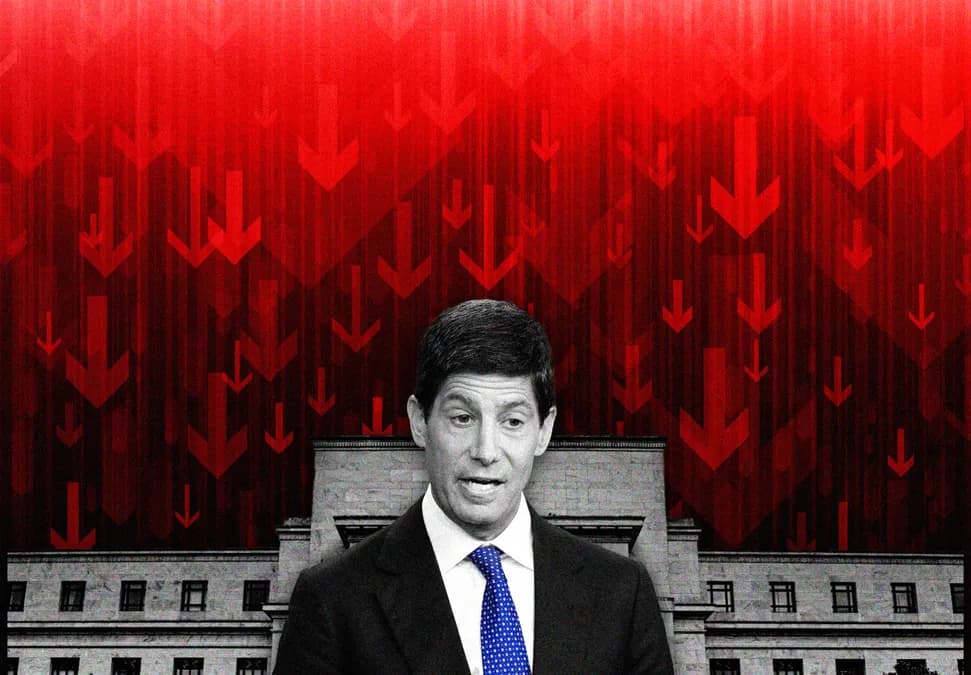
Federal Reserve Chair Kevin Warsh has delivered a pointed message to financial markets: the central bank's commitment to crushing inflation is not a posture. It is a policy. Following the Fed's latest rate move, Warsh has made clear that policymakers will not blink at market turbulence, will not pivot at the first sign of economic softening, and will not declare victory before the data justifies it.
Read next Altman: OpenAI IPO 'Ill-Advised' in 2026 | AI ValuationsThis is a departure — in tone and signal — from the more reactive posture that markets had come to expect from the Fed in recent years. Warsh, a former Federal Reserve governor and longtime Wall Street skeptic of easy money, arrived at the Fed's helm with a reputation for favoring credibility over comfort. His recent communications reinforce that reputation. Investors who expected a pause, or worse, a pivot, are being disabused of that hope.
The fed rate hike inflation narrative has shifted. It is no longer a question of whether the Fed will act — it is a question of how long it intends to keep acting, and at what cost to growth and asset prices.
Why the Inflation Fight Has Longer to Run

The Federal Reserve targets 2% annual inflation, as measured by the Personal Consumption Expenditures price index. That benchmark has proven stubbornly distant. While headline PCE and CPI figures have moderated from their multi-decade peaks — consumer prices in the United States surged above 9% year-over-year in mid-2022 — the descent back to target has been slow, uneven, and punctuated by troubling re-acceleration in services prices.
Core inflation — which strips out volatile food and energy components — has consistently demonstrated more persistence than forecasters anticipated. Services inflation, driven by shelter costs, healthcare, and insurance, tends to respond to monetary policy with a lag measured in quarters, not weeks. That lag is central to understanding why Warsh and the FOMC are signaling continued restraint even as some headline numbers have improved.
The Fed also faces a structural challenge that a single rate hike cannot resolve. When inflation expectations become unanchored — when households and businesses begin to price future inflation into wages and contracts — the self-reinforcing dynamic becomes far harder to break. Warsh understands this. His public communications are partly an exercise in expectations management, designed to convince the public and markets that the Fed will stay the course regardless of near-term political or financial pressure.
Fiscal policy has not helped. Large federal deficits inject demand into an economy that monetary tightening is simultaneously trying to cool. This tug-of-war between fiscal stimulus and monetary restraint extends the time horizon required to bring inflation down sustainably.
Market Reaction: Stocks and Bonds Under Pressure
Markets registered their dissatisfaction sharply. The Dow Jones Industrial Average shed more than 600 points in response to the Fed's latest signals, a drop that underscored just how much of the recent equity rally had been predicated on hopes for a more accommodative Fed. When those hopes collide with reality, the adjustment is rarely orderly.
Equity markets are not the only arena where stress is visible. Bond markets have recalibrated sharply as well. When the Fed signals that rates will remain elevated for longer, the entire yield curve reprices. Short-term Treasury yields rise in response to expectations for the Fed funds rate. Long-duration bonds see their prices fall — and their yields rise — as investors demand greater compensation for the extended risk of holding fixed-income instruments in an inflationary environment.
The volatility in both stocks and bonds reflects a market transitioning from a regime where investors could rely on the Fed to cushion downturns — the so-called "Fed put" — to one where the central bank has explicitly subordinated asset prices to the inflation mandate. That is a meaningful regime shift, and it typically produces sharp swings across asset classes before a new equilibrium is established.
Fixed-income strategists have noted that prolonged tightening cycles tend to produce particularly brutal outcomes for duration-heavy portfolios. When the market's terminal rate estimate rises — as it has done repeatedly in this cycle — holders of long-dated Treasuries absorb price losses even before credit spreads begin to widen. For retail investors holding bond funds expecting safety, this environment presents risks that the prior decade of falling rates did not prepare them for.
Historical Context: Fed Credibility and Inflation Expectations
The closest historical analogue to the current situation is the tightening campaign engineered by Fed Chair Paul Volcker between 1979 and 1981. Volcker inherited an economy scarred by a decade of elevated inflation, partly the product of an earlier Fed that had repeatedly backed off when rate hikes began to bite. By the time Volcker arrived, inflation expectations were deeply embedded. His solution was brutal: raise the federal funds rate to nearly 20%, tolerate back-to-back recessions, and do not blink.
It worked. Inflation fell from above 13% in 1979 to below 4% by 1983. But the cost was severe. Unemployment reached nearly 11%. Corporate bankruptcies surged. The savings and loan industry was destabilized. Volcker succeeded precisely because he was willing to absorb that pain rather than retreat.
The lesson Warsh appears to have internalized is this: central bank credibility is harder to rebuild than to maintain. Every time the Fed has signaled an early end to a tightening cycle only to find inflation reigniting — as happened in the 1970s under Arthur Burns — it paid a steep credibility price that required even more aggressive action to recoup. Warsh is, in effect, betting that the near-term pain of sustained rate hikes is a smaller cost than the medium-term catastrophe of a second inflation wave.
The fed rate hike inflation transmission mechanism works through several channels simultaneously. Higher borrowing costs suppress consumer credit and mortgage demand. Business investment slows as the cost of capital rises. The labor market softens as companies reduce hiring and capex. Housing markets cool — sometimes dramatically — as mortgage rates climb. Each of these channels operates with a different lag, which is why the full effect of tightening takes twelve to eighteen months to manifest in economic data.
What Investors Should Watch Next
Several metrics deserve close attention in the months ahead. The monthly CPI and PCE reports remain the primary scorecards for the Fed's progress. A sustained downward trend in core services inflation — particularly shelter costs, which carry the largest weighting in both indices — would give the Fed cover to pause or reduce the pace of hikes. Absent that, expect further tightening.
The labor market is equally critical. The Fed watches the relationship between wage growth and productivity carefully. When nominal wages rise faster than productivity, unit labor costs climb and feed through to prices. Monthly jobs reports and the Employment Cost Index give the clearest read on this dynamic.
Watch also for signals in the credit markets. Investment-grade and high-yield credit spreads tend to widen ahead of economic downturns as investors reprice default risk. A significant move in spreads would indicate that the tightening cycle is beginning to create genuine financial stress beyond the equity and rate markets.
Finally, monitor Fed communications for any language shift around the inflation target itself. Some economists have argued for a temporary or permanent raise in the 2% target to allow more flexibility. Warsh has shown no sympathy for that view, but if growth deteriorates sharply, the political pressure on the Fed will intensify.
Bottom Line: Navigating a Prolonged Tightening Environment
For retail investors and finance professionals alike, the core takeaway from Warsh's posture is straightforward: position for a longer, harder fight against inflation than consensus expected even three months ago.
That means reassessing duration exposure in fixed-income portfolios. Long-dated bonds remain vulnerable if the terminal rate rises further. Short-duration instruments — Treasury bills, short-duration bond funds, money market vehicles — offer yield without the duration risk that has punished long-term holders.
In equities, the environment favors value over growth. When the discount rate rises, the present value of distant future earnings falls more steeply than near-term earnings, which is why growth stocks — whose valuations are heavily front-loaded with future cash flow expectations — have underperformed during this cycle. Sectors with pricing power, stable cash flows, and lower sensitivity to the credit cycle historically hold up better in prolonged tightening environments.
Cash is no longer a drag. With short-term yields at levels not seen in a generation, the opportunity cost of holding cash has collapsed. Investors who spent a decade reaching for yield in illiquid or high-risk assets should reconsider whether that risk is still being adequately compensated.
Warsh has drawn a line. The inflation fight, by his reckoning, has further to run. Markets are adjusting — sharply, and not without pain. The investors who emerge best positioned will be those who accept the new regime rather than waiting for a Fed rescue that, under this leadership, may simply not come.
Source: MarketWatch.com - Top Stories