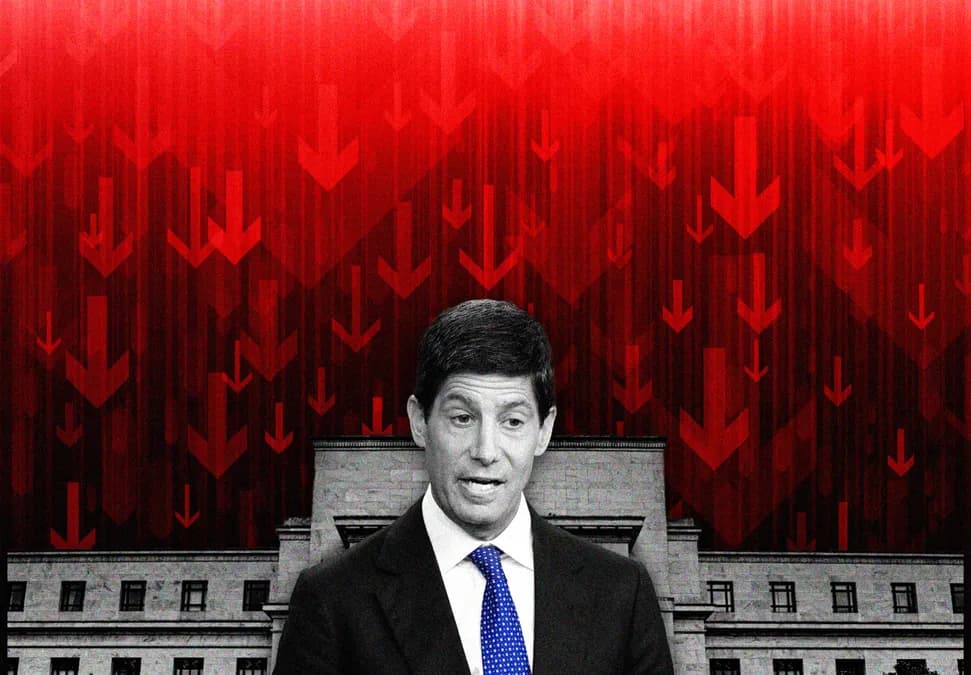
Federal Reserve Chair Kevin Warsh has delivered a message investors cannot afford to misread: the Fed rate hike inflation battle is not close to finished, and the central bank intends to press until it is. Warsh has made clear he means business. That posture carries real consequences for portfolios, borrowing costs, and the trajectory of the American economy — and the signal lands at a moment when inflation has already proven far more stubborn than early forecasts suggested.
Warsh Sends a Clear Message on Inflation
Warsh has paired the rate decision with explicit forward guidance that more tightening remains on the table — a combination that sends a sharper signal than either action alone. Unlike some prior Fed chairs who softened their tone at the first sign of market stress, Warsh is signaling a willingness to tolerate financial volatility in service of the inflation mandate. That tolerance is itself a policy instrument.
The approach echoes Paul Volcker, the Fed chair who drove the federal funds rate above 19% in the early 1980s to crush double-digit inflation — a campaign severe enough to trigger two recessions but one that restored price credibility for an entire generation. Volcker's success came not just from the rate hikes themselves but from his refusal to blink when markets and politicians pushed back. Warsh appears to be drawing from the same institutional playbook.
By anchoring hawkish expectations firmly, the Fed activates what economists call the "expectations channel" — when businesses and consumers believe inflation will be brought under control, they moderate pricing decisions and wage demands accordingly, amplifying the effect of each individual rate move. The Fed rate hike inflation framework rests on this logic: credibility compounds. A central bank that communicates resolve reduces the total tightening required to hit its 2% target. One that wavers forces markets to second-guess every decision, complicating policy transmission and potentially requiring more hikes in the long run.
Why the Inflation Fight Is Far From Over

The 2022-2023 tightening cycle saw the Federal Reserve raise its benchmark rate by more than 500 basis points in roughly 18 months — the most aggressive pace since Volcker. Yet core Personal Consumption Expenditures inflation, the Fed's preferred gauge, remained stubbornly above the 2% target well after the hiking campaign plateaued. That persistence is precisely why Warsh's current stance commands attention.
Read next Altman: OpenAI IPO 'Ill-Advised' in 2026 | AI ValuationsServices inflation has been the most resistant component of the price index. Unlike goods prices, which normalize relatively quickly once supply chains stabilize, services prices are embedded in wage contracts, rental agreements, and service-sector pricing structures. They are sticky by nature. Dislodging them requires sustained monetary pressure over months, not a handful of rate decisions.
Former Fed Governor Frederic Mishkin and other monetary economists have long argued that stopping short of target is more costly than overtightening. The reasoning is structural: a premature pause allows inflation expectations to re-anchor at elevated levels, requiring even more aggressive action later to correct. That argument carries particular weight given the inflation psychology the post-pandemic period reinforced in households and businesses across the economy.
The cautionary case study is the 1970s. Fed Chair Arthur Burns raised rates in response to oil-shock inflation but retreated when unemployment climbed. Inflation re-accelerated. Correcting that mistake required Volcker's far more brutal intervention. The lesson is now embedded in Fed institutional memory: half-measures on inflation typically make the eventual cure worse.
Market Reaction to the Fed's Hawkish Turn

The Dow Jones Industrial Average fell sharply within hours of Warsh's signal — a response pattern consistent with prior tightening cycles. During the 2022 rate-hiking campaign, the S&P 500 shed roughly 25% from peak to trough as the rate trajectory became clear, the largest equity drawdown since the 2008 financial crisis. That decline was driven primarily by the mechanical revaluation of future corporate earnings under a structurally higher discount rate.
Bond markets registered parallel stress. When the Fed signals a prolonged high-rate environment, yields on Treasury notes rise, mortgage rates climb, and corporate borrowing costs increase across the credit spectrum. Investment-grade spreads widen. Speculative-grade spreads widen further. This is the transmission mechanism at work: tighter monetary policy flows from the fed funds rate through the yield curve and into every credit-dependent corner of the economy.
Investors should anticipate continued volatility. The current environment — elevated but decelerating inflation against a Fed committed to its 2% target — is precisely the kind of ambiguity that produces wide daily swings in equities and bonds. Sharp moves reflect a repricing in process, not structural dysfunction.
What Investors Should Expect Next
Duration-sensitive bonds, high-multiple growth stocks, and speculative-grade credit face the clearest headwinds when the Fed rate hike inflation path extends further than consensus expects. Each of these asset classes reprices sharply when rate expectations shift hawkish — the 2022 cycle was a live demonstration, erasing trillions in paper wealth across equity and fixed-income markets within months.
Value equities, short-duration fixed income, and sectors with structural pricing power — energy, healthcare, select industrials — have historically provided more stability in late-cycle tightening environments. Treasury bills, offering competitive real returns for the first time in over a decade, merit a larger portfolio allocation than they warranted during the zero-rate era of 2009-2021.
The labor market remains the decisive variable. Low unemployment and above-trend wage growth give the Fed both the economic justification and the political latitude to keep pressing. A meaningful deterioration in payrolls — a sustained rise in the unemployment rate by half a percentage point or more over several months — would provide Warsh an off-ramp. Until that data arrives, he has every reason to hold the line. Investors expecting a quick pivot should plan around a longer timeline.
Implications for the Broader Economy
Consumer spending represents roughly 70% of U.S. GDP — which makes the transmission channel from Fed policy to household behavior the most consequential of all. Higher rates raise mortgage costs, auto loan payments, and credit card interest charges, directly compressing the discretionary spending that sustains economic growth. The 30-year fixed mortgage rate is particularly impactful: when it moves meaningfully higher, housing affordability shrinks, construction slows, and a sector representing 3% to 5% of output weakens materially.
Corporate America faces parallel pressure. As the cost of capital rises, capital expenditure projects that penciled out at lower rates no longer clear internal hurdle rates. Hiring slows in rate-sensitive sectors — real estate, finance, technology. Credit conditions tighten for smaller businesses that depend on floating-rate bank debt, a segment that creates a disproportionate share of new private-sector jobs.
This is the intended effect. The Fed is not trying to engineer a recession; it is trying to cool demand enough to bring price growth back to its 2% target. That distinction matters, even when it feels narrow for households managing tighter budgets.
Warsh has drawn a clear line. The decision carries a durable message: price stability comes before market comfort, and the Fed will not declare victory on sustained Fed rate hike inflation progress until the data justify it. For investors, businesses, and policymakers watching this cycle, the guidance is plain. Plan for rates to stay higher for longer than the most optimistic scenario allows. The inflation fight has further to run.
Source: MarketWatch.com - Top Stories